Switching to Sustainable Cafe Supplies: Cost Guide
August 23, 2026 · Editorial Team

Table of Contents
- Why Sustainable Cafe Supplies Matter Beyond Marketing
- Compostable Packaging Wholesale Prices: What You'll Actually Pay
- Hidden Operational Costs When Switching to Sustainable Supplies
- Reducing Cafe Food Waste Costs Through Better Sourcing
- Customer Willingness to Pay for Sustainable Packaging
- Financial Modelling: Building Your Transition Timeline
- Supplier Negotiation Strategies for Better Rates
- Conclusion
Last Updated: August 23, 2026
Why Sustainable Cafe Supplies Matter Beyond Marketing
The pressure to switch to sustainable cafe supplies isn't coming from trend forecasters anymore. It's coming from waste management bills, customer expectations, and regulatory deadlines. By 2026, many Australian councils have tightened waste acceptance criteria, meaning some of what you're currently sending to landfill won't be accepted much longer.
Most cafe owners assume sustainability is a premium you pay for brand credibility. In reality, sustainable cafe supplies cost less over time when you account for waste diversion fees, landfill levies, and operational efficiency. The upfront numbers look higher. The long-term picture tells a different story.
At Biodegradable Packaging AU, we work with cafes across Australia managing this transition. The ones who succeed approach it as a cost optimisation project that happens to improve their brand perception along the way. The circular economy isn't theoretical for food businesses anymore. It's the operating model that makes financial sense.
Compostable Packaging Wholesale Prices: What You'll Actually Pay
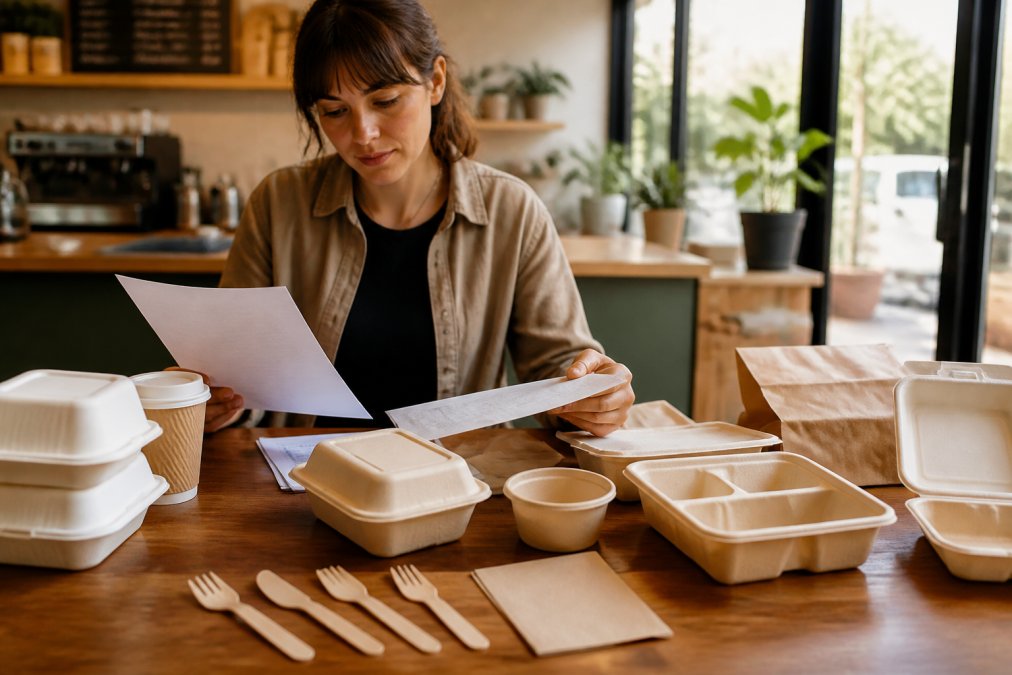
Compostable packaging wholesale prices vary significantly depending on material type, certification level, and order volume. A certified compostable coffee cup typically costs between 8-15 cents per unit at standard volumes, compared to 3-5 cents for conventional plastic.
The critical distinction is between genuinely certified compostable packaging and materials that claim to be "eco-friendly" without third-party verification. Australian Standard AS 5810 or European Standard EN 13432 certification costs money, and that cost gets built into the wholesale price. You're paying for proof that your packaging will actually break down in commercial composting conditions.
Order volume matters significantly. A single cafe ordering 500 cups monthly pays more per unit than a cafe ordering 5,000. Wooden cutlery sits at roughly 41-55 cents per unit for FSC-certified bulk packs, three to four times the cost of plastic alternatives, but with zero landfill liability.
Biodegradable Packaging AU offers FSC-certified wooden cutlery at competitive wholesale rates: the 16cm unbranded wood knife at 41.90 AUD per bulk pack, the 16cm unbranded wood spoon at 55.60 AUD, and the 16cm unbranded wood fork at 54.25 AUD. When you factor in your current waste management fees, the true cost difference shrinks dramatically.


Most suppliers require minimum orders of 500-1,000 units to access wholesale pricing. Smaller cafes can pool orders through cafe networks to negotiate better rates.
Hidden Operational Costs When Switching to Sustainable Supplies
Most cafe owners calculate switching cost as new packaging price minus old packaging price. That calculation misses everything that actually matters.
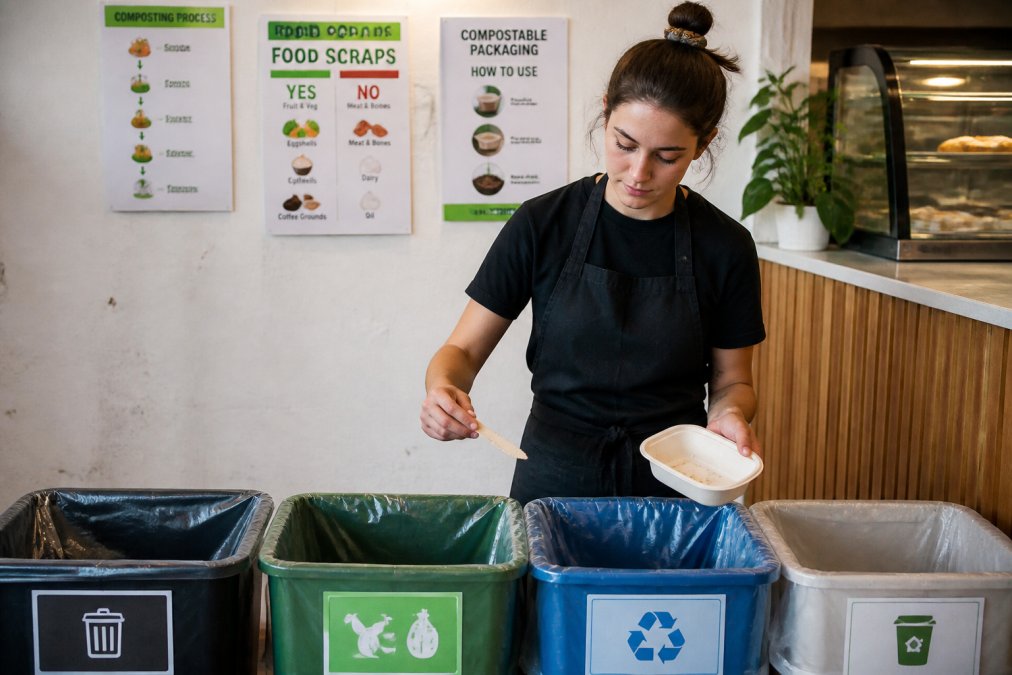
When you switch to compostable packaging, your waste stream changes fundamentally. Compostable materials require separation from contaminated waste. That means new bin systems, staff training, and ongoing monitoring. A contaminated compost batch, even 5% contamination, gets rejected by commercial composting facilities. Your entire load goes to landfill.
Staff retraining is the cost nobody budgets for. Your team needs to understand which items go into compostable bins and why cross-contamination matters. Training takes time, and ongoing compliance monitoring takes more time.
Composting infrastructure access varies wildly by location. Melbourne metro areas have established commercial composting facilities. Regional areas don't. If your local council doesn't accept compostable packaging, you're paying for collection services from private operators, often 2-3 times the cost of standard waste removal. Before you switch, contact your local council and ask specifically which certifications they accept.
Storage space for compostable packaging differs from plastic. Compostable materials are often bulkier, increasing your storage footprint. Supplier reliability also becomes critical, certified compostable suppliers are concentrated, making supply chain disruption more costly than with ubiquitous plastic suppliers.
Reducing Cafe Food Waste Costs Through Better Sourcing
Better-designed packaging reduces spillage, spoilage, and customer dissatisfaction, all of which drive waste. Compostable takeaway containers are engineered differently than plastic ones, with better seal integrity and heat retention. Customers are less likely to abandon a drink that's still drinkable.
Sourcing from suppliers who understand food safety and waste minimisation reduces oversized packaging and in-transit spillage. Fair trade coffee sourcing, which many sustainable-focused cafes pair with compostable packaging, often comes from suppliers with better traceability, creating accountability and higher staff engagement.
The waste audit is the tool most cafes skip. Before switching suppliers, measure what you're actually throwing away for one week. Most cafes discover they're throwing away 15-25% more than they thought. That number becomes your baseline. After switching to sustainable supplies and implementing proper waste streams, measure again. The reduction you achieve is real savings.
Customer Willingness to Pay for Sustainable Packaging
Customers will pay a premium for sustainability if two conditions are met: they understand the actual environmental impact, and they see proof that your sustainability claims are genuine.
A cafe that switches to compostable cups but doesn't communicate it sees no price elasticity. A cafe that explains the switch, shows customers the composting certification, and connects them to the local composting facility can often hold prices steady or increase them slightly. The difference is transparency and education.
Cafes seeing customer retention and modest price increases do three things consistently: they explain why they switched (not just "we're eco-friendly" but "we're diverting packaging from landfill through certified composting"); they make the composting process visible; and they address cost directly.
Reusable cup programs, which pair well with sustainable supplies, show stronger customer willingness to pay. A customer who brings a reusable cup often gets a 50-cent discount and is more likely to become a regular, increasing lifetime value.
Financial Modelling: Building Your Transition Timeline
A strategic transition to sustainable cafe supplies requires a financial model, not a gut decision.
Start with your current waste costs, including landfill levies, waste collection fees, and council waste charges. Most cafes underestimate this by 40-50%. Call your waste contractor for an itemised breakdown. You'll likely find you're paying 800-1,500 AUD annually.
Next, model your new packaging costs using real wholesale prices. Factor in minimum order quantities and storage space. For a cafe serving 300 cups daily, a 5-cent per-cup increase is 450 AUD monthly, 5,400 AUD annually.
Add operational costs: staff training (assume 4-8 hours at your hourly labour rate), new bin systems (typically 200-400 AUD), and ongoing compliance monitoring (assume 2-3 hours monthly). These add another 1,500-2,500 AUD in year one, then 1,000-1,500 AUD annually.
Subtract your waste cost reduction. If you're diverting 60% of your packaging waste to composting instead of landfill, you might save 300-600 AUD annually. The financial case typically shows a 2-3 year payback period, assuming you hold pricing steady. If you increase prices by 5-10 cents per cup, the payback period drops to 12-18 months.
Build a 12-month projection, not a one-time calculation. Include seasonal variation, staff turnover, and supplier price changes.
Supplier Negotiation Strategies for Better Rates
Switching suppliers is a negotiation, not a transaction. Most cafe owners accept the first price they're quoted.
Start by consolidating your order. A 3,000-unit monthly order gets better terms than three separate 1,000-unit orders. Request volume-based discounts explicitly, most suppliers have tiered pricing they don't advertise unless you ask.
Negotiate payment terms, not just unit price. A supplier offering 2-3% discount for 14-day payment instead of 30-day payment compounds significantly over a year.
Compare total cost of ownership, not unit price. Supplier A might charge 10 cents per cup but require 1,000-unit minimums and charge 50 AUD for delivery. Supplier B might charge 11 cents per cup, accept 500-unit minimums, and offer free delivery over 200 AUD. Supplier B is actually cheaper.
Build relationships with account managers. A supplier who knows you're a reliable, growing customer will often offer better terms than a one-off buyer.
Switching to sustainable cafe supplies isn't a binary decision. It's a financial calculation that changes based on your waste management costs, local composting infrastructure, and customer expectations. The cafes that execute this transition successfully measure their baseline waste costs accurately, build a realistic financial model that accounts for operational friction, and communicate the change to customers in a way that creates loyalty.
Biodegradable Packaging AU offers certified compostable foodservice packaging and FSC-certified wooden cutlery designed for Australian cafes navigating this transition. With custom branding options, free Melbourne metro delivery on orders over 200 AUD, and direct access to local composting services, we help you move from planning to implementation.
Frequently Asked Questions
Q: Are compostable takeaway containers more expensive than plastic?
Compostable packaging typically costs 15-30% more per unit than conventional plastic alternatives. However, when you factor in waste management fees, landfill levies, and potential future packaging regulations (such as those expected by 2026), the total cost of ownership often narrows. Many cafes find that bulk purchasing and switching to certified compostable materials reduces their overall packaging and waste disposal expenses over 12-24 months.
Q: How can cafes offset the cost of sustainable packaging?
Three proven strategies work: first, negotiate volume discounts with suppliers, bulk orders of 5,000+ units often unlock 10-15% savings. Second, pass a modest surcharge (5-10 cents) to customers ordering takeaway; research shows 60-70% of cafe customers accept small eco-premiums. Third, reduce total packaging waste by rightsizing containers to portion sizes, which cuts both material and disposal costs. Certified compostable packaging also qualifies for waste diversion incentives under local council sustainability schemes in many regions.
Q: Do customers pay more for sustainable cafe supplies?
Yes, but with conditions. Customers show willingness to pay for sustainable packaging when they understand the environmental benefit and perceive genuine commitment from the cafe. Studies across hospitality venues show 55-75% of customers accept a 5-10% price premium on takeaway items if packaging is certified compostable and the cafe visibly participates in local composting programs. Transparency matters: clearly label your packaging as compostable and display information about where it gets processed.
Q: What are the long-term financial benefits of sustainable cafe practices?
Over 3 years, switching to sustainable supplies typically delivers: reduced waste disposal costs (15-25% savings), lower landfill levies, improved brand loyalty (repeat customers increase 10-20%), and resilience against future packaging regulations. Additionally, certified compostable packaging supports circular economy participation, which attracts sustainability-focused customers and can justify premium pricing. Many cafes also qualify for local council waste diversion rebates and small business sustainability grants, offsetting initial transition costs by 20-40%.
This article was written using GrandRanker