Sustainable Packaging Solutions for Mobile Cafes
August 11, 2026 · Grandranker
Table of Contents
- Why Sustainable Packaging Solutions Matter for Mobile Cafes
- Compostable vs Recyclable vs Reusable: What Actually Works on the Road
- Single-Use Plastic Bans by State: What Mobile Operators Must Know in 2026
- Choosing the Right Sustainable Packaging Solutions for Your Menu
- Branding vs Sustainability: You Don't Have to Choose
- How to Source Sustainable Packaging Without Disrupting Your Supply Chain
- Waste Management Integration and Lifecycle Considerations
- Conclusion
Last Updated: August 11, 2026
Why Sustainable Packaging Solutions Matter for Mobile Cafes
Sustainable packaging solutions are no longer optional for mobile food businesses, they're a commercial and regulatory necessity. State-based single-use plastic bans are tightening annually, customers increasingly view packaging as a proxy for brand values, and conventional plastics are becoming harder to justify on cost or compliance grounds.
Mobile cafe operators face a specific challenge that fixed venues don't: every packaging decision must survive being loaded into a van, transported across suburbs, and used under field conditions. There's no back-of-house composting bin to quietly point to. The packaging itself has to do the environmental work.
Sustainable packaging solutions are materials and systems designed to reduce environmental impact across their full lifecycle, from raw material sourcing through end-of-life disposal or composting. For mobile cafes, this means packaging that stays intact under heat and pressure, meets current regulatory requirements, and can be disposed of responsibly even when customers are eating on a park bench.
According to the Australian Packaging Covenant Organisation's packaging data, food and beverage packaging represents one of the largest categories of single-use waste entering landfill. Mobile cafes are a concentrated source of that waste, high transaction volumes, short dwell times, and minimal control over post-consumer disposal. Getting the packaging right is the lever with the most impact.
Below, we'll cover every material type worth knowing, the state-by-state compliance picture for 2026, and a practical framework for choosing packaging that works for your specific menu and logistics.
Compostable vs Recyclable vs Reusable: What Actually Works on the Road
The biggest mistake mobile operators make is treating "eco-friendly" as a single category. Compostable, recyclable, and reusable packaging are fundamentally different systems and perform very differently in a mobile context.
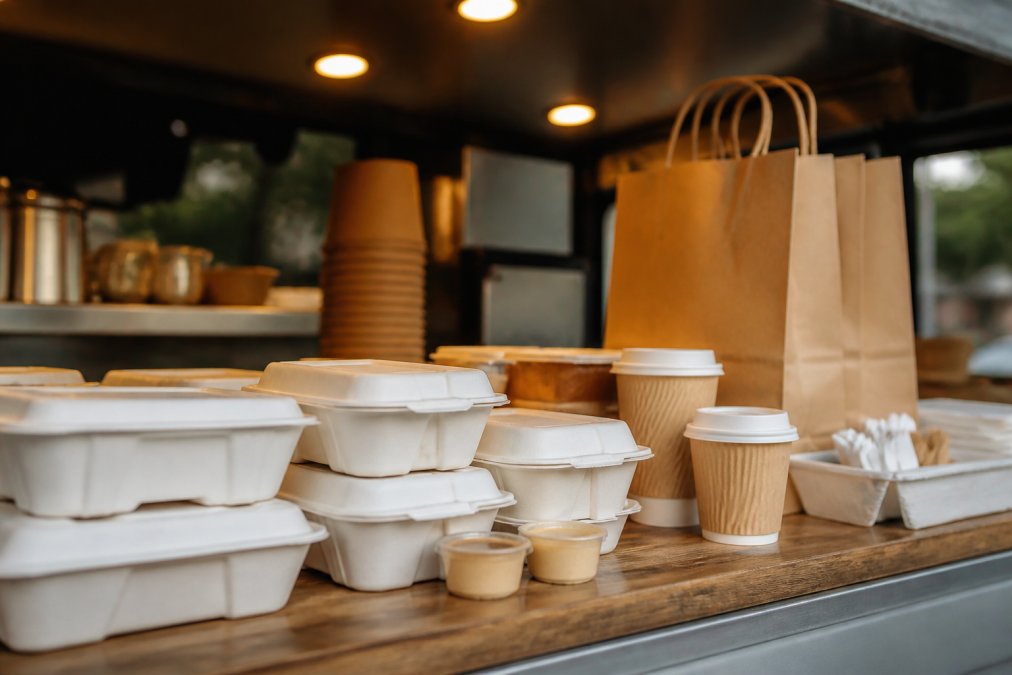
Compostable packaging is designed to break down into organic matter under specific conditions, either industrial composting facilities or, for home-compostable certified products, in a backyard compost pile. A certified compostable cup that ends up in a general waste bin goes to landfill and contributes nothing to waste diversion. Certification to AS 4736 (industrial composting) or AS 5810 (home composting) is the only reliable way to distinguish genuine compostable products from greenwashing claims.
Recyclable packaging sounds straightforward, but food-soiled packaging is the catch. A paper bag contaminated with grease or food residue is typically rejected at the recycling facility. For mobile cafes serving hot food and coffee, most packaging will be food-soiled by the time a customer discards it, which limits real-world recyclability significantly.
Reusable systems offer the best lifecycle outcome but require customer participation. On a fixed route or regular market, a deposit-and-return model is genuinely viable. For operators serving one-off events or unpredictable locations, managing returned cups and containers becomes operationally burdensome.
| Packaging Type | Best For | Limitation | Mobile Viability |
|---|---|---|---|
| Certified compostable | High-volume takeaway | Needs composting infrastructure | High, if paired with collection |
| Recyclable paper/cardboard | Dry food items | Food-soiled items often rejected | Medium |
| Reusable cups/containers | Regular routes, markets | Requires return logistics | High on fixed routes |
| Conventional plastic | None recommended | Banned in many categories | Low and declining |
Bagasse and Sugarcane Pulp Containers
Bagasse is the fibrous residue left after sugarcane juice is extracted, a by-product that would otherwise be burned or sent to landfill. Processed into sugarcane pulp, it produces food-grade containers with genuine thermal insulation, grease resistance, and structural integrity under wet conditions.
For mobile cafes, bagasse containers solve a problem that cardboard alone can't: they hold hot, wet, or fatty food without collapsing. The 1,000ml Natural Plant Fibre Takeaway Base from Biodegradable Packaging AU is a rectangular BioCane container made from rapidly renewable sugarcane pulp, priced at $142.00 for a bulk pack. For operators running meal deals or larger portions, the 23x23x8cm 3-Compartment White Plant Fibre Clamshell at $88.65 handles separated meal components without cross-contamination.


Both products are certified compostable, meaning they can enter the composting stream rather than landfill, provided your customers have access to a composting service.
Paper and Cardboard Options
Greaseproof paper and cardboard packaging are the workhorses of the mobile food sector. They're lightweight, stackable, and, when sourced from certified sustainable forestry, carry a credible environmental story.
The practical limitation is moisture. Uncoated cardboard degrades quickly with wet or fatty food. The solution is a water-based aqueous coating, which maintains compostability. Avoid packaging with PFAS-based coatings; these "forever chemicals" compromise both compostability and food safety. The Burger BioBoard Box at $70.50 uses recycled paperboard and is built for this scenario.

Reusable Cup Systems
Reusable cup programs work best when the operator controls the return environment. On a regular farmers' market circuit or fixed weekly route, a deposit-based system is operationally realistic. The operator stocks a set of cups, customers pay a small deposit, and cups come back at the next visit.
Stainless steel cups offer the most durable option and the best thermal performance. Deposit systems address concerns about non-return, as the financial incentive changes behaviour.
Single-Use Plastic Bans by State: What Mobile Operators Must Know in 2026
Regulatory compliance is non-negotiable, and the patchwork of state-based legislation across Australia makes it complex for mobile operators who cross state lines. As documented in the Australian Government's National Plastics Plan, Australia has committed to phasing out problematic and unnecessary plastics across all jurisdictions.
The items most relevant to mobile cafe operators in 2026 include:
- Expanded polystyrene food containers and cups: banned in all states and territories
- Plastic straws, stirrers, and cutlery: banned in all states and territories
- Plastic-lined cups: under active phase-out in several jurisdictions
- Lightweight plastic bags: banned nationally
- Plastic produce bags and single-use plastic plates: banned in most jurisdictions
Any packaging category currently under review in your operating state is likely to be banned within 12-24 months. Switching now avoids a forced transition later, often at higher cost and shorter lead times. Check with your state environment authority for current packaging compliance requirements to confirm the specific items banned in each jurisdiction where you operate.
Choosing the Right Sustainable Packaging Solutions for Your Menu
The right sustainable packaging solutions depend on what you're serving. Material performance varies significantly across temperature ranges, moisture levels, and structural load, and a mismatch between packaging and product is one of the most common avoidable problems in mobile food service.
Hot Drinks and Coffee Cups
Hot drinks present the most demanding packaging requirements: the cup must insulate against heat, resist moisture from condensation and splashing, and maintain structural integrity through a customer's entire commute. Double-wall construction solves the insulation problem. The coating material determines compostability.
The 295ml / 8oz (90mm) White Double Wall BioCup at $199.95 uses an aqueous water-based dispersion coating and is certified home compostable, meaning it can break down in a backyard compost pile, not just an industrial facility. For a mobile coffee operation, this is a meaningful distinction. Standardising on one cup diameter across your menu simplifies both ordering and service.
Takeaway Meals and Multi-Compartment Containers
Multi-compartment containers prevent cross-contamination between meal components. Bagasse clamshells handle this well because the material is inherently stiff and doesn't flex under the weight of a full meal.
Key specs to match against your menu:
- Volume: Ensure the container holds your largest portion with room for a lid seal
- Compartment configuration: 2-compartment for protein + side; 3-compartment for full combo meals
- Lid security: Snap-close lids prevent spillage during transport
- Thermal retention: Bagasse retains heat better than thin cardboard for meals that travel more than 10 minutes
Branding vs Sustainability: You Don't Have to Choose
Many operators assume they must choose between sustainable packaging and branded packaging. The reality is that custom-branded compostable packaging is now accessible at volumes that work for small and medium operators.
The environmental impact of branding is minimal compared to the material choice itself. A printed logo on a certified compostable cup doesn't meaningfully change that cup's carbon footprint or compostability. What it does change is your brand's visibility at every point of consumption.
Certified compostable packaging and custom branding are compatible. The certification addresses the environmental claim; the branding addresses the commercial one. Both belong on the same cup.
How to Source Sustainable Packaging Without Disrupting Your Supply Chain
Switching suppliers is the friction point that keeps many operators on conventional packaging longer than they'd like. The transition doesn't have to be disruptive, but it requires a structured approach.
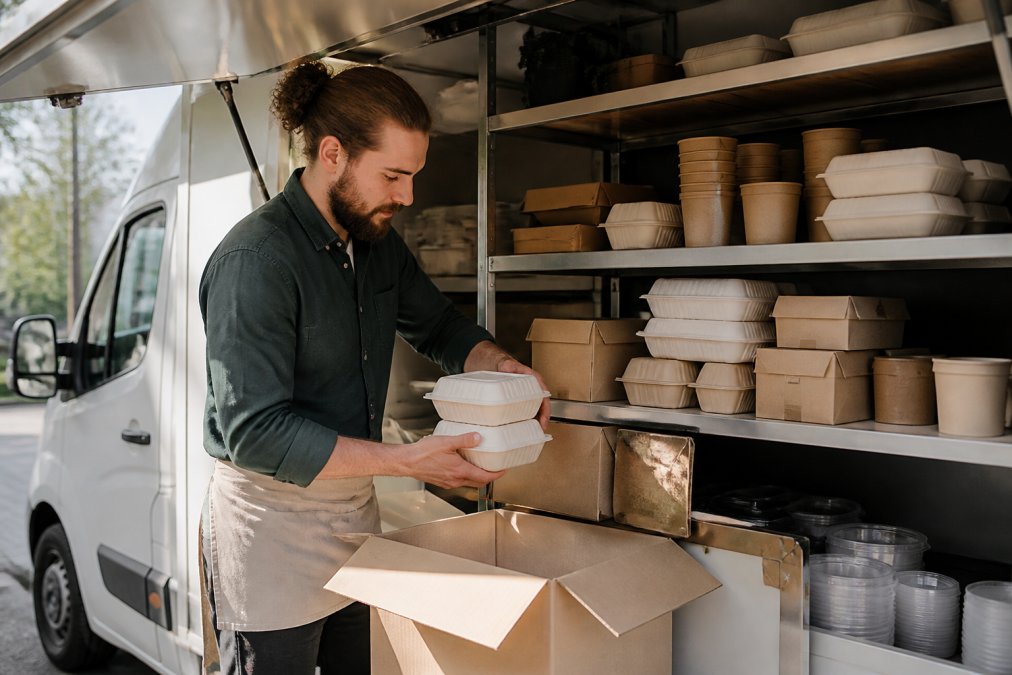
Start with a packaging audit. List every item you currently use, the volume per week, and the supplier. Prioritise the highest-volume items first, that's where the environmental and cost impact is greatest.
A practical sourcing checklist:
- Confirm certification: look for AS 4736 or AS 5810 on the product or spec sheet
- Check PFAS status: ask suppliers directly whether products are PFAS-free
- Verify lead times: standard lead times for compostable packaging range from 3-10 business days
- Confirm delivery coverage: free delivery thresholds vary by supplier and region
- Test before committing to volume: order a sample pack and run your actual menu through it
- Align with composting infrastructure: identify whether your operating area has commercial composting collection
Greenwashing in packaging is widespread; vague terms like "eco-friendly" or "biodegradable" without certification backing are marketing language, not environmental credentials. As noted by the ACCC's guidance on environmental claims, businesses making environmental claims must be able to substantiate them. Certification to Australian standards is the clearest substantiation available.
Biodegradable Packaging AU offers free delivery on orders over $200 within the Melbourne metro area, which covers a substantial operating radius for most mobile businesses.
Waste Management Integration and Lifecycle Considerations
The most overlooked dimension of sustainable packaging is what happens after the cup leaves your hand. Getting the packaging right is half the equation. The other half is ensuring it reaches the right end-of-life pathway.
A lifecycle analysis (LCA) approach looks at the full environmental impact of a packaging material, from raw material extraction through manufacturing, transport, use, and disposal. Bagasse consistently performs well in LCA comparisons against virgin plastic and even against some recycled materials, because the raw material is a by-product that would otherwise be wasted.
The practical waste management integration question for mobile operators is: how do you ensure your compostable packaging actually gets composted?
Several strategies work in practice:
- Partner with a composting collection service for your operating location.
- Communicate clearly with customers at point of sale. A simple sticker or printed message on the cup ("This cup is home compostable") increases correct disposal rates.
- Use home-compostable certified products where possible, because they don't rely on commercial facility access.
- Provide a designated compost collection point at your van or stall if you operate at fixed markets or events.
- Choose products certified to AS 5810 for home composting where your customer base is predominantly residential.
Waste diversion from landfill is the measurable outcome that justifies the investment in certified compostable packaging. Without the composting pathway, a compostable cup in a general waste bin delivers no environmental benefit over a conventional one.
| Packaging Material | End-of-Life Pathway | Composting Standard | Landfill if No Facility |
|---|---|---|---|
| Bagasse / sugarcane pulp | Industrial or home compost | AS 4736 / AS 5810 | Yes, but biodegrades faster |
| Aqueous-coated paper cups | Industrial compost | AS 4736 | Yes |
| Recycled cardboard (dry) | Kerbside recycling | N/A | Yes if food-soiled |
| PLA (corn starch) | Industrial compost only | AS 4736 | Yes |
| Stainless steel reusable | Indefinite reuse, recyclable | N/A | No |
Mobile cafe operators face a genuine packaging challenge: high transaction volumes, no fixed waste infrastructure, and a customer base that forms opinions about your brand based on what you hand them. Biodegradable Packaging AU offers certified compostable foodservice packaging made from plants, premium stainless steel reusable cups, and custom branding options designed to help your business stand out while actively diverting waste from landfill. With free Melbourne metro delivery on orders over $200 and a product range certified to Australian composting standards, the transition to genuinely sustainable packaging is more straightforward than most operators expect. Shop sale items at Biodegradable Packaging AU and start building a packaging system your business and your customers can stand behind.
Frequently Asked Questions
What are the best compostable packaging options for mobile cafes?
Bagasse (sugarcane pulp) containers are a strong choice: they handle grease, hold heat well, and are certified compostable to AS 4736. For hot drinks, double-wall paper BioCups with aqueous coating outperform standard cups. A 1,000ml bagasse takeaway base starts at $142.00 for a case, while a case of 295ml double-wall BioCups is $199.95. Pair these with compostable lids and cutlery to keep your entire service line free of single-use plastics.
What is the difference between home compostable and industrially compostable packaging?
Industrially compostable packaging, certified to AS 4736, breaks down in commercial composting facilities at higher temperatures, typically within 90 days. Home compostable packaging, certified to AS 5810, degrades in a backyard compost bin under ambient conditions, though it takes longer. For mobile cafes, industrial certification is more practical because it aligns with council and commercial composting collections. Always check that your local waste contractor accepts the specific certification before committing to a product.
How do I comply with state-based single-use plastic bans as a mobile food business?
Each state and territory has phased in its own bans on items such as plastic straws, stirrers, cutlery, and food containers. Operating across multiple locations means you must meet the strictest applicable standard at each site. Switching to certified compostable or fibre-based alternatives covers most banned categories. Check the relevant state EPA or environment department for the current prohibited items list, as schedules continue to expand through 2026 and beyond.
How can mobile cafes reduce waste while keeping costs manageable?
Buying certified compostable packaging in bulk reduces the per-unit cost significantly. Pairing disposable compostable containers with a reusable cup program for regulars cuts ongoing spend on cups. Connecting with a local composting service, such as through Compost Connect, means food-soiled packaging is diverted from landfill rather than contaminating recycling streams. Over time, reduced bin-lift fees and the ability to market genuine sustainability credentials can offset the higher upfront cost of eco-friendly stock.
This article was written using GrandRanker