Pakchain vs Local Suppliers: Compostable Packaging Comparison
August 26, 2026 · Editorial Team

Table of Contents
- Pakchain vs Local Suppliers: Key Differences at a Glance
- Certified Compostable Takeaway Containers: What Sets Suppliers Apart
- Supply Chain Reliability and Delivery Times
- Custom Branded Compostable Packaging Options
- Cost-Benefit Analysis: Pricing and Total Cost of Ownership
- Certifications, Compliance, and End-of-Life Disposal
- Which Supplier Type Should You Choose?
- Conclusion
Last Updated: August 26, 2026
Pakchain vs Local Suppliers: Key Differences at a Glance
Choosing between pakchain vs local compostable packaging suppliers comes down to three core trade-offs: speed versus customisation, standardised solutions versus tailored fit, and national scale versus local relationships. Both pathways work, but they work for different businesses at different stages.
Pakchain operates as a centralised, platform-based marketplace connecting food businesses to vetted compostable packaging suppliers. Local suppliers, by contrast, are typically smaller operators embedded in their region, often with direct relationships to composting infrastructure and faster turnaround on custom orders. The decision isn't about which is objectively better; it's about which aligns with your supply chain priorities, timeline, and brand positioning.
At Biodegradable Packaging AU, we've worked with hundreds of cafes, restaurants, and catering businesses across the country navigating this exact choice. What we've learned is that most businesses don't need to choose one path exclusively, they often run a hybrid model, using one supplier for baseline stock and another for custom or seasonal runs.
Here's what separates them in practice.
| Factor | Pakchain | Local Suppliers |
|---|---|---|
| Lead Time | 2-4 weeks standard | 1-2 weeks typical |
| Customisation | Limited to platform templates | Full custom design |
| Minimum Order Quantity | Usually 5,000+ units | Often 1,000-2,000 units |
| Delivery Coverage | National | Regional focus |
| Price at Scale | Competitive for bulk | Premium for small runs |
| Local Composting Links | Varies by region | Often established |
Certified Compostable Takeaway Containers: What Sets Suppliers Apart
The real difference between suppliers isn't the material itself, most use similar plant-based liners (typically Ingeo bioplastic) and FSC-certified paperboard. What separates them is certification depth, supply chain transparency, and how seriously they treat end-of-life disposal.

Pakchain suppliers are vetted against baseline compostability standards, but verification depth varies. You're buying into a platform's curation, not a direct relationship with the manufacturer. Local suppliers often have hands-on knowledge of regional composting facilities and can tell you exactly which of their products work in your council's composting system. This matters more than most businesses realise.
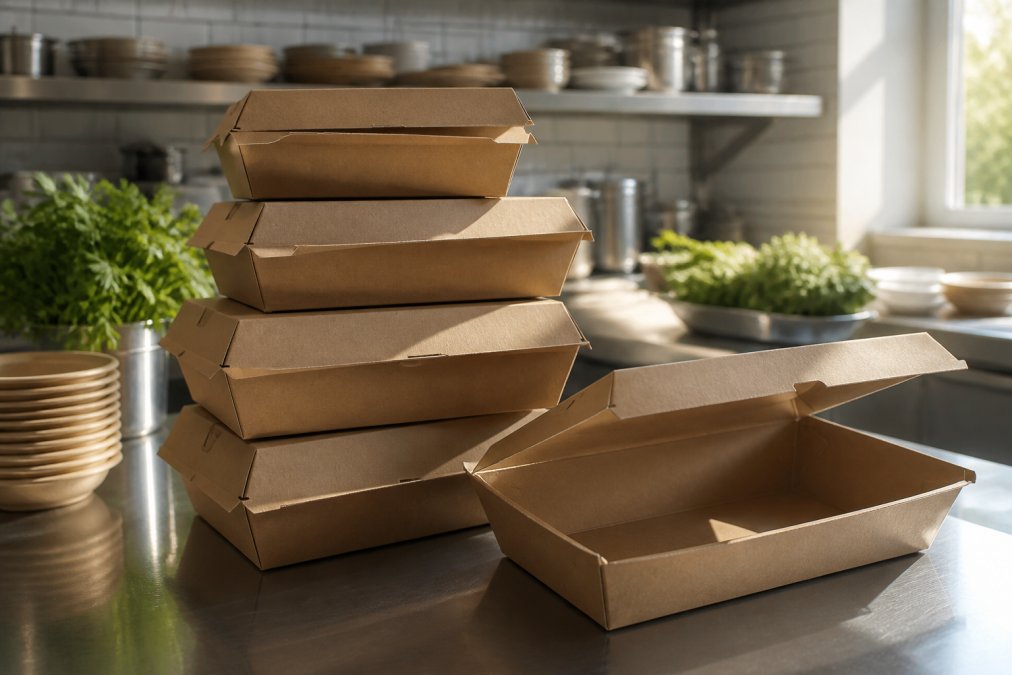
When you specify certified compostable packaging, you're typically looking at AS4736 (industrial composting) or AS5810 (home composting) certification. Pakchain suppliers will list these, but they won't necessarily tell you whether your local council's facility actually accepts AS4736 material. Local suppliers often have that answer already because they've built relationships with the facilities themselves.
A practical example: many councils accept industrially compostable packaging but lack the infrastructure to process it, so it ends up in landfill anyway. A local supplier who's worked with your council for five years knows this and can recommend home-compostable alternatives instead. Pakchain's platform can't replicate that local knowledge.
Supply Chain Reliability and Delivery Times
Pakchain's strength is consistency and predictability. Orders placed on the platform follow standardised timelines: typically 2-4 weeks from order to delivery, with tracking visibility throughout. This works well for businesses that plan quarterly or plan six months ahead.
Local suppliers operate on tighter timelines but with less predictability. A small supplier might turn around custom orders in 7-10 days, but if they hit a production bottleneck or their printer has an issue, you'll feel it immediately. They're also more vulnerable to supply shocks, if their paper stock runs out, they can't pull from a national inventory like Pakchain can.
For urgent restocks, local suppliers win. For planned, large-volume orders, Pakchain's infrastructure is more reliable. Mobile food businesses and pop-up operations often favour local suppliers because they need flexibility over stability. Established cafes with predictable inventory cycles often favour Pakchain.
Delivery is another axis. Pakchain uses national logistics partners, so delivery is consistent but not necessarily fast, expect 2-5 business days after production. Local suppliers often deliver within 24-48 hours if you're in their service area, and some offer same-day pickup. If you're based in Melbourne metro and ordering from a local supplier, free delivery on orders over a certain threshold is common. Biodegradable Packaging AU, for example, offers free delivery on orders over $200 within Melbourne metro, which changes the cost calculation for small to medium businesses.
Custom Branded Compostable Packaging Options
This is where the two models diverge most sharply. Pakchain offers branded packaging, but within constraints. You choose from a library of approved designs, colours, and print positions. Minimum order quantities are typically 5,000+ units. Turnaround is 3-4 weeks. You get professional results, but limited creative control.
Local suppliers offer true customisation. Custom die-cuts, full-wrap printing, unusual sizes, specialty finishes, if you can describe it, many local suppliers can produce it. Minimums often drop to 1,000-2,000 units, making it viable for smaller businesses. Turnaround is typically 2-3 weeks for custom design and production combined.
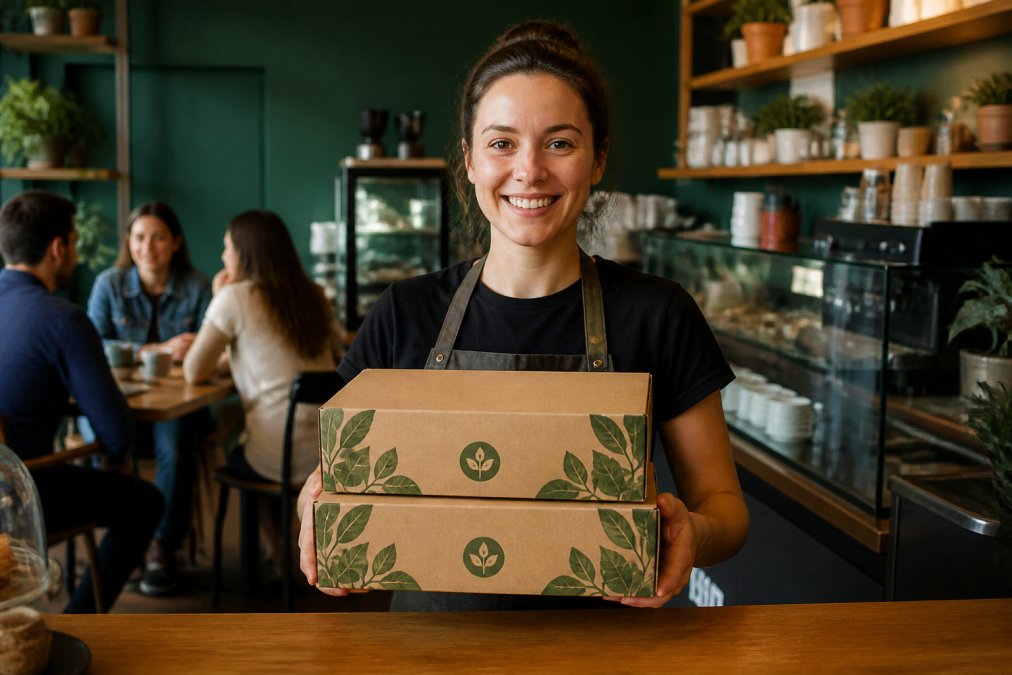
The trade-off is price. Custom runs from local suppliers typically cost 15-30% more per unit than Pakchain's templated options, especially at lower volumes. But for brand-focused businesses, specialty coffee roasters, premium takeaway concepts, catering companies building a signature look, that premium often pays for itself through perceived value and customer recall.
Biodegradable Packaging AU's custom branded packaging starts with a design consultation to understand your brand positioning, then moves into production. The process typically takes 2-3 weeks from approval to delivery.
A key consideration: custom branded packaging locks you into a specific supplier longer. Changing suppliers mid-campaign means redesigning and reprinting. Pakchain's templated approach keeps you more flexible, you can switch suppliers between orders without losing brand consistency.
Cost-Benefit Analysis: Pricing and Total Cost of Ownership
This is where most businesses get the calculation wrong. They compare unit price and miss the total cost picture.
At face value, Pakchain often looks cheaper. A standard 26oz noodle box might cost $0.18-$0.22 per unit at volume (5,000+). A local supplier's equivalent might be $0.24-$0.28. That looks like a 20-30% premium.

But total cost of ownership includes more than unit price. It includes:
- Minimum order quantities - Pakchain's 5,000-unit minimums tie up more capital upfront than a local supplier's 1,000-2,000 unit minimums
- Customisation costs - Pakchain's templated designs are free; custom design work from local suppliers typically costs $200-$500 upfront
- Delivery logistics - Local suppliers often offer free delivery in their service area; Pakchain's national logistics add $0.02-$0.05 per unit
- Inventory holding costs - Larger minimums mean longer shelf life and higher storage costs
- Waste from obsolescence - If you rebrand or change suppliers, unsold stock becomes waste
For a small cafe ordering 2,000 units quarterly, a local supplier often wins on total cost despite higher unit pricing. For a catering company ordering 50,000 units annually, Pakchain's scale economics usually win.
Biodegradable Packaging AU's pricing reflects the local supplier model. The 780ml BioBoard Noodle Box costs $156.45 per 100 units (roughly $1.56 per unit), which is premium for bulk, but includes FSC-certified paperboard, plant-based Ingeo lining, and AS4736 certification. For businesses prioritising brand alignment and environmental credibility over absolute lowest cost, that pricing anchors a value proposition. For price-sensitive operations, it's a mismatch.
Certifications, Compliance, and End-of-Life Disposal
Here's the uncomfortable truth: certification doesn't guarantee disposal. A package can be certified compostable and still end up in landfill if the composting facility doesn't accept it or if it's contaminated with non-compostable material.
Pakchain suppliers provide certification documentation, typically AS4736 (industrial) or AS5810 (home compostable). But they're not responsible for what happens after delivery. You get the paperwork; you own the outcome.
Local suppliers, especially those embedded in their region, often have direct relationships with composting facilities. They know which certifications their local facility accepts, which ones it rejects, and what contamination protocols matter. Some local suppliers even facilitate drop-off programs or partner with community composting networks.
According to Australian Compost Standards AS4736 guidelines, industrially compostable material must break down within 180 days in a controlled composting environment. But most council facilities don't meet those exact conditions, they're hotter, wetter, or run shorter cycles. A package certified to AS4736 might not actually compost in your council's facility. Local suppliers know this and can recommend the right certification for your specific facility.
PFAS-free certification is increasingly important. Traditional compostable liners sometimes contain PFAS (per- and polyfluoroalkyl substances) that persist in soil even after composting. Plant-based liners like Ingeo eliminate this risk. Pakchain suppliers list PFAS status inconsistently; local suppliers often specialise in PFAS-free materials and can provide third-party test reports.
For waste diversion compliance and circular economy credibility, the certification matters less than the actual disposal pathway. Choose a supplier who can tell you where your packaging goes after use and what happens to it. That's the real differentiator.
Which Supplier Type Should You Choose?
The decision hinges on four questions:
1. How predictable is your order volume? If you order the same quantities on the same schedule, Pakchain's standardised timelines work. If you fluctuate seasonally or operate with short planning horizons, local suppliers' flexibility wins.
2. How important is brand differentiation?? If custom packaging is a competitive advantage, local suppliers' design flexibility justifies the premium. If you're using packaging as a functional container, Pakchain's templated options are sufficient.
3. How committed are you to actual waste diversion? If you're serious about composting (not just greenwashing), choose a supplier with documented relationships to local composting infrastructure. Local suppliers typically have this; Pakchain suppliers vary.
4. What's your volume and timeline? Small businesses ordering 1,000-5,000 units quarterly usually save money with local suppliers despite higher unit costs. Large businesses ordering 50,000+ units annually usually benefit from Pakchain's scale. Businesses ordering in between often use both.

Biodegradable Packaging AU fits the local supplier model, we prioritise custom branded options, direct relationships with Melbourne metro composting facilities, and free delivery on orders over $200. We're built for businesses that value brand control and waste diversion certainty over absolute lowest cost. If that describes your operation, we're worth exploring. If you're optimising purely for unit cost and have predictable, large-volume orders, Pakchain's centralised model might serve you better.
The hybrid approach works too. Many businesses maintain a base order with Pakchain for standard stock, then use a local supplier for custom seasonal runs or branded initiatives. That combination gives you Pakchain's cost efficiency plus local suppliers' flexibility.
Conclusion
The choice between Pakchain and local compostable packaging suppliers isn't about one being objectively better, it's about which model matches your supply chain priorities. Pakchain wins on scale, consistency, and unit cost at volume. Local suppliers win on customisation, speed, and local waste diversion certainty.
Most businesses benefit from understanding both models and choosing deliberately rather than defaulting to whichever option they've heard of first. If custom branding, faster turnaround, and direct relationships with local composting infrastructure matter to your operation, Biodegradable Packaging AU offers certified compostable packaging with full customisation, FSC-certified materials, and free Melbourne metro delivery on orders over $200. Explore our certified compostable takeaway containers and custom branded options to see if our approach aligns with your sustainability goals and supply chain needs.
Frequently Asked Questions
What certifications should I look for in compostable packaging?
Look for AS4736 certification, which confirms industrial composting compliance in Australia. Home compostable packaging should meet AS5810. PFAS-free certification is critical, it confirms the packaging contains no 'forever chemicals' that prevent decomposition. Check for FSC™ certification on paperboard products, which ensures sustainably sourced materials. Suppliers should provide third-party test reports, not just claims. Compost Connect and other local composting operators can verify which certifications they accept at their facilities.
How do certified compostable takeaway containers actually break down in composting facilities?
Industrial composting facilities reach temperatures of 55-65°C over 12 weeks, breaking down certified compostable containers into biomass, water, and carbon dioxide. Home composting occurs slower, at 20-30°C, requiring 6-12 months. The key is that certified materials have been tested to decompose fully without leaving microplastics or toxins. Local facilities like Compost Connect can tell you their specific timelines and which certifications they accept, so your packaging will actually decompose rather than sit in landfill.
Is custom branded compostable packaging worth the extra cost?
Custom branded packaging typically costs 10-20% more than generic options, but delivers measurable benefits: stronger brand recall, customer perception of sustainability commitment, and reduced likelihood of packaging ending up as litter (branded items feel more valuable). For cafes and restaurants targeting environmentally conscious customers, the investment often pays back through customer retention and premium pricing ability. Small businesses can start with smaller order quantities to test impact before committing to bulk stock.
What's the actual difference between Pakchain and local suppliers for compostable packaging?
Pakchain offers national distribution and bulk pricing but typically has longer lead times (2-4 weeks) and higher minimum orders. Local suppliers often provide faster delivery (same-week or next-day in metro areas), flexible order sizes, and direct support for customisation. Local suppliers may offer free or discounted delivery on orders over $200 in their service area. The trade-off: Pakchain's scale may offer lower per-unit costs on very large orders, while local suppliers excel at responsiveness and personalised service for smaller businesses.
How do I know the packaging will actually get composted and not end up in landfill?
Contact your local council's waste management team or composting operator directly (such as Compost Connect) to confirm they accept the specific certification your packaging holds. Ask for their approved materials list. Request the supplier's Certificate of Compostability and verify the certification body is recognised in Australia. Some suppliers provide waste-diversion tracking or work directly with local composting facilities. Never assume, verify before committing to a supplier.
This article was written using GrandRanker