KeepCup Alternatives for Wholesale Supply
September 1, 2026 · Editorial Team

Table of Contents
- Why Cafes Are Moving Beyond KeepCup
- Comparison Table: KeepCup Alternatives at a Glance
- Branded Reusable Coffee Cups Wholesale: Custom Options
- Stainless Steel Coffee Cups Bulk: Durability and Performance
- Total Cost of Ownership: What KeepCup Alternatives Really Cost
- Material Composition and Thermal Insulation Performance
- Supply Chain Transparency and Certified Sustainability
- Conclusion
- Frequently Asked Questions
Last Updated: September 1, 2026
Why Cafes Are Moving Beyond KeepCup
The reusable coffee cup market has shifted dramatically. What started as a niche environmental choice has become a wholesale supply decision that directly affects cafe margins, brand positioning, and waste diversion targets. Regulatory changes are tightening around single-use packaging, customer expectations around sustainability have matured, and the total cost of ownership for reusable systems is now transparent enough for cafe owners to calculate real value.
At Biodegradable Packaging AU, we've observed that cafes switching away from established brands typically cite three reasons: inflexible wholesale pricing that doesn't reward loyalty, limited customisation options for brand differentiation, and a growing mismatch between what they're paying and what they're actually getting. This guide examines real alternatives, not just other reusable cup brands, but fundamentally different approaches to solving the same problem, so you can make decisions based on your actual business needs rather than habit.
Comparison Table: KeepCup Alternatives at a Glance
| Alternative Type | Material | Best For | Thermal Performance | Customisation | Wholesale Model |
|---|---|---|---|---|---|
| Branded reusable cups | Stainless steel / BPA-free plastic | Premium positioning, customer loyalty | Excellent (maintains temp 4+ hours) | Full logo printing available | Tiered bulk pricing |
| Compostable takeaway cups | Plant-based fibre (sugarcane pulp) | High-volume, eco-focused cafes | Moderate (insulated sleeves recommended) | Custom printing, PFAS-free | Per-unit wholesale rates |
| Stainless steel bulk supply | Food-grade stainless steel | Durability-focused, corporate gifting | Excellent | Limited to etching/engraving | Volume discounts 100+ units |
| Hybrid systems (reusable + compostable) | Mixed materials | Flexibility, customer choice | Variable | Both options customisable | Dual pricing tiers |
Your choice depends on whether you're optimising for customer retention (reusable), environmental impact per transaction (compostable), durability over years (stainless steel), or flexibility across use cases (hybrid).
Branded Reusable Coffee Cups Wholesale: Custom Options
Custom branding transforms a reusable cup into a marketing asset. When customers carry a branded cup with your logo, they advertise your business every time they refill it.
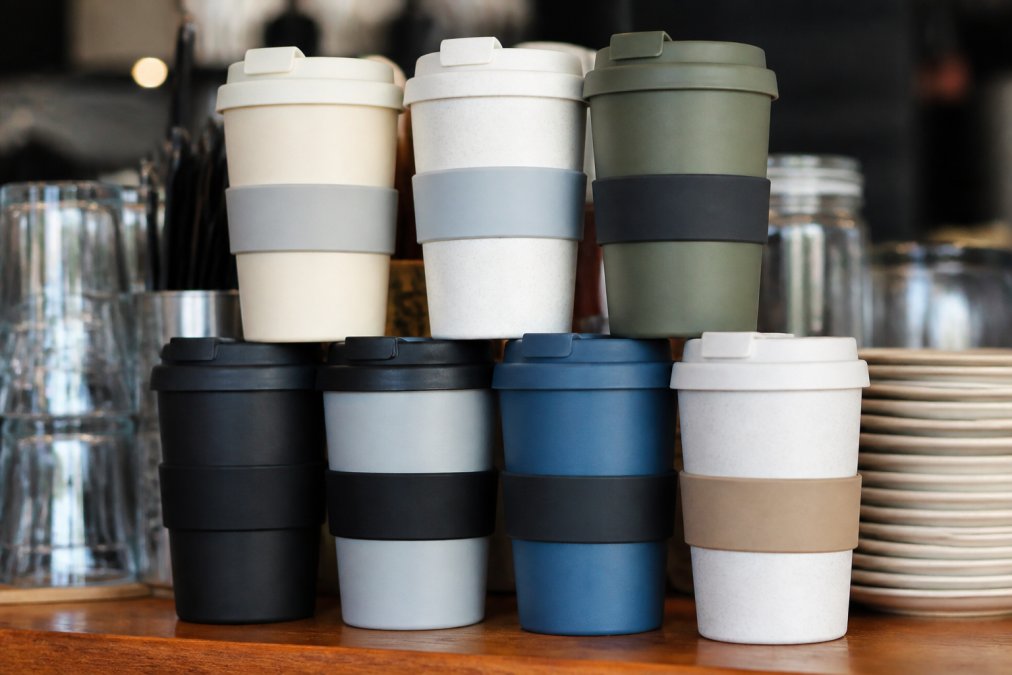
The customisation process involves selecting your base cup (material, size, colour), choosing logo placement, and committing to a minimum order quantity of 500-2,000 units. Lead times typically range from 6-16 weeks depending on complexity and manufacturer capacity.
A common mistake is overestimating customer adoption. Many cafes order aggressively expecting high uptake, only to find that 60-70% of customers prefer single-use options. Start with a smaller order to test uptake, then scale if the program gains traction.
Branded reusable cups create a psychological anchor. Customers who own a branded cup are more likely to return because they've already invested in the system. This retention effect justifies the higher per-unit cost compared to generic reusable cups.
Material choice signals your brand positioning. Stainless steel cups feel premium and justify higher retail prices. Plastic alternatives (BPA-free, food-grade) are lighter and cheaper but feel less durable. Bamboo or cork accents add aesthetic appeal but require careful sourcing.
Stainless Steel Coffee Cups Bulk: Durability and Performance
Stainless steel dominates the reusable cup market for good reason. It survives thousands of wash cycles, maintains beverage temperature effectively, and offers the best per-use cost over time.
Quality double-wall stainless steel maintains hot beverages at drinkable temperatures for 4-6 hours and keeps cold drinks cold for 8+ hours. This performance directly affects customer satisfaction with your reusable program. Temperature loss within 30 minutes causes customers to abandon reusable cups and request disposables.
Food-grade stainless steel comes in grades 18/8 or 18/10 (referring to chromium and nickel content). For cafe use, 18/8 is sufficient and more cost-effective. Avoid suppliers who don't specify the grade; vague descriptions often indicate lower-quality material that will stain or degrade within 12-18 months.
Bulk ordering typically requires minimums of 100-500 units. Unit costs fall from $15-20 at low volumes to $8-12 at 500+ units. The break-even point for a reusable program usually occurs after 15-20 uses per cup, which most regular customers exceed within 2-3 months.
Expect to replace 10-15% of cups annually due to loss, damage, or theft. Some cafes mitigate this by charging a deposit ($5-10) that customers reclaim when returning the cup, which dramatically improves return rates.
Total Cost of Ownership: What KeepCup Alternatives Really Cost
Most cafe owners compare per-unit prices without understanding the full economics. A branded reusable cup at $12-18 wholesale seems expensive versus a single-use cup at $0.30, but this ignores the fundamental reusable model.
Total cost of ownership includes: initial purchase, replacement frequency, washing costs (water, detergent, labour), storage, and return logistics management. For a cafe, this typically works out to $0.08-0.15 per use over a 3-year lifecycle, compared to $0.25-0.40 per single-use cup.
A concrete example: A cafe ordering 500 branded stainless steel cups at $16 each pays $8,000 upfront. If 80% of customers use the reusable program with 3 purchases per week, approximately 120 cups are in active circulation. At 12% annual replacement, you'll purchase 60 replacement cups yearly at $12 each ($720). Washing costs (water and detergent for 120 cups, 5 days weekly) run roughly $2,000 annually. Total annual cost: $2,720 for 18,000 transactions = $0.15 per transaction.
Single-use cups: 18,000 cups at $0.35 each = $6,300 per year. The reusable system saves roughly $3,500 annually after year one. Payback period is typically 8-12 months.
However, this assumes consistent participation and effective loss management. If participation drops below 50% or replacement rates exceed 20% annually, the economics shift. This is why many cafes fail with reusable programs.

The hidden cost most cafes overlook is labour. Reusable cup programs require staff training, customer education, and ongoing return logistics management. If your team spends 2 hours weekly managing the program, that's 100 hours annually, $1,500-2,000 in labour costs.
Compostable alternatives shift this cost structure. You eliminate replacement costs and loss management because the cup is single-use. You trade that for higher per-unit material costs ($0.35-0.50) but lower operational complexity. For high-volume cafes where logistics management is expensive, compostable cups can be more cost-effective.
Material Composition and Thermal Insulation Performance
The material you choose determines performance, longevity, and environmental impact.
Stainless steel (18/8 or 18/10 grade) is the performance standard. It maintains temperature effectively, survives thousands of wash cycles, and resists staining and corrosion. A stainless steel cup requires roughly 50 uses to offset its manufacturing emissions compared to single-use alternatives, a threshold most reusable programs exceed within weeks.
Food-grade silicone and BPA-free plastics are lighter and cheaper but degrade faster. Silicone can develop odours if not dried thoroughly. Plastic cups typically last 2-3 years before replacement becomes necessary. Thermal performance is adequate but not excellent, maintaining temperature for 2-3 hours rather than 4-6.
Plant-based fibre cups (sugarcane pulp, bamboo) are certified home compostable under AS5810, breaking down in residential composting systems within 12 weeks. They're designed for single-use and degrade if repeatedly washed. For cafes with access to commercial composting infrastructure, these cups eliminate return logistics entirely.
Double-wall stainless steel provides superior insulation because the air gap acts as an insulator. Silicone and plastic require external sleeves or jackets. Compostable fibre cups rely on paper sleeves for insulation, effective but less durable than integrated construction.
Environmental impact extends beyond the cup itself. Stainless steel requires significant production energy but lasts years, amortising that impact across thousands of uses. Compostable materials require less energy to produce but must be properly composted to deliver environmental benefit. A compostable cup in landfill provides no advantage over conventional plastic.
Supply Chain Transparency and Certified Sustainability
Understanding where cups are manufactured, how workers are treated, and whether environmental claims are verifiable is essential for cafes positioning themselves as genuinely sustainable.
Certified compostable cups must meet specific standards. In Australia, AS5810 certifies that a product breaks down in home composting within 12 weeks. However, certification alone doesn't guarantee your local council's composting facility will accept the cups. Many councils have more restrictive acceptance criteria than the standard.
Before committing to a compostable cup supplier, verify that your local council's composting facility actually accepts the material. Request documentation of acceptance, not just assurances. Some cafes discovered mid-program that their council doesn't accept compostable cups, forcing them to switch suppliers or abandon sustainability claims.
Supply chain transparency means knowing where cups are manufactured, under what labour conditions, and whether raw materials are sustainably sourced. Many wholesale suppliers source from Asian manufacturers without verifying labour practices. Some use virgin plastic rather than recycled materials, undermining environmental claims. Reputable suppliers provide documentation of manufacturing partners and material sourcing.
Biodegradable Packaging AU prioritises supply chain transparency by working with certified manufacturers and providing documentation of material composition and manufacturing practices.
Conclusion
Selecting keepcup alternatives for wholesale supply isn't about finding a cheaper brand, it's about aligning your supply chain with your cafe's cost structure, brand positioning, and sustainability commitments. The right choice depends on whether you're optimising for customer loyalty (branded reusable cups), environmental impact per transaction (compostable alternatives), durability and long-term value (stainless steel), or flexibility across use cases (hybrid systems).
The most common mistake cafes make is treating the cup choice as isolated from broader operations. Material, cost, customisation, and supply chain transparency are interconnected. A cheap reusable cup that customers abandon defeats the purpose. A compostable cup that your council won't compost creates greenwashing liability. A branded cup with poor thermal performance frustrates customers and undermines your sustainability narrative.
Biodegradable Packaging AU helps cafes navigate these trade-offs by offering certified compostable plant-based cups with custom branding options, premium stainless steel reusable alternatives, and transparent supply chain documentation. Our reclosable plant fibre BioCup lids (available in 80mm natural and 90mm sizes) are certified home compostable under AS5810 with no added PFAS, and our paper cup sleeves reduce waste from double-cupping. Free Melbourne metro delivery on orders over $200 means you can test different approaches without committing to massive upfront inventory. Get started with a sample order and calculate your actual total cost of ownership before scaling.


Frequently Asked Questions
What makes KeepCup alternatives better for wholesale supply than the original?
KeepCup alternatives designed for wholesale supply often offer better bulk pricing structures, faster turnaround on custom branding, and improved thermal insulation performance. Many alternatives also provide certified compostable lids (AS5810) paired with reusable cups, addressing the circular economy demand cafes now face. Supply chain transparency and local manufacturing options further differentiate wholesale-focused alternatives from consumer-grade products.
How do stainless steel coffee cups bulk orders compare to plastic reusables?
Stainless steel reusable cups offer superior durability, heat retention, and aesthetic appeal compared to plastic alternatives. They resist damage from repeated dishwasher cycles and maintain thermal insulation longer. For bulk orders, stainless steel typically carries higher upfront costs but delivers lower total cost of ownership due to extended product lifespan. They also align better with premium brand positioning and customer retention through reusable cup return schemes.
Are compostable cup lids actually certified, and will they really compost?
Certified compostable lids meeting AS5810 (Australian Standard for home compostability) are genuinely certified by independent testing. However, actual composting depends on access to appropriate facilities. Verify your local council accepts certified compostable items before committing to wholesale orders. Many councils now accept AS5810-certified products in food organics and garden organics (FOGO) streams, but coverage varies by region. Contact your local waste authority to confirm.
What's the typical lead time for custom-branded reusable cups wholesale?
Lead times for branded reusable coffee cups wholesale vary by supplier and order volume. Standard orders typically take 4-8 weeks from design approval to delivery, though expedited options may add cost. Compostable lid customisation often requires separate tooling, extending timelines. Discuss urgent restocking options with suppliers upfront, particularly if your cafe operates across multiple locations requiring frequent replenishment.
This article was written using GrandRanker