KeepCup Alternatives for Cafe Wholesale in 2026
September 8, 2026 · Editorial Team

Table of Contents
- Why Australian Cafes Are Rethinking KeepCup for Wholesale
- KeepCup Alternatives at a Glance: A Wholesale Comparison
- Stainless Steel Coffee Cups Bulk: The Durable Contender
- Glass and Ceramic Options for a Premium Feel
- Branded Reusable Cups Wholesale: Customisation That Works
- Cafe Reusable Cup Programs: Implementation and Staff Training
- The Total Cost of Ownership for Reusable Cups
- Making the Switch: Practical Steps for Your Cafe
- Frequently Asked Questions
Last Updated: September 8, 2026
Why Australian Cafes Are Rethinking KeepCup for Wholesale
The single-use coffee cup problem is well documented, but the solution many cafes adopted a decade ago is now showing its limits. KeepCup pioneered the barista-friendly reusable, yet cafes sourcing stock for retail shelves or loyalty programs increasingly hit walls with wholesale trade orders, lead times, and breakage rates. We field questions weekly from owners asking what actually survives a commercial dishwasher and a drop on a tiled floor. KeepCup alternatives for cafe wholesale now centre on durability, custom branding options, and total cost, not just aesthetics.
The shift is practical. A reusable cup program only cuts single-use waste reduction if customers actually return the cups, and return rates depend on design and deposit mechanics (the EPA). Many businesses find that glass and ceramic options feel premium but shatter, while stainless steel handles the abuse of cafe operations far better. Below, we compare the main material categories so you can match a cup to your workflow rather than to a trend.

KeepCup Alternatives at a Glance: A Wholesale Comparison
Choosing a reusable cup for bulk procurement comes down to four material families, each with a different trade-off between feel, durability, and price. The table below summarises how they perform in a busy cafe environment. For wholesale buyers, the numbers that matter are not just the per-unit price, they are the physical dimensions, the dishwasher cycle rating, and the stated drop-test result.
| Material | Typical Wall Construction | Dishwasher Rating | Drop Test (from 1.5m onto tile) | Heat Retention (minutes above 60°C) | Wholesale Price Range (AUD, per unit at 100+ qty) | Best For | Watch Out For |
|---|---|---|---|---|---|---|---|
| Stainless steel (double-wall) | 304 grade, vacuum-insulated | 500+ cycles (commercial grade) | Passes, no deformation | 60-90 | $6.50-$12.00 | High-volume cafes, takeaway | Feels less like ceramic; heavier than plastic |
| Tempered glass (double-wall) | Borosilicate, 2.5mm wall | 200-300 cycles (top-rack only) | Fails on edge impact | 20-30 | $8.00-$15.00 | Premium retail shelves | Shatters on hard floors; thermal shock risk if pre-heated |
| Ceramic (stoneware) | Single-wall, glazed | 100-200 cycles (crazing risk) | Fails immediately | 15-25 | $4.50-$9.00 | Dine-in aesthetics | Breakage in transit; heavy freight cost |
| Composite/plastic (polypropylene) | Single-wall, 2mm | 300-400 cycles | Passes, may crack lid | 10-20 | $2.50-$5.50 | Budget-friendly stock | Perceived as cheap; odour retention after 12 months |
These figures represent the range seen across Australian hospitality suppliers that publish technical datasheets. If a supplier cannot provide a dishwasher cycle rating or a drop-test result in writing, treat that as a red flag, commercial cafes run 5-10 wash cycles per cup per day, and a cup rated for domestic use only will fail within three months.
A note on volume: the price spreads above narrow significantly at 500+ unit orders. At that volume, stainless steel typically lands within 15-20% of the composite price, which changes the total cost calculation entirely. The gap between "budget" and "durable" shrinks as your order grows, which is why we recommend requesting tiered quotes before ruling out steel on price alone.
The standout for wholesale is stainless steel. Our premium stainless steel reusable cups are BPA-free, food-grade silicone sealed, dishwasher safe, and barista-friendly in size. Glass and ceramic belong in a different conversation, one about retail merchandising strategy rather than daily operational use.
Stainless Steel Coffee Cups Bulk: The Durable Contender
For cafes ordering in volume, stainless steel coffee cups bulk purchasing makes sense because the product survives the two killers of reusable programs: the dishwasher and the drop. A double-wall steel cup keeps coffee hot for the commute while the exterior stays cool enough to hold, and the material does not absorb flavours or odours over years of service.
The durability argument is also a financial one. A steel cup that lasts through hundreds of wash cycles spreads its wholesale trade cost across far more uses than a glass cup that breaks in the first month (peer-reviewed research). When you factor in custom logo printing, steel takes branding well through laser etching or durable coatings that do not peel.
Glass and Ceramic Options for a Premium Feel
Glass and ceramic cups win on sensory appeal. A double-walled tempered glass cup shows off the coffee crema and feels substantial in hand, which suits cafes where the reusable cup is part of the dine-in experience or a retail product sold to eco-conscious consumers. Ceramic offers the familiar lip feel that coffee drinkers associate with a specialty pour.
Where these materials fall short is the floor. One dropped cup in a busy service period is a write-off, and breakage rates in transit and in the cafe eat into margins quickly. For wholesale trade orders, glass and ceramic also require more careful packaging, which raises freight cost. They work best as a complement to a steel core range, not a replacement for it.
Branded Reusable Cups Wholesale: Customisation That Works
Custom branded merchandise only delivers value if the branding survives daily use, and that is where material choice matters most. A steel cup with a logo printed in durable enamel or etched into the body keeps the brand visible for years. The same logo on a plastic cup can fade or scratch within months, which reflects poorly on the cafe.
What most manufacturer pages do not tell you is how the decoration method changes your supply chain. Wholesale buyers planning a branded cup program need to understand four variables before they brief a designer: the decoration method, the minimum order quantity (MOQ), the artwork lead time, and the reorder lead time. These four numbers determine whether your branded cup program can survive a sold-out rush or a rebrand.
Decoration methods compared for cafe wholesale:
- Pad printing, The most common method for curved cup bodies. Works well on steel and plastic. Single-colour logos are cheapest; each additional colour adds a print station and raises the per-unit cost. Typical MOQ: 100-250 units. Artwork lead time: 5-7 business days after approval.
- Laser etching, Permanently engraves the steel surface. No ink to peel or fade. Best for monochrome logos or text. Slightly higher setup cost but the lowest per-unit cost at volume. Typical MOQ: 250 units. Artwork lead time: 3-5 business days.
- Enamel or epoxy coating, A coloured fill applied over a printed or etched base. Produces a smooth, premium finish. More expensive per unit and requires a longer curing time. Typical MOQ: 500 units. Artwork lead time: 10-14 business days.
- Silicone band printing, The removable band around the cup body is printed separately. This is a high-visibility surface during drinking, but bands are replaceable parts, which means you can reorder printed bands without reordering the whole cup. Typical MOQ: 500 bands. Artwork lead time: 7-10 business days.
The supply-chain question competitors do not answer: what happens when you need a reorder? Most Australian suppliers hold blank stock but do not hold decorated stock. That means a reorder of printed cups carries the same artwork lead time as your first order, typically 2-3 weeks from order confirmation to dispatch. If you run a seasonal promotion or a limited-edition design, factor that lead time into your campaign calendar. A cafe that runs out of branded stock mid-promotion and waits three weeks for a reorder has effectively killed the program's momentum.
A practical pattern among successful cafe programs is splitting the order: 70% of units in a core, evergreen design (laser-etched logo on steel) and 30% in seasonal or campaign-specific designs (pad-printed or enamel). The evergreen stock is always reorderable with minimal lead time, while the seasonal stock is ordered once and sold through. This approach keeps the brand visible year-round without tying up capital in slow-moving decorated inventory.
When ordering branded reusable cups wholesale, think about where the brand appears. The cup body is the obvious spot, but the lid and the silicone band are high-visibility areas during drinking. A coordinated design across all three surfaces turns a functional item into walking advertising at the point of sale and beyond, but only if the decoration method matches the surface. Lids are typically printed with a small logo or a single colour, while the band offers a larger canvas for a tagline or a secondary mark. Coordinate the design system, not just the logo placement, and your branded cup becomes a cohesive piece of merchandise rather than a cup with a sticker on it.
Cafe Reusable Cup Programs: Implementation and Staff Training
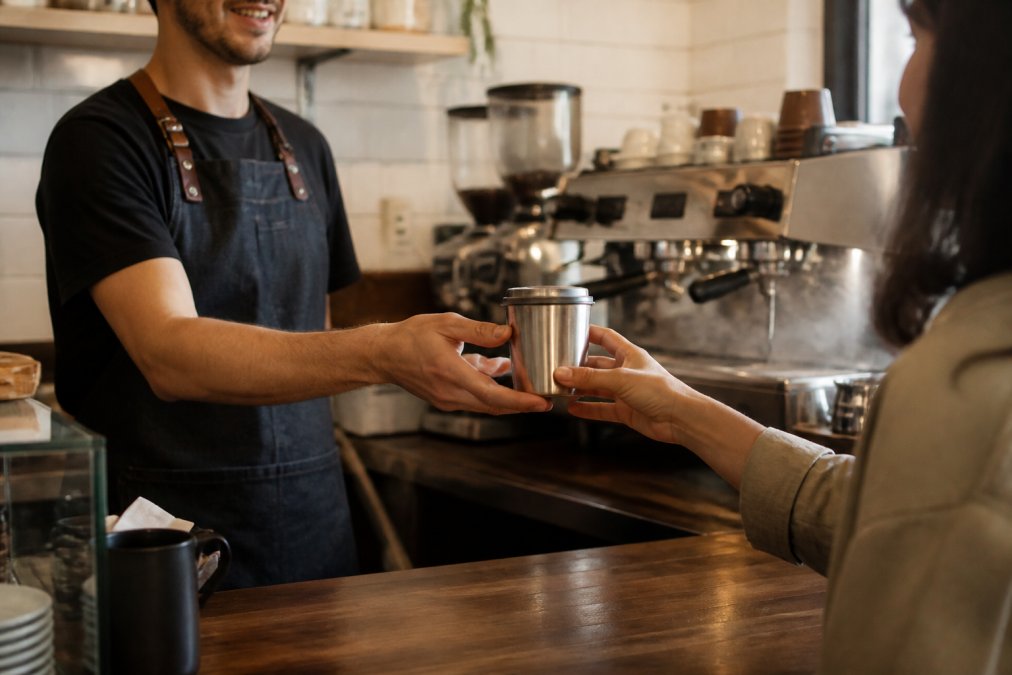
A reusable cup program fails at the counter, not in the warehouse. Staff need a clear, fast protocol for accepting a customer cup, and they need to know the hygiene rules around handling items that have left the premises. Many cafes adopt a simple swap system where the customer hands over a clean cup and receives a filled one, which removes the need to rinse returns during peak service.
Training should cover two scenarios: the customer who brings their own cup and the cafe-owned cup in a borrow-and-return scheme. For the latter, decide how deposits are tracked. A common approach is a token or stamp card that ties the deposit to the customer's next visit. Keep the process under ten seconds so it does not slow the queue.
The Total Cost of Ownership for Reusable Cups
The per-unit price of a reusable cup tells you very little about what it costs your cafe over a year. Total cost of ownership includes the purchase price, breakage and replacement rates, washing labour and energy, and the value of cups that never come back. A cheaper cup that breaks or disappears at a higher rate is often the more expensive option.
| Cost Factor | Glass/Ceramic | Stainless Steel |
|---|---|---|
| Replacement rate | Higher, fragile | Lower, shock resistant |
| Washing cost | Same energy per load | Same, but survives more loads |
| Customer retention | Premium feel | Practical daily use |
| Brand longevity | Print can wear | Etching lasts years |
For cafes running a borrow scheme, stock shrinkage is the hidden cost. Set a realistic loss rate and factor it into your pricing, or move to a deposit system that gives customers a reason to return the cup. Biodegradable Packaging AU pairs its premium stainless steel reusable cups with certified compostable takeaway packaging, so the reusable option covers dine-in while the compostable range handles the overflow that still goes out the door.

Making the Switch: Practical Steps for Your Cafe
Start small. Order a trial batch of stainless steel cups, put them through your dishwasher for a week, and drop one on the floor deliberately to test the shock resistance. Run them past your baristas, because their buy-in determines whether the program works during a Saturday rush.
Next, decide on the program model. Retail sale suits cafes where customers want to own their cup, while a deposit-based borrow scheme drives higher reuse rates but needs a tracking system. Whichever you choose, display the cups prominently at the point of sale and train staff to offer them before the customer asks for a takeaway cup.
Finally, review your supply chain. Ask your supplier about lead times for custom branding and whether they hold buffer stock for urgent restocks. A reusable cup program is a long-term commitment, and the logistics partner you choose should make reordering as simple as the first order.
Switching your cafe to reusable cups is less about chasing a trend and more about choosing materials that survive your actual service environment. Stainless steel offers the durability and branding potential that glass and ceramic cannot match, and it pairs naturally with certified compostable packaging for everything that still leaves the store. Biodegradable Packaging AU supports this transition with premium stainless steel reusable cups, custom brand packaging options, and free Melbourne metro delivery on orders over $200. Get started with Biodegradable Packaging AU and build a reusable program that lasts.
Frequently Asked Questions
What are the best wholesale alternatives to KeepCups for cafes?
The best alternatives depend on your priorities. Stainless steel coffee cups bulk orders offer superior durability and insulation, making them ideal for high-turnover cafes. Glass cups provide a premium feel but break more easily. For a cost-effective entry point, consider a branded reusable cup program using double-wall stainless steel. Look for suppliers that offer food-grade, BPA-free materials and custom logo printing to maximise brand visibility.
How do stainless steel reusable cups compare to glass for cafe wholesale?
For cafe wholesale, stainless steel cups generally outperform glass on durability, thermal insulation, and breakage rates. A dropped glass cup is a safety hazard and a product loss; a stainless steel cup will likely survive the drop. Stainless steel also keeps drinks hot or cold for longer. The main trade-off is that glass offers a clearer view of the beverage, which some specialty coffee shops prefer.
What should cafes look for when sourcing branded reusable cups?
Prioritise cups that are BPA-free, food-grade, and dishwasher safe to ensure they withstand commercial use. Check the minimum order quantities (MOQs) and lead times for custom logo printing. A cup that is barista-friendly, meaning it fits under standard group heads and stacks well, will integrate smoothly into your workflow. Ask about the supplier's supply chain and their end-of-life recycling programs.
How can cafes implement a successful reusable cup program?
Start by choosing a cup design that fits your existing operations, then train staff on the program's benefits and mechanics. Offer a small incentive, such as a discount, to encourage participation. Track cup return rates to measure success. Keep a stock of washed cups ready at the point of sale and communicate the environmental impact clearly to customers to build engagement.