How to Verify Compostable Certification
August 24, 2026 · Editorial Team

Table of Contents
- Why Verifying Compostable Certification Matters
- Step 1: Check for Australian Standards (AS 4736 vs AS 5810 Standards)
- Step 2: Identify Certified Compostable Logos and Symbols
- Step 3: Verify Independent Testing and Accreditation
- Step 4: Spot Compostable Packaging Greenwashing Red Flags
- Step 5: Confirm Your Local Composting Facility Accepts the Product
- Conclusion
Last Updated: August 24, 2026
Why Verifying Compostable Certification Matters
Greenwashing in sustainable packaging has become rampant. Brands slap "eco-friendly" labels on products that aren't actually certified, banking on consumer confusion about what compostable really means. The problem isn't just misleading marketing, it's that genuinely certified compostable packaging ends up in landfill because consumers and businesses can't tell the difference.
When you fail to verify compostable certification, three things happen. First, your business gets associated with false environmental claims, which damages trust when customers discover the truth. Second, you're potentially breaking consumer protection laws by making unsubstantiated environmental claims. Third, you're missing the actual benefit of certified compostable packaging: diverting real waste from landfill through legitimate commercial composting facilities.
At Biodegradable Packaging AU, we work with cafes, restaurants, and caterers who want to make a genuine environmental impact. The difference between certified and uncertified packaging isn't subtle, it's the difference between actually composting and ending up in landfill. This guide walks you through exactly how to verify compostable certification so you can confidently choose packaging that does what it claims.
The five steps below cover everything from checking Australian standards to spotting red flags that signal greenwashing. By the end, you'll know exactly what to look for when evaluating any compostable product, whether you're sourcing from established suppliers or evaluating new vendors.
Step 1: Check for Australian Standards (AS 4736 vs AS 5810 Standards)
Australia has two key standards for compostability, and they're not interchangeable. AS 4736 covers industrially compostable plastics, while AS 5810 covers home compostable products. Understanding the difference is your first line of defence against greenwashing.
AS 4736 is the standard for products that break down in commercial composting facilities. These facilities operate at higher temperatures (around 58°C) and maintain specific moisture and oxygen levels. If you're sourcing packaging for a cafe or restaurant, this is the standard you need. Products certified to AS 4736 will actually decompose at the commercial facilities that handle food waste in your area.
AS 5810 applies to home composting conditions. These are much slower decomposition processes that occur in backyard compost bins or garden waste. A product certified to AS 5810 might take 12 months or longer to break down in home conditions. If your packaging is certified only to AS 5810, it won't decompose in commercial facilities, it'll sit in landfill even if sent to a composting plant.
The practical difference matters enormously. When you verify compostable certification, check which standard appears on the product documentation. Look for "AS 4736" if the packaging will go to commercial composting facilities. If you're marketing to consumers who home-compost, AS 5810 is relevant, but it's less useful for hospitality businesses.
Many suppliers list both certifications, which is actually a good sign, it means the product works across multiple scenarios. However, if only AS 5810 appears, the packaging won't work for your business operations unless you have a specific home composting program.
Standards Australia's compostability standards framework provides the official specifications for both standards. Request the certification documentation from your supplier and verify the standard number explicitly.
Step 2: Identify Certified Compostable Logos and Symbols
Certified compostable packaging displays specific logos and symbols that serve as your visual verification tool. These aren't just marketing badges, they're regulated marks that indicate third-party testing and compliance with Australian standards.
The most recognisable symbol in Australia is the Australian Bioplastics Association (ABA) certification logo. This circular mark indicates that the product has been independently tested and verified to meet AS 4736 or AS 5810. When you see this logo, it means an accredited laboratory has confirmed the product's compostability claims.
Other legitimate marks include certifications from international bodies like Vincotte (Belgium-based, widely recognised) and TÜV Austria, which also conduct rigorous testing. However, the ABA mark is your strongest local indicator because it's specifically tied to Australian standards.
The key difference between legitimate logos and greenwashing is that real certification marks always include the specific standard number. A genuine compostable logo will display "AS 4736" or "AS 5810" somewhere on the packaging or in the product documentation. If a package shows a compostable-looking symbol but no standard number, it's almost certainly greenwashing.
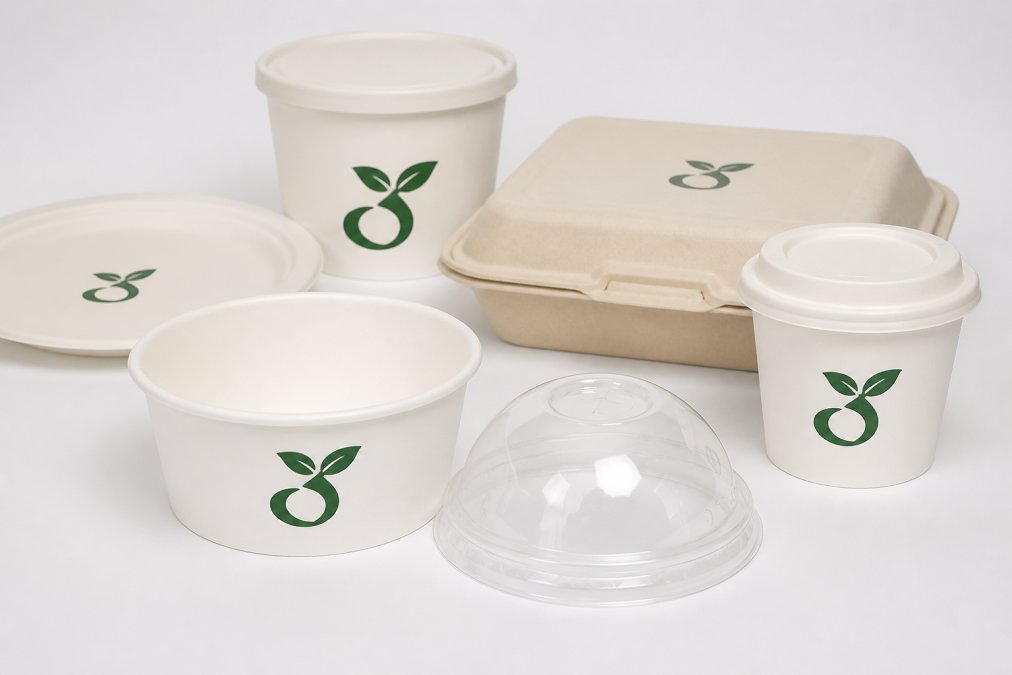
When verifying compostable certification, photograph or document the exact logo and standard number. Cross-reference it against the supplier's technical documentation. Legitimate suppliers provide a product data sheet or certificate of compliance that lists the testing laboratory, the standard tested against, and the date of certification.
Biodegradable Packaging AU's compostable products, including our plant-based BioCups and PLA cutlery, display certification marks that verify compliance with industrial composting standards. When you source from a verified supplier, you can access these certificates directly rather than guessing based on packaging alone.
Watch for vague terminology like "eco-friendly," "biodegradable," or "natural materials." These words have no regulatory meaning in Australia. Only logos tied to specific standards (AS 4736, AS 5810, or equivalent international standards) indicate genuine certification.
Step 3: Verify Independent Testing and Accreditation
Certification means nothing without independent testing by an accredited laboratory. This is where many businesses get caught, they trust a supplier's claims without verifying that an actual third party conducted the testing.
When you verify compostable certification, ask your supplier for the name of the testing laboratory. Legitimate certifications come from accredited facilities that specialise in compostability testing. In Australia, look for laboratories accredited by National Association of Testing Authorities (NATA), which maintains a register of accredited testing facilities.
The testing process itself is rigorous. An independent laboratory takes samples of the product and subjects them to controlled composting conditions that replicate commercial composting environments. They measure disintegration (how quickly the material breaks apart), biodegradation (how thoroughly it converts to biomass), and ecotoxicity (whether the resulting compost is safe for plants and soil). Only products that pass all three measures receive certification.
Request the certificate of compliance or test report from your supplier. This document should include:
- The testing laboratory's name and NATA accreditation number
- The specific standard tested (AS 4736 or AS 5810)
- The date of testing and validity period
- Test results for disintegration, biodegradation, and ecotoxicity
- The product batch or production run covered by the certification
Many suppliers are reluctant to share these documents, which is itself a red flag. Legitimate manufacturers keep this documentation readily available because it's their proof of compliance. If a supplier deflects when you ask for the test report, they're likely greenwashing.
The accreditation number matters because it's verifiable. You can cross-check the laboratory's credentials against NATA's public register. This takes five minutes and eliminates most fraudulent claims immediately.
Step 4: Spot Compostable Packaging Greenwashing Red Flags
Greenwashing in the compostable packaging space relies on specific tactics. Learning to spot these red flags protects your business from making purchasing decisions based on false claims.
The first red flag is vague environmental language without specific standards. Phrases like "compostable," "eco-friendly," "natural," "plant-based," or "biodegradable" sound good but mean nothing legally. A product can be plant-based and still not compostable. It can be biodegradable but take 50 years to break down. These terms are intentionally ambiguous because they allow marketers to imply certification without stating it.
The second red flag is missing certification marks. If packaging doesn't display a recognised compostable logo (ABA, Vincotte, TÜV Austria, or equivalent), the product probably isn't certified. Suppliers that have invested in third-party testing always display it prominently because it's their competitive advantage. If the packaging is blank of certification marks, ask why.
The third red flag is conflicting or missing standard numbers. When you verify compostable certification, check whether the documentation specifies AS 4736 or AS 5810. If a supplier says the product is "compostable" but can't specify which standard it meets, they're being deliberately evasive. Legitimate products have clear standard designations.
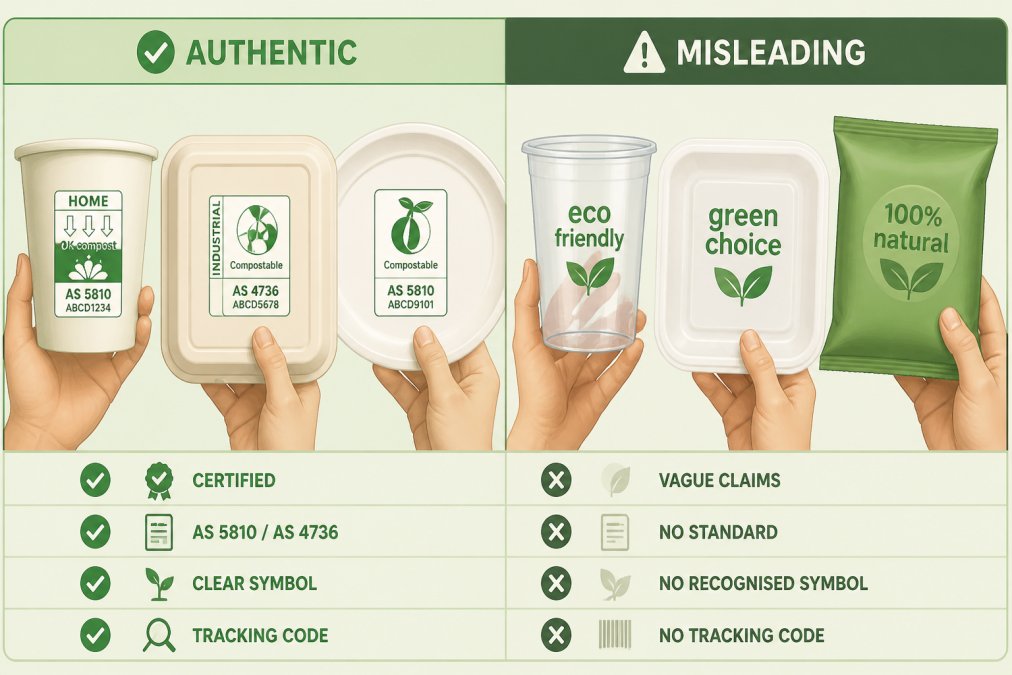
The fourth red flag is no access to test reports. As mentioned above, suppliers of genuinely certified products have test reports available. If a supplier tells you "the laboratory tested it" but won't provide documentation, they're likely fabricating the claim. Accredited testing creates a paper trail, no paper trail means no testing.
The fifth red flag is "certified compostable" claims without specifying by whom. A product might say it's "certified compostable" but omit the certifying body. This is a classic greenwashing tactic. Always ask: certified by which laboratory, to which standard, when? If the supplier can't answer all three questions, the claim is suspect.
The sixth red flag is conflicting information across channels. If a supplier's website says the product is AS 4736 certified but the packaging says AS 5810, or if different sales staff give different answers about which standard applies, that's a sign of internal confusion or deliberate deception. Legitimate suppliers have consistent messaging because they're accurately representing their products.
Many businesses also fall for the "compostable but not certified" pitch. A supplier might say the product is compostable but hasn't been formally tested and certified. This is essentially admitting there's no verification. Without third-party testing, you have no proof the product actually decomposes as claimed.
The final red flag is premium pricing without premium certification. If a supplier charges significantly more for "compostable" packaging but can't produce certification documentation, they're charging a sustainability premium for a non-sustainable product. Genuine certification adds real cost, but it also comes with documented proof.
Step 5: Confirm Your Local Composting Facility Accepts the Product
Certification matters only if your local composting facility actually accepts the product. A package certified to AS 4736 is useless if your nearest commercial composting facility doesn't process industrially compostable materials.
This is the step most businesses skip, and it's why genuinely certified compostable packaging still ends up in landfill. You need to contact your local council or waste management authority and ask: Do you accept industrially compostable packaging? What standards do you recognise? What's the process for dropping off compostable waste?
Different facilities have different capabilities. Some accept only food waste. Others accept food waste plus compostable packaging. Some accept only packaging certified to specific standards. A few facilities don't accept compostable materials at all and treat them as contamination.
When you verify compostable certification, also verify that your facility accepts it. Call or email your local composting facility and ask these questions:
- Do you accept industrially compostable packaging?
- Which standards do you recognise (AS 4736, Vincotte, TÜV Austria)?
- Is there a separate drop-off point for compostable materials, or do they go in general food waste?
- Are there any materials you don't accept (for example, some facilities reject certain bioplastics)?
- What's the process for businesses to submit compostable packaging?
Many facilities have specific requirements. Some require packaging to be separated from food waste. Others have minimum batch sizes. Some have seasonal restrictions. Understanding these requirements before you commit to compostable packaging prevents the frustrating scenario where you've switched to certified products but can't actually use them.
Biodegradable Packaging AU facilitates access to local composting services for customers. When you source from a supplier that understands the full supply chain, from certification through to actual composting, you avoid the greenwashing trap of buying certified packaging that your facility won't accept.
Verifying compostable certification protects your business from greenwashing and ensures your packaging actually diverts waste from landfill. The five steps above, checking standards, identifying logos, verifying independent testing, spotting red flags, and confirming facility acceptance, eliminate guesswork and give you confidence in your purchasing decisions.
When you're ready to source certified compostable packaging for your cafe, restaurant, or catering business, Biodegradable Packaging AU offers plant-based products like our 300-700ml Dome X-Slot Lid Clear BioCup Lid and 16.5cm PLA Fork, all certified to industrial composting standards with full documentation available. With custom branding options and free Melbourne metro delivery on orders over $200, switching to verified compostable packaging becomes practical and cost-effective. Get started with Biodegradable Packaging AU and transform your packaging into a genuine environmental asset rather than a greenwashing liability.


Frequently Asked Questions
What are the official compostable certification logos in Australia?
The two main certification marks are the Australian Standards certifications: AS 4736 for industrially compostable products and AS 5810 for home compostable products. Look for certification logos from accredited testing laboratories on packaging. These logos confirm that independent testing has verified the product meets compostability standards. Genuine certifications display the laboratory name and accreditation details, not vague environmental claims.
How do I check if a product is AS 4736 or AS 5810 certified?
Check the packaging for the specific standard number (AS 4736 or AS 5810) alongside the certification logo. Contact the supplier directly and ask for their certification documentation from an accredited laboratory. Many suppliers, including Biodegradable Packaging AU, provide certification details for each product. Verify the laboratory is genuinely accredited through the relevant standards body. Never rely on vague terms like 'biodegradable' without the specific standard number.
What is the difference between home compostable and commercially compostable?
Home compostable products (AS 5810) break down in home compost systems at lower temperatures over several months. Commercially compostable products (AS 4736) require industrial composting facilities with controlled temperature and moisture conditions. Most certified compostable foodservice packaging is AS 4736 (commercially compostable) because it performs better in high-volume food environments. Check your local composting facility to confirm which standard they accept before purchasing.
How do I know if a supplier's compostable certification is genuine?
Request the full certification document from the supplier, not just a product listing. Verify the accredited laboratory's name on the certification and cross-reference it with official accreditation registers. Genuine certifications include specific test results, disintegration rates, and ecotoxicity data. Suppliers like Biodegradable Packaging AU provide transparent certification details for each product. Be cautious of suppliers who use vague language or refuse to share certification documents.
This article was written using GrandRanker