How to Start Composting in Cafes: Step-by-Step Guide
September 5, 2026 · Editorial Team

Table of Contents
- The Real Cost of Not Composting in Your Cafe
- What You Need to Start Composting in Cafes
- Step 1: Choose Your Composting Method and Bin Placement
- Step 2: Set Up Sorting Stations That Actually Work
- Step 3: How to Train Staff on Waste Separation
- Step 4: Balance Greens and Browns, Manage Coffee Grounds
- Step 5: Find a Commercial Composting Service
- How Certified Compostable Foodservice Packaging Fits In
- Frequently Asked Questions
Last Updated: September 5, 2026
The Real Cost of Not Composting in Your Cafe
Food waste is one of the largest and most avoidable expenses in cafe operations. When food scraps, coffee grounds, and compostable packaging head to landfill, you are paying twice: once for the product and again for its disposal as general waste. Composting turns that waste stream into a resource while shrinking your environmental impact and waste management bills.
At Biodegradable Packaging AU, we supply certified compostable foodservice packaging to hospitality businesses across Australia. This guide walks you through the operational steps, from bin placement to staff training, so you can start composting with confidence.
The core idea is simple. Organic waste that breaks down in a compost system returns nutrients to soil, whereas the same material in landfill generates methane, a potent greenhouse gas. Many Australian councils now offer organics collection, and sustainability guidance from the Australian Government encourages businesses to pursue waste diversion as part of broader carbon reduction efforts. For a cafe producing kilograms of coffee grounds daily, the potential for landfill reduction is substantial.
What You Need to Start Composting in Cafes
Before you buy a single bin, assess your space, your waste volume, and your local collection options. Composting in cafes requires three core elements: a dedicated bin system, a supply of carbon-rich browns, and a destination for the finished compost.
Start with a simple audit. Track what you throw away for one week and sort it into food scraps, coffee grounds, compostable packaging, and general rubbish. This tells you which bin sizes you need and how often collection should happen. A common mistake is underestimating the volume of coffee grounds, which are dense and heavy, so weigh them separately.
You will also need the right tools: countertop bins with lids for the prep area, larger wheelie bins for out the back, and compostable bin liners. Many cafes overlook the need for aeration and drainage in their storage area, which prevents odour issues before they start. If you handle food directly, disposable gloves made from bioplastic, like the Small Compostable Glove, keep hygiene standards high without adding plastic to your waste stream.

Step 1: Choose Your Composting Method and Bin Placement
Your composting method depends on whether you have space for an on-site system or need to partner with a commercial composting service. On-site composting suits cafes with outdoor space and gardens, while urban venues typically rely on council organics bins or a dedicated collection service.
Bin placement matters more than most guides admit. Put your organics bin where the waste is generated: next to the espresso machine for coffee grounds, beside the prep bench for food scraps, and at the dishwashing station for plate scrapings. If the bin is more than an arm's reach away, staff will not use it consistently.
For the back-of-house storage area, choose a location with good drainage and airflow. A dedicated compost bin with a tight-fitting lid controls pests and odours, but you must empty it frequently enough that it never overflows. Collection frequency should match your busiest days, not your quietest ones.
Step 2: Set Up Sorting Stations That Actually Work
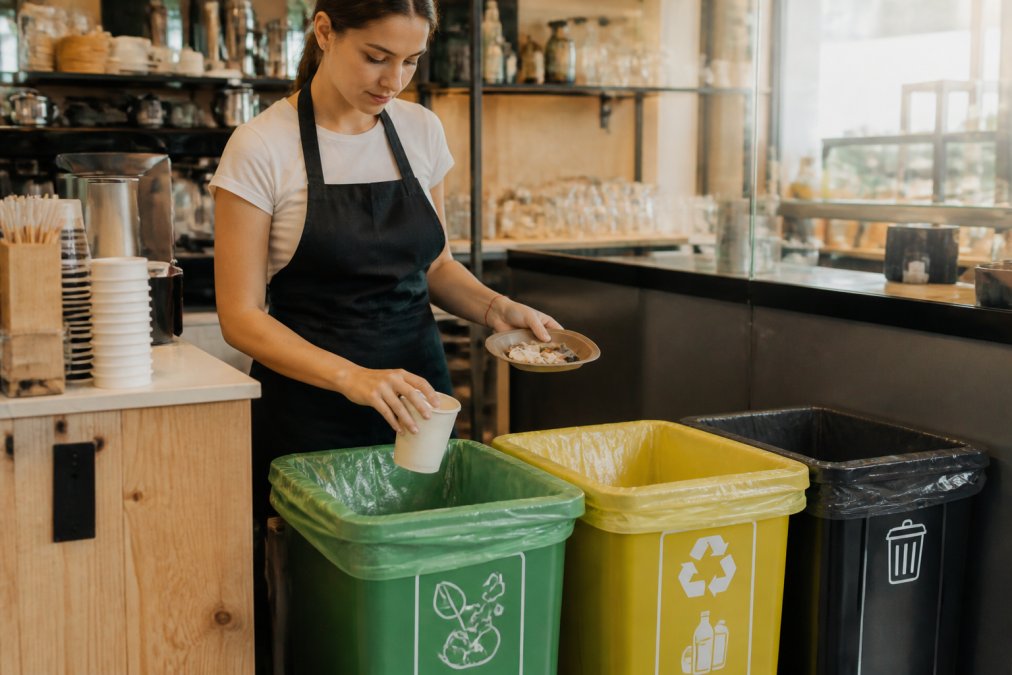
A sorting station is a physical system that makes correct disposal the easiest option. Composting in cafes fails when staff must think about which bin to use, so design stations that remove the guesswork.
Place three bins side by side: organics, recycling, and landfill. Use colour-coded lids and clear, visual signage showing what belongs in each bin. A photo of a coffee cup, a banana peel, and a plastic wrapper is worth a thousand words for a busy barista during a rush.
The organics bin should be the largest and most accessible, since food scraps and compostable packaging will dominate your waste. Position it at the front of the station, not tucked behind the recycling bin. Keep a small bin for compostable takeaway items near the front counter so customers can dispose of their cups correctly.
Step 3: How to Train Staff on Waste Separation
Staff training on waste separation is the difference between a compost program that works and one that quietly dies. You cannot assume that employees know what is compostable, so build training into onboarding and refresh it quarterly.
Run a hands-on session where staff physically sort a tray of waste items. This is far more effective than a handout. Cover the common mistakes: compostable packaging that looks identical to plastic, coffee cups with plastic lids, and food-soiled paper that belongs in organics, not recycling. Explain why separation matters by showing the cost of contamination, which can see an entire bin rejected by your commercial composting service.
Assign a waste champion on each shift. This person checks the bins at the end of the day, catches contamination early, and answers questions from newer staff. A short daily checklist keeps everyone accountable: empty the organics bin, wipe down the sorting station, and note any items that ended up in the wrong bin.
Step 4: Balance Greens and Browns, Manage Coffee Grounds
Successful composting depends on the ratio of nitrogen-rich greens to carbon-rich browns. Food scraps and coffee grounds are nitrogen-rich greens, while cardboard, paper towels, and dry leaves are carbon-rich browns. A ratio of roughly two parts browns to one part greens keeps the pile aerated and prevents odours. But in a café, the challenge is maintaining a system that does not create odours or pests where customers are metres away from your waste storage.
Coffee grounds are your cafe's most abundant compostable resource.
They are dense and acidic on their own, so they must be balanced with browns. Many cafes partner with local gardeners who collect grounds directly, a simple form of waste diversion requiring no processing on your part. If you go this route, set up a dedicated bucket near the espresso machine and empty it into the gardener's collection container at the end of each day. Do not let grounds sit overnight in an open bin, they ferment quickly and create a sour smell that will drift into the dining area.
Equipment maintenance is the overlooked operational detail.
Commercial-grade compost bins in a café environment require daily attention. Unlike a backyard bin, a café bin is filled multiple times per day with wet, dense material that compacts and becomes anaerobic if left undisturbed. Anaerobic decomposition produces hydrogen sulphide, the rotten egg smell that customers will notice immediately. To prevent this:
- Empty the organics bin at least twice per day during peak service. A bin that is more than three-quarters full will compact and start to smell within hours.
- Rinse the bin with hot water and a food-safe sanitiser at the end of every shift. Residual organic matter on the bin walls is what attracts fruit flies and cockroaches.
- Use compostable bin liners that fit your bin exactly. A liner that is too small will tear under the weight of wet coffee grounds, creating a mess that is difficult to clean.
- Keep a spray bottle of diluted white vinegar near the bin station. A quick mist after each empty neutralises odours without introducing harsh chemicals that could contaminate your compost.
For on-site systems, layer your waste.
Add a handful of browns each time you empty the organics bin into the compost pile. This controls smell, discourages pests, and speeds up decomposition. If you rely on a commercial composting service, check whether they accept coffee grounds and compostable packaging together, as requirements vary by provider.
Managing the coffee ground volume.
A typical café produces 10-20 kg of wet coffee grounds per day, or 50-100 kg per week. If you are not sending those grounds to a commercial service or a local gardener, you need a storage strategy. A dedicated 60 L bin with a tight-fitting lid, emptied daily, is the minimum for a busy café. Do not mix coffee grounds with food scraps in the same bin unless you are emptying it multiple times per day, the combination accelerates decomposition and odour production.
When to escalate to a professional cleaning service.
If your bins develop a persistent odour despite daily cleaning, the problem is likely in the bin itself, scratches and cracks harbour bacteria that washing cannot remove. Commercial-grade bins should be replaced every 12-18 months under heavy use. Some commercial composting services offer bin cleaning as part of their collection fee, which is worth asking about when you compare providers.
Step 5: Find a Commercial Composting Service
Many Australian cafes cannot compost on-site, so a commercial composting service is the practical solution. These services collect your organics bin and process the material at an industrial facility, where temperatures are high enough to break down certified compostable packaging. However, choosing a service is not just about logistics, it is also about meeting your obligations under state environmental protection authorities (EPAs) and local council health regulations.
Understand your regulatory obligations first.
Before signing a contract, check your state's environment protection regulations. For example, in Victoria, the Environment Protection Act 2017 requires businesses to manage waste to minimise risks to human health and the environment. In New South Wales, the Protection of the Environment Operations Act 1997 sets out similar duties. Most councils require that organic waste bins be kept covered, be located away from public access points, and be cleaned regularly to prevent odours and pest infestations. A commercial composting service that provides a bin and a scheduled collection is often the easiest way to demonstrate compliance, because the service provider takes responsibility for the waste once it leaves your premises.
What to ask a potential service provider.
When you contact a service, ask these specific questions:
- What contamination threshold do you accept? Most services reject a load if contamination exceeds 1-2% by weight. Ask for their exact tolerance so you can train staff accordingly.
- Do you accept certified compostable packaging? Some services only take food scraps and garden waste. If you use compostable cups and containers, confirm they are accepted. Look for the AS 4736 (home compostable) or AS 5810 (industrial compostable) certification marks on your packaging.
- What is the collection frequency and minimum volume? Some services only collect weekly, which may not be enough for a busy café producing several full bins of organic waste per day. Others offer daily or twice-weekly pickups at a premium.
- Do you provide the bins and liners? Many services supply wheelie bins and compostable liners as part of the fee. This simplifies your procurement and ensures the liners are compatible with the facility's processing equipment.
- What happens if a load is rejected? Understand the financial penalty and the process for rectifying contamination. A single rejected load can double your waste costs for that period.
Cost is a genuine consideration for small cafes.
While collection fees add an expense line, they are often offset by reduced general waste collection and lower landfill levies. The waste management guidance from Sustainability Victoria outlines how businesses can assess the financial case for organics collection, including potential savings on waste disposal. A common pattern is that a café producing 50-100 kg of organic waste per week can reduce its general waste bin size from 240 L to 120 L, which often offsets 50-70% of the organics collection fee. Ask your current waste hauler for a quote on downsizing your general waste bin when you price organics collection.
What if no commercial service operates in your area?
If you are in a regional area without access to a commercial composting facility, you still have options. Some councils offer community drop-off points for food organics, and local community gardens often accept coffee grounds and food scraps. You can also partner with a nearby farm or market garden that will collect your organic waste directly, a form of waste diversion that may not require a formal service agreement but still keeps waste out of landfill. Check with your council's waste management team for local options and any permit requirements for storing organic waste on your premises.
How Certified Compostable Foodservice Packaging Fits In
Your compost program is only as good as the packaging you put through it. Certified compostable foodservice packaging is designed to break down in commercial composting facilities, but only if it meets recognised standards and ends up in the right bin.
Look for packaging certified to Australian standards. Products made from plants, such as sugarcane pulp or PLA-lined cups, are common options. Biodegradable Packaging AU supplies certified compostable foodservice packaging that is compatible with commercial composting services, along with custom brand packaging options so your sustainability initiative becomes part of your customer-facing identity.

The catch is that not all "compostable" claims are equal. Some products require industrial facilities that your local service may not offer, while others are only home compostable. Verify the certification before you buy, and confirm with your commercial composting service that they accept the specific packaging you use.
When customers see compostable takeaway items and clearly labelled bins, they become part of the system rather than a source of contamination. This supports your zero-waste goals and strengthens your brand's environmental credibility.
| Waste Type | Bin Destination | Common Mistake | Correct Practice |
|---|---|---|---|
| Coffee grounds | Organics | Mixed with general waste | Combine with carbon-rich browns |
| Compostable cups | Organics | Sent to recycling | Verify AS 4736 or AS 5810 certification |
| Food scraps | Organics | Left in prep area bins | Empty daily to control odours |
| Plastic lids | Landfill | Placed in organics | Remove before composting cups |
The operational shift to composting in cafes is not complicated, but it does require planning. Start with a waste audit, choose a method that fits your space, and build sorting and training systems that make correct disposal the path of least resistance. For the packaging side of the equation, composting standards guidance from Standards Australia clarifies which certifications you should look for.
Frequently Asked Questions
Can I put too much coffee grounds in my compost?
Yes. Coffee grounds are nitrogen-rich greens, and too many relative to carbon-rich browns create a sludgy, smelly pile. A safe ratio is roughly one part coffee grounds to two or three parts dry browns like cardboard or shredded paper. Mix grounds through the pile rather than dumping them in a layer. If your cafe produces large volumes, store grounds in a sealed bucket and add them gradually when you turn the compost.
How do I find a local organic waste collection service for my business?
Start by contacting your council's waste management team to ask about commercial organics collections or nearby facilities. Many councils in metropolitan areas run food organics and garden organics (FOGO) services. You can also search for a commercial composting service through industry directories or ask your current waste contractor if they offer organic waste diversion. Some compostable packaging suppliers partner with collection services and can make an introduction.
What are the benefits of using certified compostable packaging in cafes?
Certified compostable foodservice packaging lets customers place their used cups and containers in your organics bin alongside food scraps, keeping the whole waste stream out of landfill. Look for packaging certified to Australian standards like AS 4736 for industrial composting. This supports your zero-waste goals and reduces contamination in your compost. It also signals to customers that your sustainability initiative is genuine, not just marketing.
What items should never be placed in a commercial compost bin?
Keep plastics, glass, metal, and liquids out of the compost bin. Bioplastics that are not certified compostable will not break down properly. Glossy printed takeaway cups and containers without certification also contaminate the batch. Meat, dairy, and oils are possible in industrial systems but check with your composting service first, as they can attract pests in smaller setups. When in doubt, use signage with pictures to guide customers.
Getting composting right comes down to consistent habits, the right bins, and packaging that actually breaks down. Biodegradable Packaging AU supports Australian cafes with certified compostable foodservice packaging made from plants, compostable gloves for safe food handling, and custom brand packaging options that turn your sustainability efforts into a customer-facing strength. Get started with Biodegradable Packaging AU and make your organics bin the busiest bin in the cafe.
This article was written using GrandRanker