Do Local Councils Accept Compostable Packaging?
August 14, 2026 · Grandranker

Table of Contents
- Why Most Councils Do Not Accept Compostable Packaging
- Understanding FOGO Bin Rules in Your Area
- How to Identify Certified Compostable Packaging
- AS 4736 Compostable Certification: The Standard That Matters
- Checking Your Local Council's Specific Waste Guidelines
- The Impact of Contamination in Organic Waste Streams
- Alternative Disposal Methods for Compostable Packaging
- Making Compostable Packaging Work for Your Business
Last Updated: August 14, 2026
Why Most Councils Do Not Accept Compostable Packaging
Many councils across Australia do not accept compostable packaging in their FOGO bins, despite certification. Most councils lack the industrial composting infrastructure required to break down certified compostable materials within their processing timelines. Industrial composting facilities operate on specific temperature, moisture, and processing schedules optimised for food and garden waste, not bioplastics. Even certified compostable packaging can take weeks or months to fully decompose, and many facilities lack the capacity to handle the additional processing time.
Contamination risk is another critical factor. If compostable packaging breaks down into fragments rather than fully degrading, it contaminates the final compost product, making it unsuitable for agricultural or horticultural use. Councils restrict what enters FOGO bins to protect their waste streams.
Understanding FOGO Bin Rules in Your Area
What FOGO actually means
FOGO stands for Food Organics Garden Organics. It refers to the organic waste stream collected by councils, the green bin that accepts food scraps, garden clippings, grass, leaves, and sometimes paper and cardboard. FOGO systems are built around the principle that everything in the bin will decompose into soil-like material within a defined timeframe. The key constraint is that processing facilities need to handle the waste within weeks, not months, which is why compostable packaging creates problems.
Why councils restrict what goes in FOGO bins
Councils set strict rules because contamination in the waste stream directly affects the quality of the final product. The processed compost or mulch is sold back to landscapers, gardeners, and agricultural operations. If contamination levels are too high, the product becomes unmarketable.
Compostable packaging, even when certified, introduces risk. A piece of compostable packaging that hasn't fully degraded looks identical to conventional plastic contamination. Sorting facilities can't reliably distinguish between the two. Additionally, many councils have contractual agreements with waste processors specifying which materials can be accepted, written around conventional organic waste, not emerging materials like compostable packaging.
How to Identify Certified Compostable Packaging
The seedling logo and what it means
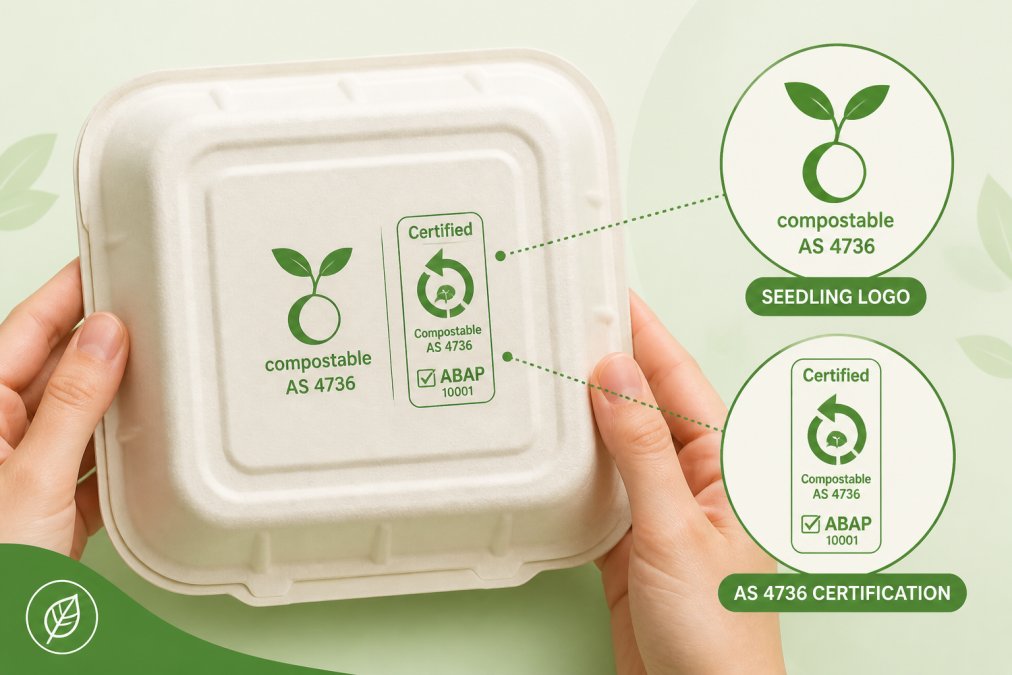
The seedling logo is the most reliable visual indicator of certified compostable packaging. It's a small, green symbol showing a seedling sprouting from the earth, meaning the packaging has been independently tested and certified to meet recognised compostability standards, primarily AS 4736 in Australia.
The seedling logo doesn't appear on all compostable packaging. Some manufacturers claim their products are "compostable" without certification. The certified seedling logo is your assurance that the packaging meets specific, measurable requirements. Look for it on the packaging itself, usually on the base, back, or inside of the container, often accompanied by the certification standard and sometimes a unique certification number.
Reading certification standards on packaging
Beyond the seedling logo, certified compostable packaging displays one or more certification standards. AS 4736 and AS 5810 are the two Australian standards you'll encounter most frequently. Understanding the difference is crucial because they indicate different composting conditions.
AS 4736 certifies packaging for industrial composting, the large-scale facilities that councils typically use. AS 5810 certifies packaging for home composting, which often takes longer to break down and requires specific conditions not always present in backyard compost heaps. Some packaging is certified to both standards, making these the most versatile options. Packaging certified only to AS 5810 is unsuitable for council FOGO bins.
When reviewing packaging, look for the specific standard number printed alongside the seedling logo. This tells you exactly where the packaging can be safely composted.
AS 4736 Compostable Certification: The Standard That Matters
Industrial versus home compostable
The distinction between industrial and home compostable is the most important factor determining whether your packaging will actually be processed in your council's FOGO system. Industrial compostable packaging (AS 4736) breaks down in large-scale facilities within 12 weeks at temperatures above 58°C. Home compostable packaging operates under different assumptions, lower temperatures, longer timescales, different moisture conditions.
Councils don't accept home compostable packaging because their facilities aren't designed for it. An industrial composting facility processes hundreds of tonnes of material daily on tight schedules. Home compostable packaging would still be decomposing long after the facility has finished its processing cycle.
When sourcing compostable packaging for your business, verify the certification is AS 4736 specifically. This is the only standard that guarantees compatibility with council processing systems.
What happens in a processing facility
When organic waste arrives at a processing facility, it's fed into large composting systems, typically windrows or in-vessel reactors. The facility maintains these systems at specific temperatures and moisture levels to accelerate decomposition. Temperature is maintained at 55-65°C, which is hot enough to break down certified compostable packaging.
After the active composting phase, the material moves to a curing phase where it stabilises. The finished compost is then screened to remove contaminants before being sold or distributed. Compostable packaging certified to AS 4736 is designed to fully break down during this entire process.
Checking Your Local Council's Specific Waste Guidelines
Step 1: Find your council's waste management page
Start by visiting your local council's official website. Most councils have a dedicated waste management or environmental services section. Search for terms like "waste guidelines," "FOGO," "organic waste," or "green bin." If you can't locate it through navigation, use the site's search function.
Step 2: Look for their FOGO or organic waste policy
Once you've found the waste management section, locate the specific FOGO or organic waste guidelines. Most councils publish a list of acceptable and unacceptable items. Pay close attention to how the policy describes compostable items. Some councils explicitly state "compostable packaging is not accepted," while others use general language like "only food scraps and garden waste."

Step 3: Contact your council directly if guidance is unclear
If the published guidelines don't clearly address compostable packaging, contact your council's waste management team directly. Ask: "Are certified compostable food containers (AS 4736) accepted in FOGO bins?" Be specific about the certification standard to prevent confusion between home and industrial compostable products. Document the response for future reference.
The Impact of Contamination in Organic Waste Streams
Contamination in organic waste streams is the silent killer of composting programs. A small amount of contamination, pieces of plastic, compostable packaging fragments, or non-organic items, can render an entire batch of compost unusable. When compost is contaminated with plastic fragments or undecomposed compostable packaging, it can't be sold to landscapers or agricultural operations.
The financial impact is significant. Processing contaminated compost requires additional screening and manual labour. If contamination levels exceed acceptable thresholds, the entire batch may need to be diverted to landfill. This is why councils restrict compostable packaging from FOGO bins. If your council doesn't accept compostable packaging, using it doesn't make your business more sustainable, the packaging still ends up in landfill, either directly or after being separated as contamination.
Alternative Disposal Methods for Compostable Packaging
Home composting as a backup option
If your council doesn't accept compostable packaging in FOGO bins, home composting is viable only if you're using packaging certified to AS 5810 (home compostable) or certified to both AS 4736 and AS 5810. Home compostable packaging requires active management, adequate moisture, regular turning, and a mix of carbon-rich and nitrogen-rich materials. Under these conditions, it typically breaks down within 6-12 months.
The limitation is scale. Home composting works for a small cafe or restaurant with dedicated space and effort. For larger operations or mobile food businesses, it isn't practical.
Commercial composting facilities outside council collection
Several commercial composting facilities operate independently of council waste streams and accept compostable packaging directly. Some facilities specialise in compostable materials and have optimised their systems specifically for plant-based packaging. Search for "commercial composting near me" or check with industry bodies like the Compost Connect network. These facilities typically charge a fee but provide certainty that your compostable packaging will be processed correctly.
Making Compostable Packaging Work for Your Business
Compostable packaging only delivers environmental benefits if it's actually composted. If your council doesn't accept it in FOGO bins and you don't have access to commercial composting, compostable packaging becomes just another material heading to landfill.
Before switching to compostable packaging, verify your council's acceptance policy. This single step prevents costly mistakes and ensures your packaging choice aligns with your sustainability goals. If your council doesn't accept compostable packaging, explore alternatives: commercial composting facilities, home composting if you have the space and capacity, or reusable options.
At Biodegradable Packaging AU, we work with businesses across Australia to navigate these complexities. Our certified compostable packaging is AS 4736 certified, designed specifically for industrial composting systems. We also help you verify council acceptance before committing to a supplier change. If your council does accept certified compostable packaging, the environmental case is compelling. Diverting both food scraps and packaging from landfill significantly reduces methane emissions and supports the circular economy.
For businesses in the Melbourne metro area looking to transition to certified compostable packaging, Biodegradable Packaging AU offers free delivery on orders over $200. Our 50L Bioplastic Bag, 80L Bioplastic Bag, 120L Bioplastic Bag, and 240L Bioplastic Bag are all made from plant-based Ecopond bioplastic, certified compostable, and designed to work seamlessly with certified composting systems. We also offer custom branded packaging options and premium stainless steel reusable cups for businesses wanting to reduce packaging waste further.


The decision to adopt compostable packaging is ultimately about ensuring the material reaches the right endpoint. Verify council acceptance, understand the certification standards, and choose suppliers who can prove their products meet AS 4736 requirements. When you get these details right, compostable packaging becomes a genuine environmental win rather than a greenwashing exercise.
Compostable packaging only works if your council actually accepts it. Many businesses discover too late that their local facility doesn't process compostable materials, leaving them stuck with higher-cost packaging that still ends up in landfill. Get clarity on your council's specific guidelines before making the switch. At Biodegradable Packaging AU, we help cafes and restaurants across Australia navigate these rules and source certified compostable packaging that actually gets processed. Explore our range of plant-based, AS 4736 certified packaging solutions and discover how to make sustainability work for your business operations.
Frequently Asked Questions
Are compostable plastics accepted in FOGO bins?
Not always. Most councils explicitly reject compostable packaging from FOGO bins because it breaks down too slowly in industrial composting facilities and can contaminate the organic waste stream. Even certified compostable packaging labelled AS 4736 may be rejected by your local council. Always check your specific council's FOGO guidelines before assuming compostable items are accepted, rules vary significantly across different regions.
How can I tell if my packaging is certified compostable?
Look for the seedling logo and certification standards printed on the packaging. Certified compostable packaging in Australia should display AS 4736 (industrial compostable) or AS 5810 (home compostable) standards. Check the fine print on the base or side of the container. If you cannot find these markings, contact your supplier. Biodegradable Packaging AU's certified compostable products carry these certifications and are made from plants rather than oil-based plastics.
Why do some councils reject compostable packaging?
Councils reject compostable packaging because it contaminates organic waste streams. Industrial composting facilities operate on tight timescales, typically 12 weeks, and certified compostable items may not fully break down in that window. Contamination slows processing, reduces compost quality, and increases facility costs. Many councils treat compostable packaging the same as conventional plastic, sending it to landfill rather than risking contamination in their composting operations.
What's the difference between industrial and home compostable packaging?
Industrial compostable packaging (AS 4736) breaks down in commercial composting facilities at high temperatures and controlled conditions within 12 weeks. Home compostable packaging (AS 5810) breaks down in backyard compost heaps over several months. Most councils reject both types from FOGO bins, but home compostable packaging is suitable for your own garden waste bin if your council permits it. Check your local guidelines to confirm which, if either, your council accepts.
This article was written using GrandRanker