Compostable vs Recyclable Packaging for Cafes: 2026 Guide
September 7, 2026 · Editorial Team

Table of Contents
- Compostable vs Recyclable Packaging: What's the Real Difference?
- Quick Comparison Table: Compostable vs Recyclable for Cafes
- Why AS 4736 Compostable Certification Matters for Your Cafe
- Australian Recycling Infrastructure Limitations: Why Composting Often Wins
- How to Dispose of Compostable Coffee Cups the Right Way
- Cost Analysis: Compostable vs Recyclable Packaging
- Making the Switch: What Your Cafe Should Do Next
- Conclusion
- Frequently Asked Questions
Last Updated: September 7, 2026
Compostable vs Recyclable Packaging: What's the Real Difference?
The decision between compostable and recyclable packaging for cafes comes down to one question: what happens after the customer throws it away? Compostable packaging is designed to break down into nutrient-rich soil under specific composting conditions, while recyclable packaging is reprocessed into new materials through established recycling streams. The answer is rarely as simple as "green is good."
Most cafe owners assume recyclable is the safer bet because recycling infrastructure feels familiar. The reality is more complicated. For food-soiled packaging, which is most takeaway waste, recyclable materials often fail at the sorting stage, while certified compostable packaging can carry both the food and the container into a single waste stream. The choice matters because it determines whether your packaging actually diverts waste or quietly ends up in landfill.
Below, we'll break down the certification standards, infrastructure realities, disposal methods, and true costs so you can make a decision that works for your business and your customers.
Quick Comparison Table: Compostable vs Recyclable for Cafes
Compostable packaging is the stronger choice for food-based waste, while recyclable packaging suits dry, clean items like cardboard sleeves or unsoiled containers. The table below summarises how each option performs across the factors that matter most in a busy cafe environment.
| Factor | Compostable | Recyclable |
|---|---|---|
| Handles food contamination | Yes, composted with food waste | No, contamination ruins batches |
| Certification standard | AS 4736 (industrial) | Varies by material |
| Home compostable options | Limited, specific products | Not applicable |
| Local council acceptance | Growing, check your council | Established but limited for food |
| Best use case | Hot drinks, food containers | Clean cardboard, some lids |
| End-of-life outcome | Becomes soil | Becomes new materials |
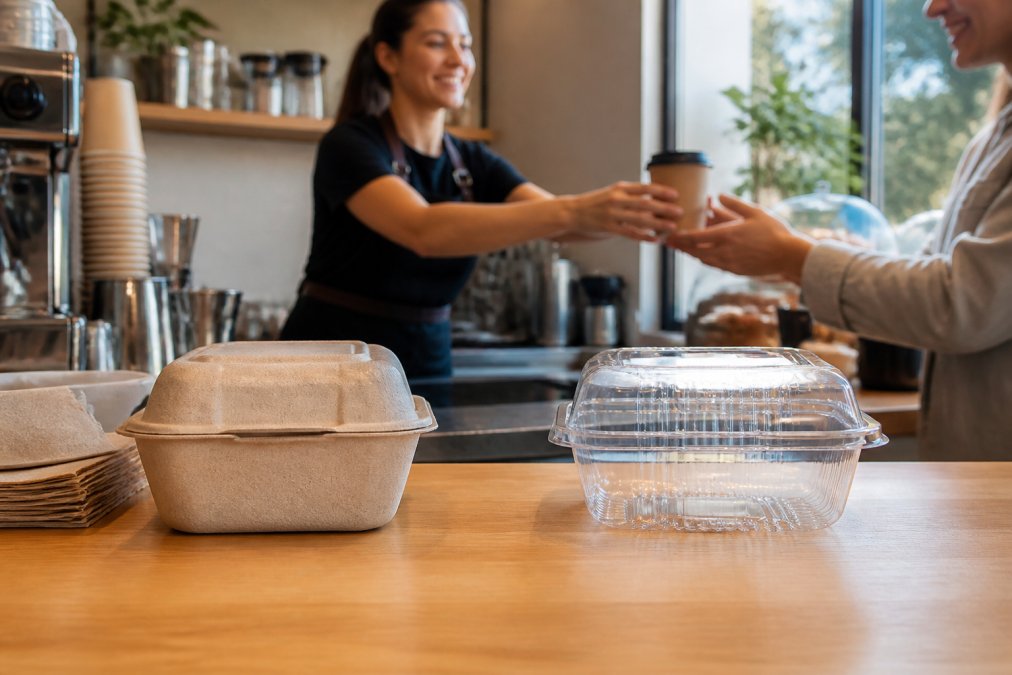
The critical distinction is contamination. A recyclable cup smeared with coffee grounds contaminates the entire recycling batch at the material recovery facility. Compostable packaging, by contrast, is designed to break down alongside the food residue it carries.
Why AS 4736 Compostable Certification Matters for Your Cafe
AS 4736 is the Australian standard for industrially compostable packaging, and it is your first line of defence against greenwashing. Packaging bearing this certification has been independently tested to break down within a set timeframe under commercial composting conditions, leaving no toxic residue behind.
The standard matters because the term "biodegradable" is unregulated and meaningless in practice. A plastic bag labelled biodegradable can take decades to break down in landfill, where oxygen and moisture are scarce. AS 4736 certification, by contrast, verifies that the material will fully compost in an industrial facility, giving you a verifiable environmental claim you can make to customers.
When you buy certified packaging, you are also protecting yourself from regulatory risk. Australian waste management standards are tightening, and councils are increasingly auditing commercial waste streams. Packaging that cannot demonstrate a genuine end-of-life solution is becoming a liability.
Australian Recycling Infrastructure Limitations: Why Composting Often Wins
Australian recycling infrastructure simply does not handle food-contaminated packaging well. Most material recovery facilities are designed to sort clean, dry recyclables, and a single greasy container can ruin an entire batch of otherwise recyclable paper or cardboard.
This is where the compostable vs recyclable packaging for cafes debate tilts toward composting. A coffee cup with residual coffee, a takeaway container with sauce, a wrapper with food crumbs: these are the daily realities of a cafe. When that waste goes into a recycling bin, it often ends up diverted to landfill because the contamination rate makes reprocessing uneconomic.
Composting infrastructure, while still developing, is expanding through commercial composting services and council food organics programs. The key is mapping your local waste infrastructure before you commit. Check which councils in your area accept compostable packaging, whether a commercial composter operates nearby, and what certification they require.
- Contact your local council's waste team and ask about commercial composting acceptance
- Confirm whether your waste contractor offers a food organics collection service
- Verify which certification standards your local composter accepts (AS 4736 is the common baseline)
The Australian Government's circular economy guidance highlights that improving waste diversion requires matching packaging choices to available recovery infrastructure, rather than assuming all "sustainable" options work everywhere.
How to Dispose of Compostable Coffee Cups the Right Way
Compostable coffee cups only deliver their environmental benefit if they reach the right facility. An AS 4736 certified cup sent to landfill behaves much like a regular cup, breaking down slowly without oxygen and releasing methane in the process.
The correct disposal route is a commercial composting facility. These facilities maintain the high temperatures, moisture levels, and microbial activity needed to break down compostable packaging within the required timeframe. Your role as a cafe owner is to ensure the cups enter that system, not the general waste bin.
This requires a visible in-store system. Place dedicated bins for compostable packaging and food waste, clearly labelled with what can and cannot go in. Train your staff so they know the difference between compostable, recyclable, and landfill waste, and can guide customers who ask.
A common mistake is assuming customers will sort waste correctly without guidance. Contamination rates and "wish-cycling," where people toss items into bins hoping they are recyclable or compostable, undermine the entire system. Clear signage and staff training are not optional extras; they are the mechanism that makes compostable packaging work.
Cost Analysis: Compostable vs Recyclable Packaging
Compostable packaging typically carries a higher unit cost than conventional recyclable plastic, and pretending otherwise does not help anyone budget. However, the comparison is not as simple as shelf price, because the two options serve different waste streams and carry different reputational value.
For a small cafe running on tight margins, the cost gap can feel significant. A common approach is to phase in compostable packaging for high-volume, food-contact items like coffee cups and takeaway containers, while keeping recyclable options for dry goods where contamination is not a concern. This hybrid model controls costs while moving the majority of your waste toward composting.
The National Packaging Targets and waste reduction framework signals that regulatory pressure on single-use plastics will continue to grow, meaning the cost of non-compliance may eventually outweigh the premium for certified packaging. Forward-thinking cafe owners factor this into their decision.
| Packaging Type | Relative Cost | Best Application |
|---|---|---|
| Certified compostable cups | Higher unit cost | Hot drinks, food containers |
| Recyclable PET lids | Moderate cost | Cold drinks, dry items |
| Conventional plastic | Lowest cost | Short-term only, regulatory risk |
For cold food items, Biodegradable Packaging AU offers recyclable rPET lids, such as the 280-630ml Clear RPET Takeaway Lid at $88.25, which are accepted in most council recycling streams. This gives you a cost-effective option where compostability is not required.

Making the Switch: What Your Cafe Should Do Next
Start with a waste audit. For one week, sort your outgoing waste into food, compostable packaging, recyclable packaging, and general landfill. You will quickly see where the volume sits and which packaging choices drive your waste costs. This data tells you where compostable packaging delivers the most value.
Next, verify your supply chain. Ask your packaging supplier for their certification documentation and confirm which composting services accept their products. Supply chain transparency matters because a certified product is only useful if there is a facility that will process it. At Biodegradable Packaging AU, we provide certified compostable options like the 120ml / 4oz Leaf Single Wall BioCup at $134.65, lined with plant-based bioplastic and certified for industrial composting.

Staff training is the final piece. Your team must know which bin each item belongs in, why it matters, and how to answer customer questions. A well-trained team turns your packaging investment into a customer-facing sustainability story, and many businesses find that customers respond positively to visible environmental commitment.
- Conduct a one-week waste audit to identify contamination hotspots
- Request certification documentation from your current supplier
- Confirm your local composter accepts AS 4736 certified packaging
- Train staff on correct waste sorting and customer communication
The standards for compostable plastics in Australia provide a clear reference point for verifying claims. If your supplier cannot produce certification, that is a red flag.
Conclusion
Choosing between compostable and recyclable packaging for cafes is not about picking the universally "greenest" option. It is about matching your packaging to the waste infrastructure that actually exists in your area and the type of waste your cafe produces. Food-contaminated packaging belongs in the composting stream, while clean, dry materials can be recycled.
The regulatory landscape is moving toward stricter waste management requirements, and certified compostable packaging positions your cafe ahead of these changes. Biodegradable Packaging AU supports this transition with certified compostable products, custom brand packaging options, and free Melbourne metro delivery on orders over $200. Our team helps you divert waste from landfill and support the circular economy with packaging that performs.
Get started with Biodegradable Packaging AU and move your cafe toward a genuinely sustainable packaging system.
Frequently Asked Questions
What are the downsides of compostable packaging?
The main downside is that most compostable packaging requires industrial composting facilities, which may not be available in your area. If it ends up in landfill, it may not break down properly. It can also cost more than conventional plastic or recyclable alternatives. Check that your packaging carries AS 4736 certification to ensure it meets Australian standards for compostability.
How do I verify if packaging is certified compostable in Australia?
Look for the AS 4736 certification logo on the packaging. This Australian standard verifies that packaging will break down in a commercial composting facility within 180 days. You can also ask your supplier for their certificate of compliance and check the Australasian Bioplastics Association's list of certified products. Packaging from brands like Biodegradable Packaging AU displays this certification clearly.
What is the most environmentally friendly food packaging for a cafe?
The most environmentally friendly option depends on your local waste infrastructure. Compostable packaging made from bagasse or certified paper cups is ideal if you have access to an industrial composter. Recyclable packaging works better when your council accepts it in the recycling stream. The key is choosing packaging that actually gets processed, not just packaging that claims to be eco-friendly.
Can compostable coffee cups go in the recycling bin?
No. Compostable coffee cups should never go in the recycling bin. They are designed to break down in industrial composting facilities, not to be reprocessed with paper or plastic. If you put them in recycling, they contaminate the recycling stream and can cause whole batches of recyclables to be sent to landfill. Always dispose of certified compostable cups through a commercial composting service.