Compostable vs Biodegradable Packaging Explained
August 11, 2026 · Grandranker

Table of Contents
- What Compostable vs Biodegradable Packaging Actually Means
- Key Differences: Decomposition, Residues, and Environmental Impact
- AS 4736 Certification and Australian Composting Standards
- FOGO Bin Requirements Australia: What Actually Gets Accepted
- Greenwashing in Packaging: How to Spot False Claims
- Compostable vs Biodegradable Packaging: Pros, Cons, and When to Choose Each
- A Practical Disposal Guide for Australian Hospitality Operators
- Conclusion
Last Updated: August 10, 2026
What Compostable vs Biodegradable Packaging Actually Means
The terms "compostable" and "biodegradable" appear on packaging constantly, yet they describe fundamentally different processes with very different environmental outcomes. At Biodegradable Packaging AU, we work with cafe owners, caterers, and hospitality operators across Australia every day, and the confusion between these two terms is one of the most common barriers to making genuinely sustainable choices.
Compostable vs biodegradable packaging is not just a semantic debate. The distinction determines whether your packaging diverts waste from landfill or simply breaks down more slowly inside it. Below, we cover exactly how each material works, what Australian certification standards require, and how to make a practical decision for your business.
Defining Biodegradable Packaging
Biodegradable packaging is any material that can be broken down by microorganisms, bacteria, or fungi into natural elements over time. The critical word here is "time." There is no regulated timeframe attached to the term in Australia. A product labelled biodegradable might break down in six months or sixty years, depending on the material and the environment it ends up in.
This lack of regulation is the central problem. Conventional plastic technically biodegrades over hundreds of years. Some bio-based materials require industrial heat and humidity to break down at all. In a landfill, where oxygen is scarce, many biodegradable materials undergo anaerobic digestion instead, producing methane, a greenhouse gas far more potent than carbon dioxide. Some materials also leave behind toxic residues or microplastics rather than returning cleanly to the soil.
Defining Compostable Packaging
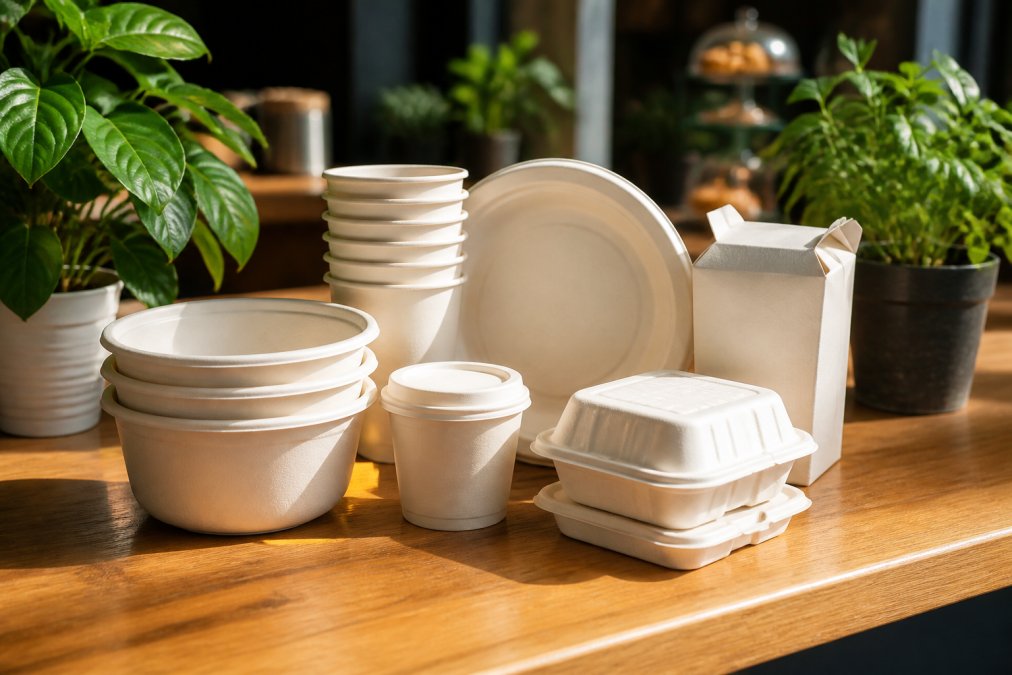
Compostable packaging is a specific subset of biodegradable materials that meets defined performance standards. To be certified compostable, a product must break down within a set timeframe into carbon dioxide, water, and biomass, leaving no toxic residues and no visible fragments. The resulting compost must be beneficial to soil health, not harmful to it.
Compostable packaging is typically made from bio-based materials such as polylactic acid (PLA) derived from cornstarch, sugarcane bagasse, bamboo, or other plant-based feedstocks. These biopolymers are designed to break down under specific conditions, either in industrial composting facilities or, for products meeting a higher standard, in home compost environments. Certified compostable packaging can enter the organic waste stream and contribute to a circular economy, whereas biodegradable-only packaging generally cannot.
Key Differences: Decomposition, Residues, and Environmental Impact
Decomposition Timeframes and Breakdown Environments
Under Australian standard AS 4736, a compostable product must disintegrate within 12 weeks and fully biodegrade within 180 days in an industrial composting environment, which operates at sustained temperatures above 55°C with controlled humidity and aeration.
Home compostable certification under AS 5810 applies a lower temperature threshold, reflecting the ambient conditions of a backyard compost bin, and requires breakdown within 26 weeks. This is a meaningfully harder standard to meet for many materials.
Biodegradable-only packaging has no equivalent benchmark. The breakdown environment is undefined, which means a product marketed as biodegradable might require industrial heat to break down, perform poorly in soil, and fail entirely in a landfill or ocean environment. According to Australian Competition and Consumer Commission guidance on environmental claims, vague claims like "biodegradable" without qualification can mislead consumers, and businesses making such claims need to be able to substantiate them.
Microplastics, Toxic Residues, and Soil Health
Some materials marketed as biodegradable, particularly oxo-degradable plastics, do not biodegrade in any meaningful sense. They fragment into smaller pieces under UV exposure, eventually producing microplastics that persist in soil and waterways for decades. The European Union has moved to restrict oxo-degradable plastics on these grounds, and Australian regulators have noted similar concerns.
Certified compostable packaging avoids this problem by design. The certification process requires that no ecotoxic residues remain after composting and that the resulting material does not inhibit plant growth. For hospitality operators, if your packaging ends up in the wrong bin or in the environment, biodegradable-only products can cause more harm than their labelling suggests. Certified compostable products carry a verifiable performance guarantee.
AS 4736 Certification and Australian Composting Standards
AS 4736 certification is the benchmark for industrial compostability in Australia. It specifies that certified products must disintegrate to fragments smaller than 2mm within 12 weeks, achieve at least 90% biodegradation within 180 days, and leave no toxic residues in the resulting compost. Products carrying the AS 4736 certification are eligible for industrial composting streams, including FOGO bins where councils accept them.
The seedling logo, administered internationally through certification bodies, is one of the most recognised marks for compostable packaging. In Australia, the Australasian Bioplastics Association (ABA) manages certification against both AS 4736 and AS 5810.
Industrial Composting vs Home Compostable Standards
Industrial composting facilities maintain high temperatures, controlled moisture, and regular turning. These conditions allow PLA and other biopolymers to break down within the certified timeframe. Without those conditions, a certified industrial compostable product may sit largely intact in a home compost bin for years.
Home compostable certification, AS 5810, requires breakdown at lower temperatures typical of a backyard environment. Products meeting this standard can go into a home compost bin, a FOGO bin, or an industrial facility. For hospitality businesses, the practical question is: what composting infrastructure does your local council actually support? The answer determines which certification level is actually useful to you.
| Certification | Standard | Temperature Required | Breakdown Timeframe | Suitable For |
|---|---|---|---|---|
| Industrial Compostable | AS 4736 | 55°C+ (industrial) | 180 days | FOGO bins, compost facilities |
| Home Compostable | AS 5810 | Ambient (backyard) | 26 weeks | Home compost, FOGO bins |
| Biodegradable (uncertified) | No Australian standard | Variable | Undefined | No guaranteed stream |
| Oxo-degradable | Not certified | UV/heat dependent | Fragments into microplastics | Not suitable for any stream |
FOGO Bin Requirements Australia: What Actually Gets Accepted
FOGO stands for Food Organics and Garden Organics. The FOGO bin requirements in Australia vary significantly by council. Many councils accept certified compostable packaging in their FOGO bins, provided the packaging carries AS 4736 or AS 5810 certification. However, acceptance is not universal. Some councils only accept food scraps and garden waste, while others accept certified compostable serviceware but not packaging films or bags.
The Australian Government's National Waste Policy Action Plan has set targets for expanding FOGO collection nationally, with a goal of all Australians having access to food waste collection services. Progress varies by state and territory, and metropolitan areas generally have more mature infrastructure than regional ones.
Even certified compostable packaging ends up in landfill if the local waste management infrastructure cannot process it. For hospitality operators, the most responsible approach is to:
- Confirm your local council's FOGO acceptance criteria before switching packaging
- Use only AS 4736 or AS 5810 certified products for any organic waste stream claim
- Never place packaging labelled only "biodegradable" into a FOGO or green bin
- Partner with a composting service if council collection is unavailable
Compost Connect can help businesses identify local composting options where council infrastructure falls short.
Greenwashing in Packaging: How to Spot False Claims
Greenwashing in packaging is widespread, and the hospitality sector is particularly exposed to it. The most common pattern is using the word "biodegradable" without any certification, timeframe, or conditions attached. Under the Australian Consumer Law, misleading environmental claims can attract significant penalties. Businesses purchasing packaging are not immune: if you repeat a supplier's unsubstantiated claim to your customers, you may share liability.
Red flags to watch for when evaluating packaging suppliers:
- "Biodegradable" with no certification mark or standard cited
- "Eco-friendly" or "green" with no specific environmental attribute
- Claims of compostability without AS 4736 or AS 5810 certification
- "Plant-based" used as a proxy for compostable (plant-based materials can still be non-compostable)
- Certification logos that do not correspond to any recognised Australian or international standard
The honest question to ask any supplier is: which certification body has tested and verified this product, and against which standard? A credible answer names a specific standard and a specific certifier.
Compostable vs Biodegradable Packaging: Pros, Cons, and When to Choose Each
The right choice depends on your waste infrastructure, your product requirements, and your sustainability goals.
Certified compostable packaging:
Pros: Verified breakdown performance under defined conditions; eligible for organic waste streams where infrastructure exists; no microplastic formation; contributes to soil health when composted correctly; supports a genuine circular economy outcome.
Cons: Requires access to industrial composting or home composting infrastructure; generally carries a shorter shelf life than conventional plastic; some products require specific temperature and humidity to break down; costs more than conventional alternatives.
Biodegradable-only packaging:
Pros: Often lower cost than certified compostable alternatives; wider material options available.
Cons: No regulated timeframe or conditions for breakdown; can produce microplastics if oxo-degradable; not accepted in FOGO or organic waste streams; greenwashing risk if claims are not substantiated; may produce methane in landfill conditions.
Lifecycle Assessment Considerations for Australian Businesses
A lifecycle assessment (LCA) looks at the full environmental impact of a material from raw material extraction through to end-of-life disposal. For Australian hospitality businesses, the LCA picture for compostable packaging is generally favourable compared to conventional plastic, provided the product actually reaches a composting facility.
The carbon footprint of producing plant-based packaging materials is typically lower than virgin petroleum-based plastics. This environmental advantage is only realised, however, if the end-of-life pathway works. Certified compostable packaging sent to landfill loses most of its environmental benefit. Businesses that pair certified compostable products with access to composting services, whether through council FOGO collection or a private composting partner, achieve the best environmental outcome.
A Practical Disposal Guide for Australian Hospitality Operators
Step 1: Check your council's FOGO acceptance criteria. Search your council's website for "FOGO" or "food organics" and confirm whether certified compostable packaging is accepted. Note the specific certification standard required.
Step 2: Only purchase AS 4736 or AS 5810 certified products for any organic waste stream. If your council accepts certified compostable packaging, buy products with visible certification marks tied to these Australian standards. Keep supplier documentation on file.
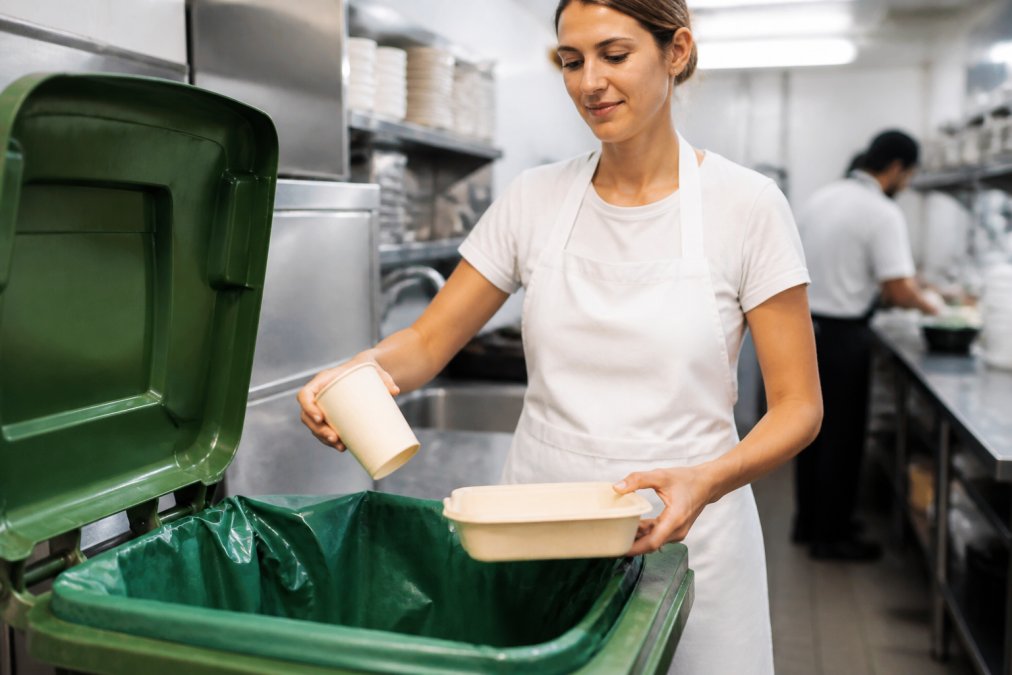
Step 3: Set up a separate collection point for compostable packaging. Use a clearly labelled bin for certified compostable serviceware and food scraps. Contamination from conventional plastic or non-certified packaging will undermine the whole stream.
Step 4: If council collection is unavailable, engage a private composting service. Services like Compost Connect can collect certified compostable waste directly from hospitality businesses.
Step 5: Never place biodegradable-only packaging into the FOGO or green bin. Only certified compostable products belong in organic waste streams. Biodegradable-only packaging goes to general waste.
Step 6: Train your team. Disposal errors are almost always a training issue. A five-minute briefing on which bin receives which product type prevents contamination and protects your composting access.
For hospitality operators across Australia, Biodegradable Packaging AU supplies certified compostable foodservice packaging made from plant-based materials, with access to composting service connections through partners like Compost Connect. Custom branding options are available, and free Melbourne metro delivery applies on qualifying orders.
The real challenge for Australian hospitality operators is not choosing between compostable and biodegradable packaging. It is building a disposal pathway that makes the choice matter. Certified compostable packaging without a composting outlet is a better story than conventional plastic, but it falls short of the circular economy outcome your business is aiming for. Biodegradable Packaging AU offers certified compostable foodservice packaging, plant-based materials, and connections to local composting services so your packaging investment translates into a genuine environmental result. Get started with Biodegradable Packaging AU and put your waste diversion strategy on solid ground.
Frequently Asked Questions
What is the main difference between biodegradable and compostable packaging?
Biodegradable packaging breaks down over time through microbial action, but there is no regulated timeframe or guarantee about what remains after breakdown. Compostable packaging meets specific standards, such as AS 4736 in Australia, requiring it to break down within a set period under composting conditions, leave no toxic residues, and support soil health. All certified compostable packaging is biodegradable, but not all biodegradable packaging is compostable.
Does 100% biodegradable mean compostable?
No. The term 'biodegradable' has no regulated definition in Australia, so a product labelled 100% biodegradable carries no guarantee about how quickly it breaks down, where it breaks down, or what residues it leaves behind. Compostable packaging, by contrast, must meet Australian Standards such as AS 4736 (industrial) or AS 5810 (home composting) to carry that claim legitimately. Without certification, biodegradable claims should be treated with caution.
Why are some compostable bags not accepted in council FOGO bins?
Many councils only accept packaging certified to AS 4736, which confirms the material breaks down correctly in industrial composting facilities. Bags certified only to AS 5810 (home compostable) or those carrying unverified biodegradable claims may not break down quickly enough in a commercial compost facility, contaminating the batch. Always check your local council's accepted materials list and look for the Australasian Bioplastics Association seedling logo before placing packaging in a FOGO bin.
How do I identify certified compostable packaging in Australia?
Look for the Australasian Bioplastics Association (ABA) seedling logo on the packaging, which indicates certification to AS 4736 for industrial composting or AS 5810 for home composting. You can also verify certification directly through the ABA's certified products database. Avoid packaging that uses terms like 'eco-friendly', 'plant-based', or 'biodegradable' without a recognised certification mark, as these claims are not independently verified and may constitute greenwashing.
What does the Australian Standard AS 4736 signify?
AS 4736 is the Australian Standard for packaging designed to break down in industrial or commercial composting facilities. To meet this standard, a material must biodegrade at least 90% within 180 days, disintegrate so that no more than 10% remains on a 2mm sieve, leave no toxic residues harmful to plants or soil, and not exceed heavy metal limits. It is the benchmark certification Australian councils and composting facilities use when deciding which packaging to accept in commercial organics streams.
What are the downsides of compostable packaging for Australian hospitality businesses?
Certified compostable packaging typically costs more than conventional plastic alternatives. It also has a limited shelf life, generally 12 months or less, meaning stock management matters. Most certified compostable foodservice packaging requires access to a commercial composting facility to break down correctly; without that infrastructure, it may end up in landfill where it performs no better than conventional plastic. Checking that your local council or a composting service provider accepts the material before committing to a product range is essential.
This article was written using GrandRanker