Compostable Takeaway Packaging Wholesale
August 15, 2026 · Grandranker
Table of Contents
- Why Compostable Takeaway Packaging Matters for Your Business
- Plant-Based BioCane Containers for Food Service
- BioBoard Boxes: FSC-Certified Paper-Based Solutions
- AS 4736 Compostable Certification: What It Means for Your Supply Chain
- Home Compostable vs Industrial Compostable: Which Works for Your Business
- Wholesale Pricing, Bulk Orders, and Delivery Options
- Cost-Benefit Analysis: Making the Sustainable Switch Affordable
- Disposal and Composting Logistics for Food Businesses
Why Compostable Takeaway Packaging Matters for Your Business
Compostable takeaway packaging is becoming a practical necessity for food businesses across Australia. If you're running a cafe, restaurant, or catering operation, the shift toward sustainable packaging affects your bottom line, brand reputation, and ability to meet evolving customer expectations.
The challenge isn't whether to switch, but how to do it affordably without compromising durability. Many business owners assume sustainable means expensive or flimsy. That assumption costs them customers who increasingly expect better environmental choices. Early movers gain a competitive edge: they attract sustainability-minded customers, reduce landfill footprint, and future-proof against tightening regulations.
Below, we'll walk you through certified options available in Australia, explain the regulatory landscape, and show you how to calculate whether compostable packaging makes financial sense for your operation.
Plant-Based BioCane Containers for Food Service
Plant-based BioCane containers are made from rapidly renewable sugarcane pulp, a by-product of sugar refining. They're microwave and oven-friendly, leak-resistant, and certified compostable. For food businesses, they're the workhorse option: durable enough for hot meals, professional enough for branded service, and genuinely compostable at industrial facilities.
BioCane holds up to real-world use: hot soups, curries, baked goods, and wet salads don't compromise container integrity, unlike some compostable alternatives that feel flimsy or stain easily.
3-Compartment Clamshells and Bases
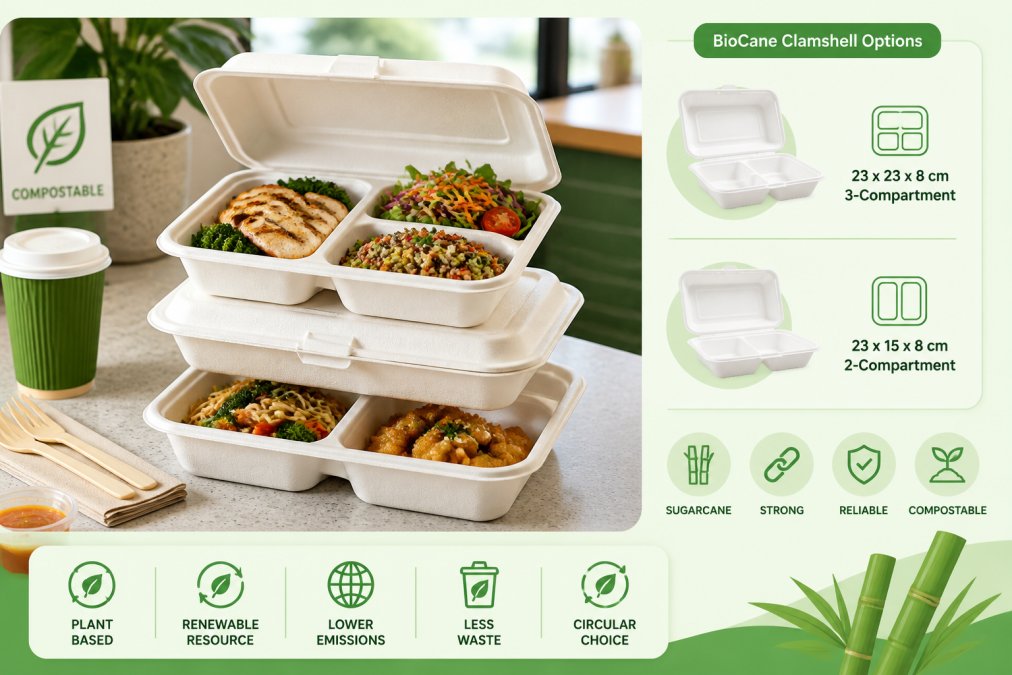
The 23x23x8cm 3-Compartment White Plant Fibre Clamshell at $88.65 per unit is ideal for meal prep services, catering, and takeaway restaurants needing to separate different foods. The three compartments prevent flavour mixing and keep portions distinct, essential for mixed meals. It's rigid enough to stack during transport, doesn't absorb grease, and handles both hot and cold foods without warping.

For operations needing flexibility, rectangular BioCane containers come in three sizes. The 750ml White Plant Fibre Takeaway Base at $119.65 handles individual meals and lunch portions. The 1,000ml Natural Plant Fibre Takeaway Base at $142.00 works for larger portions or family-sized orders. Both are microwave and oven-safe. The 2-Compartment Natural Plant Fibre Takeaway Base at $149.65 adds flexibility without the bulk of a clamshell. Pair any base with the 2 & 3-Compartment White Plant Fibre Takeaway Lid at $144.10 to create a complete, sealed package.


Compartment Trays for Catering
The 6-Compartment Plant Fibre Tray at $90.25 is purpose-built for catering operations needing to portion multiple items on a single tray. It's microwave, fridge, and freezer-friendly, and ships without a lid, giving you flexibility to use your own covers or cling film. For high-volume catering, this reduces packaging costs while maintaining the compostable standard.
BioBoard Boxes: FSC-Certified Paper-Based Solutions
BioBoard containers are made from sustainably sourced FSC-certified paperboard lined with Ingeo, a bioplastic made from plants rather than oil. They're lighter than BioCane, better for branding with kraft-look printing, and fully compostable to AS 4736. The trade-off is they're not suitable for wet foods; they work best for dry goods, baked items, noodles, and hot foods where moisture is contained.
BioBoard is the premium choice if you want custom branding and elegant presentation. The kraft aesthetic appeals to modern food businesses positioning themselves as sustainable and artisanal.
Lunch Boxes and Noodle Containers
The Large BioBoard Lunch Box at $111.20 is perfect for prepared meal services, sushi boxes, and lunch delivery. The kraft-look printing gives a premium feel without custom setup costs. It's sturdy, stackable, and the FSC certification signals environmental responsibility to customers.
The 780ml / 26oz BioBoard Noodle Box at $156.45 is engineered for Asian noodle dishes, ramen, and hot soups. It's certified industrially compostable to AS 4736. The paperboard construction handles heat without stiffness, and the Ingeo lining prevents leakage.
Speciality Boxes and Trays
The Hot Dog BioBoard Box at $129.05 is essential for food trucks, street food vendors, and casual dining. It's simple, sturdy, and holds the right amount without excess packaging. The BioBoard Tray #1 at $73.90 is the most economical option for serving prepared foods, bakery items, or catering platters, available in both kraft and white.
AS 4736 Compostable Certification: What It Means for Your Supply Chain
AS 4736 is the Australian standard for industrially compostable packaging. If a product carries AS 4736 certification, an independent laboratory has tested it to ensure it breaks down completely in industrial composting facilities within 180 days, leaving no toxic residue. This is the gold standard for compostable takeaway packaging in Australia.
The distinction matters because "compostable" without certification is meaningless. AS 4736 certification removes the guesswork. When you buy certified packaging, you're buying a guarantee that your packaging will actually compost. Many of Biodegradable Packaging AU's products carry AS 4736 certification, allowing you to confidently tell customers the packaging will be processed at industrial composting facilities. This determines where your packaging goes after use: without certification, even well-intentioned composting programs may reject your packaging.
Home Compostable vs Industrial Compostable: Which Works for Your Business
Home compostable packaging breaks down in backyard compost heaps at ambient temperatures. Industrial compostable packaging breaks down in commercial facilities at high temperatures and controlled conditions. They require completely different material formulations.
Most takeaway packaging, including products Biodegradable Packaging AU offers, is industrially compostable. This is the practical choice for food businesses because it aligns with actual composting infrastructure: local councils operate industrial composting facilities, not home compost programs. Industrial compostable packaging is also more durable for food service, withstanding hot foods and transport without degrading prematurely.
The regulatory landscape is shifting toward industrial compostable as the standard. Councils across Australia increasingly accept industrially compostable packaging in their green waste streams, a trend that will accelerate.
Wholesale Pricing, Bulk Orders, and Delivery Options
Wholesale pricing for compostable takeaway packaging depends on order volume and product type. Biodegradable Packaging AU offers free Melbourne metro delivery on orders over $200. For businesses outside Melbourne, shipping costs will vary.
The per-unit cost of compostable packaging is higher than conventional plastic, but not by as much as many assume. A BioCane 3-compartment clamshell runs $88.65 per unit wholesale. A BioBoard noodle box runs $156.45 per unit. For context, comparable conventional plastic containers cost $0.30-$0.50 per unit at scale. The gap narrows significantly when you order in bulk.
Bulk ordering shifts the economics in favour of compostable packaging. Most suppliers offer better per-unit pricing at higher volumes. If you're ordering 1,000+ units, the cost per container drops noticeably. Minimum order quantities vary by product, but this makes the transition affordable for small to mid-sized operations.
| Order Volume | BioCane 3-Compartment | BioBoard Noodle Box | Delivery Cost (Melb Metro) |
|---|---|---|---|
| 100 units | $88.65 each | $156.45 each | Free (over $200) |
| 500 units | Lower per-unit cost | Lower per-unit cost | Free |
| 1,000+ units | Negotiable | Negotiable | Free |
Most suppliers can turn around standard orders within 1-2 weeks. Custom-branded packaging takes 4-6 weeks. Plan ahead or start with unbranded options while custom packaging is in production.
Cost-Benefit Analysis: Making the Sustainable Switch Affordable
The decision to switch hinges on whether the cost difference translates to business benefits that offset the price premium. Calculate your current packaging spend. If you're ordering 1,000 conventional plastic containers per month at $0.40 each, you're spending $400/month. Switching to compostable containers at $0.80-$1.00 each costs $800-$1,000/month, a $400-$600 monthly increase, or $4,800-$7,200 annually.
Now calculate offsetting benefits. Customers who choose your business because of sustainable packaging represent direct revenue. Research from Australian Sustainable Business Council shows environmentally conscious consumers are willing to pay a premium for sustainable options. If switching attracts even 5-10% more customers, that revenue gain can offset the packaging cost increase entirely.
Brand differentiation matters too. In competitive markets, sustainable packaging signals environmental responsibility. This matters especially for younger customers, corporate clients, or sustainability-focused neighbourhoods.
Regulatory tailwinds also apply. Several Australian states are tightening packaging regulations. According to Australian Government Department of Climate Change, Energy, Environment and Water, single-use plastic restrictions are expanding. Being ahead means you won't face forced transition later with limited supplier options.
For most food businesses, compostable packaging breaks even or generates modest profit within 12-18 months when you factor in customer acquisition, retention, and brand value. The math works better for businesses with higher margins (cafes, specialty food) than high-volume, low-margin operations. Calculate your customer acquisition cost, average customer lifetime value, and estimate what percentage of new customers you'd attract with sustainable packaging. If that number exceeds your annual packaging cost increase, the switch is financially justified.
Disposal and Composting Logistics for Food Businesses
Compostable takeaway packaging only delivers environmental benefit if it actually gets composted. Many businesses switch to certified containers but don't establish a disposal pathway, so packaging ends up in landfill anyway.
The logistics depend on your location and council's composting program. Most Australian councils accept industrially compostable packaging in their green waste streams, but not all. Before switching, contact your local council to confirm they accept AS 4736-certified packaging.
For businesses outside areas with industrial composting infrastructure, alternatives exist. Some councils operate drop-off composting programs. Others partner with private composting operators like Compost Connect, which operates across multiple Australian states and accepts industrially compostable packaging from businesses.
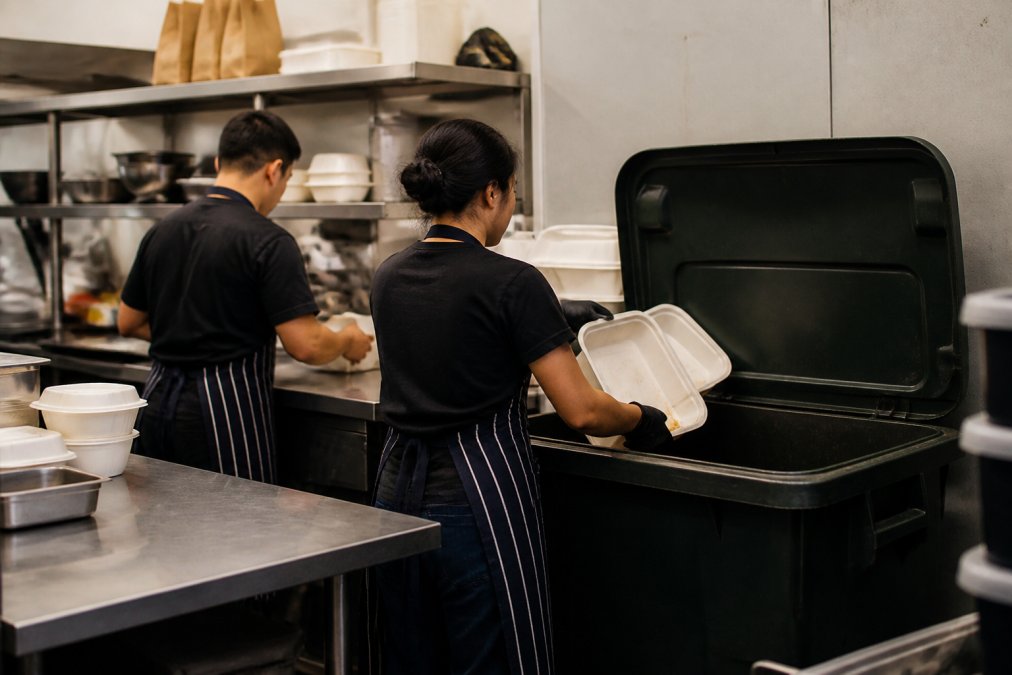
Create a separate collection bin for compostable packaging and train staff to place used containers there, not with general waste. This prevents contamination and ensures packaging reaches the composting facility. For small operations, a single bin suffices. The cost is minimal, just the bin and staff training. The benefit is significant: you can confidently tell customers their packaging will be composted, not landfilled.
Biodegradable Packaging AU provides guidance on local composting services and helps businesses establish disposal partnerships, removing guesswork and ensuring your investment delivers real environmental outcomes.
Switching to compostable takeaway packaging is a practical business decision that aligns with customer expectations, regulatory trends, and long-term supply chain stability. The cost premium is offset by customer acquisition, brand differentiation, and regulatory certainty. Choose the right products for your operation (BioCane for durability, BioBoard for branding), understand certification standards (AS 4736 for industrial composting), and establish a disposal pathway so your packaging actually gets composted.
Get started with Biodegradable Packaging AU and access certified compostable takeaway packaging, custom branding options, and free Melbourne metro delivery on orders over $200. Our team can help you calculate the cost-benefit analysis for your operation and connect you with local composting services.
Frequently Asked Questions
What certifications should I look for in compostable packaging?
Look for AS 4736 certification, which is the Australian standard for industrially compostable plastics and materials. This ensures your compostable takeaway packaging will break down within commercial composting facilities. Check product labels or ask your supplier for certification documentation. Certified packaging gives you confidence that materials will actually compost rather than persist in landfill.
What is the difference between home compostable and industrial compostable packaging?
Industrial compostable packaging (AS 4736 certified) breaks down in commercial composting facilities at temperatures above 55°C within 90 days. Home compostable packaging decomposes in backyard compost bins at lower temperatures. Most food business takeaway containers are industrial compostable because home composting cannot reliably reach the required temperature. Industrial compostable is the practical choice for cafes and restaurants.
How do I know if my packaging will actually get composted and not end up in landfill?
Partner with a local composting service that accepts certified compostable takeaway containers. Compost Connect and similar services collect and process these materials. Ask your council which facilities accept AS 4736 certified packaging in your area. Provide customers with information about proper disposal so they understand the packaging is designed for composting, not general recycling bins.
Is compostable packaging actually better for the environment?
Certified compostable packaging diverts food waste and packaging from landfill, reducing methane emissions. Plant-based materials like sugarcane pulp use renewable resources rather than fossil fuels. However, environmental benefit depends on actual composting occurring. When disposed of properly in industrial composting facilities, compostable takeaway packaging significantly reduces your business's carbon footprint and supports the circular economy.
What wholesale pricing and delivery options are available for bulk orders?
Biodegradable Packaging AU offers free Melbourne metro delivery on orders over $200. Bulk orders of compostable takeaway containers start from $73.90 per item (BioBoard Tray) to $156.45 (BioBoard Noodle Box), with pricing that decreases at higher volumes. Contact us for custom quotes on large orders or to discuss delivery options outside Melbourne metro areas.
This article was written using GrandRanker