Compostable Packaging for Greasy Foods: A How-To Guide
August 29, 2026 · Editorial Team

Table of Contents
- Why Compostable Packaging Matters for Greasy Foods
- Understanding Grease Resistance Without PFAS
- AS 4736 Compostable Certification: What It Means for Your Business
- PFAS-Free Food Packaging: Why It Matters and How to Verify
- Selecting the Right Material: Bagasse, Bioplastic, and Plant-Based Options
- How to Dispose of Greasy Pizza Boxes and Other Takeaway Containers
- Making the Switch: Cost, Performance, and Practical Implementation
- Conclusion
Last Updated: August 29, 2026
Why Compostable Packaging Matters for Greasy Foods
Compostable packaging for greasy foods solves a problem most takeaway businesses face: standard compostable containers fail when exposed to oils and fats. Your pizza boxes, fried chicken containers, and burger wraps end up contaminating entire compost batches because moisture barriers break down under heat and grease. This isn't a minor issue, it's why many councils reject contaminated loads entirely, sending perfectly good packaging to landfill instead.
The real challenge isn't finding any compostable packaging. It's finding packaging that actually performs under real-world conditions: hot food, saturated oils, extended storage. That's where certified compostable materials designed specifically for greasy applications make the difference.
Below, we'll show you exactly how to select, verify, and implement compostable packaging for greasy foods that meets Australian standards and actually gets composted rather than landfilled.
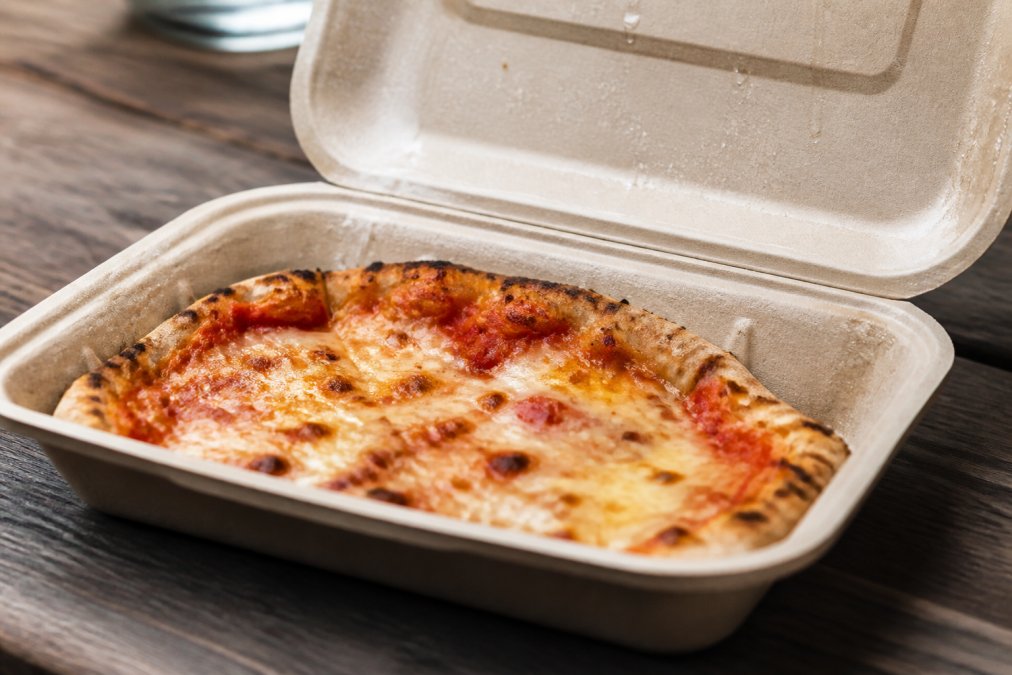
Understanding Grease Resistance Without PFAS
Grease resistance in compostable packaging traditionally relied on PFAS (per- and polyfluoroalkyl substances), synthetic chemicals that repel oils and water. The problem: PFAS persist in the environment indefinitely, accumulating in soil and water systems. Many councils now reject PFAS-containing packaging outright, even if it's technically compostable, because the chemicals contaminate the finished compost.
The alternative is barrier coatings made from plant-based or mineral sources. Natural plant fibre containers like bagasse (sugarcane pulp) can be lined with compostable coatings that provide genuine grease resistance without synthetic chemicals. These coatings break down during the composting process, leaving no toxic residue.

Here's what matters in practice: a PFAS-free coating needs to handle both heat and saturated oils without degrading prematurely. Test this by checking whether the packaging can hold hot, greasy food for at least 30 minutes without structural failure. The best performers use multi-layer construction, plant fibres for structure, compostable coating for moisture and grease barriers, and no synthetic additives.
When you're evaluating suppliers, ask directly: "What's in your moisture barrier?" If they can't name the coating material or claim it's "proprietary," that's a red flag. Legitimate manufacturers specify their barrier technology because it's a competitive advantage, not a secret.
AS 4736 Compostable Certification: What It Means for Your Business
AS 4736 is the Australian Standard for industrial compostable plastics. If your packaging carries this certification, it's guaranteed to break down in commercial composting facilities within 180 days at temperatures above 58°C. This is the standard that matters for most food businesses because commercial composting infrastructure exists across major Australian cities.
Here's the distinction: AS 4736 applies to industrial composting only. Your local council's composting facility operates under these conditions. Home composting, the kind that happens in backyard bins, doesn't reach those temperatures consistently, so AS 4736-certified packaging may not fully break down at home.
There's also AS 5810, which certifies packaging for home compostable conditions (lower temperatures, longer timeframes). Some suppliers now offer AS 5810-pending products, meaning they're in the certification process. These are genuinely useful if your customers compost at home, but they're less critical for business operations because most councils handle commercial composting, not home bins.
When you're sourcing packaging, verify the certification number on the product datasheet or supplier documentation. "Certified compostable" without a specific standard is marketing language, not a guarantee. The certification body matters too, look for logos from BPI (Biodegradable Products Institute) or equivalent bodies recognised by your local council.
PFAS-Free Food Packaging: Why It Matters and How to Verify
PFAS-free food packaging has become a regulatory priority in Australia. Several councils now explicitly reject packaging containing PFAS, even if it's compostable, because the chemicals persist through the composting process and end up in finished compost used on farms and gardens.
The verification process is straightforward but requires diligence. Request the supplier's chemical composition statement or safety data sheet (SDS). Legitimate manufacturers provide this without hesitation. Look for specific language: "Contains no added PFAS" or "PFAS-free formulation." Vague claims like "safe" or "eco-friendly" don't confirm absence of PFAS.
Some suppliers use the term "fluorine-free" as a proxy for PFAS-free. This is accurate but incomplete, fluorine-free means no fluorinated compounds at all, which is actually stricter than just avoiding PFAS. Either claim is acceptable, but PFAS-free is the specific standard councils care about.
When evaluating plant-based options like bagasse containers, ask whether the moisture barrier uses any fluorinated compounds. The best performers use silicone-based or plant-derived coatings. These cost slightly more than traditional options but eliminate regulatory risk and contamination concerns.
According to guidance from the Australian Council of Recycling, councils increasingly audit composting streams for PFAS contamination. Non-compliant packaging can result in facility rejection and penalties for your business. Verification upfront prevents costly supply chain disruptions.
Selecting the Right Material: Bagasse, Bioplastic, and Plant-Based Options
Three material categories dominate compostable food packaging: bagasse, bioplastic, and plant-based fibres. Each has distinct performance characteristics, cost profiles, and composting requirements.
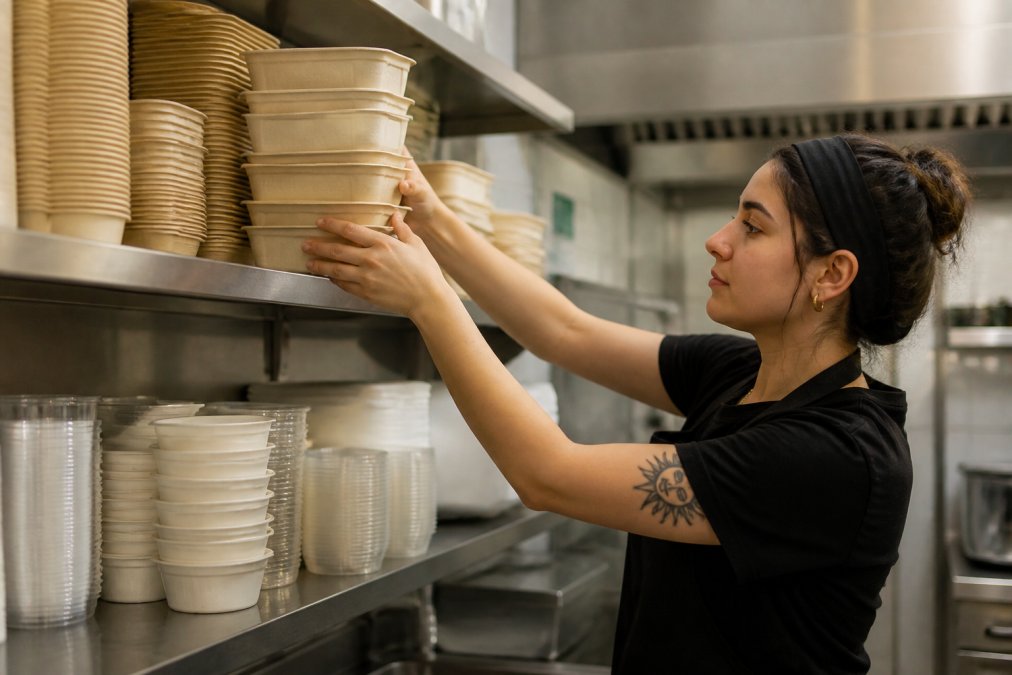
Bagasse (sugarcane pulp) is a by-product of sugar refining. It's fibrous, lightweight, and naturally compostable. Bagasse containers perform well for dry or moderately oily foods but require grease-resistant coatings for hot, saturated applications. The material itself is renewable, sugarcane regrows annually, making it genuinely sustainable from a resource perspective. Cost typically ranges from $0.15 to $0.35 per unit depending on size and coating quality.
Bioplastic (typically polylactic acid or PLA) is derived from corn starch or sugarcane. It mimics plastic's durability and transparency, making it popular for applications where visibility matters (bakery items, salads). PLA requires industrial composting facilities and won't break down in home bins or standard landfills. Performance under heat is excellent, PLA maintains structural integrity up to 50°C, but it can soften slightly under sustained grease exposure. Cost is typically $0.12 to $0.28 per unit.
Plant-based fibres (wood pulp, wheat straw, bamboo) offer structural strength and good thermal properties. These materials naturally resist moisture better than bagasse and require lighter coating applications. They're ideal for hot foods and perform consistently across temperature ranges. Cost typically ranges from $0.18 to $0.40 per unit.
For greasy foods specifically, bagasse and plant-based fibres with proper coatings outperform PLA because they handle prolonged heat and oil exposure without degradation. PLA works well for short-term storage (under 2 hours) but isn't ideal for pizza, fried foods, or items stored in warming trays.
Biodegradable Packaging AU's 1,750ml Large Natural Plant Fibre Takeaway Base uses sugarcane pulp with a compostable moisture barrier, designed specifically for greasy takeaway applications. At $116.85 per pack, it's positioned for businesses prioritising performance and composting compliance over lowest-cost options.
How to Dispose of Greasy Pizza Boxes and Other Takeaway Containers
Disposal of greasy pizza boxes and similar containers follows specific protocols. Standard cardboard pizza boxes, even compostable ones, can't go into residential recycling bins because the grease contaminates paper recycling streams. They must either go to commercial composting facilities or landfill.
For compostable greasy containers, the process is: collect separately, verify your local council accepts them, deliver to the designated commercial composting facility. Most major Australian councils (Melbourne, Sydney, Brisbane, Perth) have established commercial composting programs that accept certified compostable packaging. Smaller councils may not have this infrastructure yet.
Here's the practical workflow:
- Separate collection: Train staff to place used compostable containers in a dedicated bin, not mixed with general waste or recycling
- Verify acceptance: Contact your local council's waste management team and confirm they accept AS 4736-certified packaging at their composting facility
- Delivery logistics: Arrange regular collection or drop-off at the facility. Most councils offer scheduled collection for businesses generating significant compostable waste
- Documentation: Keep records of disposal. This matters for sustainability reporting and demonstrates genuine waste diversion
The biggest mistake businesses make is assuming all compostable packaging is accepted everywhere. It's not. Some councils accept only specific certifications, others have contamination thresholds, and some don't have composting infrastructure at all. Verify before switching suppliers.
If your council doesn't have commercial composting capacity, home composting becomes your only option. Greasy containers are challenging for home systems because they require sustained temperatures above 55°C and careful management to avoid attracting pests. Most home composters struggle with this, which is why commercial infrastructure is critical for food businesses.
Making the Switch: Cost, Performance, and Practical Implementation
Switching to compostable packaging involves three considerations: upfront cost, performance consistency, and operational changes.
Cost comparison depends on your current packaging and order volume. If you're currently using standard plastic takeaway containers, compostable alternatives typically cost 15-30% more per unit. For a small cafe ordering 500 containers monthly, this might be an additional $50-150 per month. For a larger operation ordering 5,000 units monthly, the premium is $500-1,500 monthly. This is material but manageable for most food businesses, especially if you can gradually phase in compostable options rather than switching everything at once.
Biodegradable Packaging AU's plant fibre containers offer competitive pricing within the certified compostable market. The 1,000ml Natural Plant Fibre Takeaway Base at $142.00 per pack and the 750ml Natural Plant Fibre Takeaway Base at $119.65 per pack are positioned for businesses prioritising certified compostable performance. Free Melbourne metro delivery on orders over $200 reduces logistics costs for local operations.


Performance consistency requires testing before full rollout. Order a small batch, use it in normal operations for 2-3 weeks, and evaluate: Does the container hold hot, greasy food without degrading? Does it maintain structural integrity during transport? Do customers notice any difference? Most modern compostable containers perform identically to plastic for normal use, but greasy foods expose weaknesses quickly.
Operational changes are minimal for most businesses. Staff training takes one conversation: "Compostable containers go in the green bin, not recycling." The main workflow change is ensuring containers reach the composting facility rather than mixed waste streams. This requires dedicated collection bins and clear labelling.
A common objection is that compostable packaging costs more and customers don't care. This is partly true, price-sensitive customers prioritise cost. But sustainability-conscious customers increasingly choose businesses with visible environmental commitments. Compostable packaging signals that commitment and can justify modest price increases or become a marketing differentiator.
Another concern is lead time. Custom-branded compostable packaging typically requires 4-8 weeks for production and delivery, longer than standard plastic. Plan ahead and maintain buffer stock to avoid disruptions.
Conclusion
Compostable packaging for greasy foods is no longer a niche choice, it's becoming a standard expectation for food businesses in Australia, especially as councils tighten waste diversion requirements and customers demand sustainable options.
The key is moving beyond "compostable" as a marketing term and understanding the specific standards, materials, and disposal infrastructure that make packaging actually compostable. AS 4736 certification, PFAS-free formulations, and verified local composting acceptance are the practical requirements that separate genuine solutions from greenwashing.
Biodegradable Packaging AU provides certified compostable containers specifically engineered for greasy takeaway applications. Our plant fibre bases with compostable moisture barriers handle hot, saturated foods without degradation, and our containers meet AS 4736 standards accepted by major Australian composting facilities. With custom branding options and free Melbourne metro delivery on orders over $200, switching to certified compostable packaging is operationally straightforward and cost-competitive with premium plastic alternatives.
Australian Standard AS 4736 specifications and local council composting program details provide the regulatory framework. Get started with Biodegradable Packaging AU and divert your food packaging from landfill while meeting customer expectations for genuine sustainability.
Frequently Asked Questions
Can you put greasy food packaging in the compost bin?
Certified compostable packaging for greasy foods can go in commercial composting facilities, which are designed to handle oils and fats at high temperatures. However, home composting is more complex. Grease-resistant coatings may slow decomposition in backyard compost. Always check your local council's guidelines, many facilities accept certified compostable takeaway containers, but some restrict greasy items. Biodegradable Packaging AU's plant-fibre containers are made with no added PFAS, and are pending home compostable to AS5810 standards, making them suitable for both pathways depending on certification status.
What is the difference between compostable and biodegradable packaging?
Biodegradable packaging breaks down over time but may leave toxic residues. Compostable packaging is biodegradable AND breaks down into non-toxic, nutrient-rich compost within a specific timeframe (typically 180 days in commercial facilities). Certified compostable packaging meets standards like AS 4736, guaranteeing it will decompose properly in controlled conditions. For greasy foods, certification matters because the grease barrier coating must also be compostable. Always look for the compostable certification logo, not just 'biodegradable' claims.
How do I know if packaging is actually certified compostable and not greenwashing?
Look for third-party certification logos and standards. In Australia, AS 4736 is the key standard for compostable packaging. Certified products carry certification marks from recognised bodies. Check the packaging label for the standard number and certifier name. Biodegradable Packaging AU's plant-fibre containers are made with no added PFAS and are pending home compostable to AS5810 standards. Avoid vague claims like 'eco-friendly' or 'green', demand specific certification numbers and ask your supplier for documentation.
Will switching to compostable packaging for greasy foods actually increase my costs?
Plant-fibre compostable containers typically cost more upfront than conventional plastic. For example, Biodegradable Packaging AU's 1,000ml plant-fibre takeaway bases are $142.00 per pack, compared to cheaper plastic alternatives. However, calculate total cost including waste disposal fees, potential future packaging regulations (2026 regulations are tightening), and brand value. Many customers favour sustainable businesses, which can offset pricing. Custom branding also strengthens customer loyalty. Free Melbourne metro delivery on orders over $200 reduces logistics costs for eligible locations.
This article was written using GrandRanker