Bulk Compostable Packaging Delivery: 7 Options
August 21, 2026 · Grandranker

Table of Contents
- Why Switch to Certified Compostable Takeaway Containers
- BioBoard Lunch and Noodle Boxes for Food Delivery
- Kraft Paper Bags: Recyclable Foodservice Solutions
- Custom Branded Compostable Packaging for Your Business
- Compostable Packaging Disposal Guidelines and Local Compliance
- Bulk Ordering, Pricing, and Free Metro Delivery
- Cost-Benefit Analysis: Compostable vs. Traditional Plastic
- Conclusion
Last Updated: August 21, 2026
Why Switch to Certified Compostable Takeaway Containers
Switching to certified compostable packaging is a business decision affecting your bottom line, brand perception, and waste management costs. The critical difference: certified means your packaging meets AS4736 standards, the Australian composting certification ensuring industrial facilities can actually break down your containers (standards.org.au). Without certification, packaging may still end up in landfill regardless of labelling claims.
Compostable packaging reduces waste disposal costs while positioning your brand as genuinely committed to circular economy principles. Many hospitality businesses report that switching signals authenticity to environmentally conscious customers who choose where they eat based on sustainability practices.
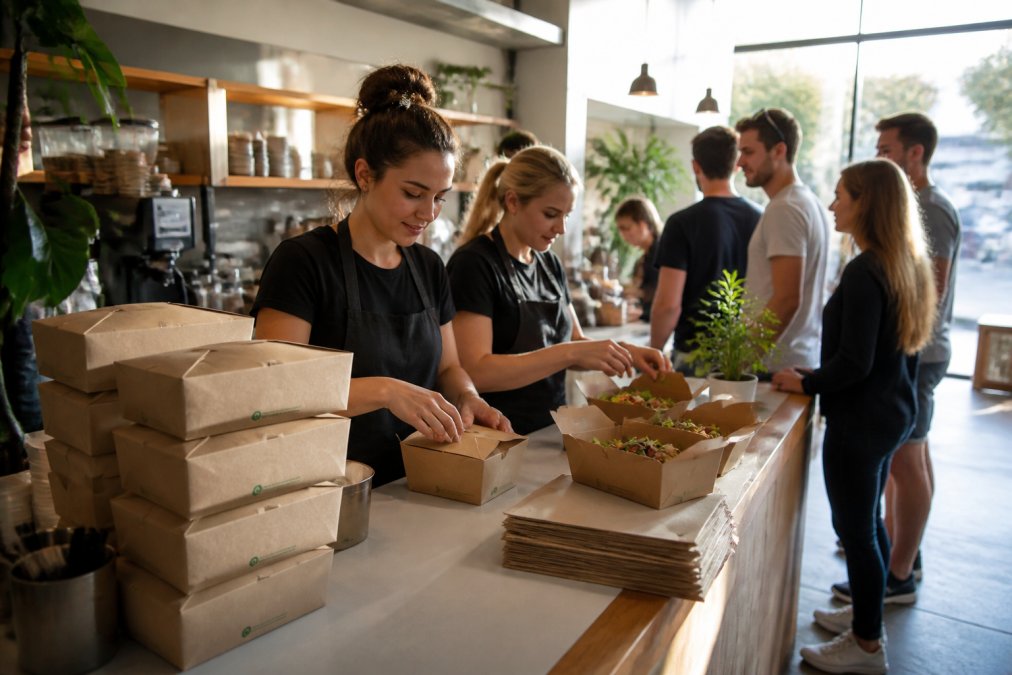
Biodegradable Packaging AU specialises in certified compostable foodservice solutions for Australian cafes, restaurants, and catering operations. The range includes BioBoard lunch boxes and noodle boxes made from sustainably sourced FSC-certified paperboard lined with Ingeo bioplastic (plant-derived, not oil-based), plus recyclable kraft paper bags. All products meet AS4736 certification standards.

The real cost comparison isn't "compostable versus plastic", it's total waste management cost plus brand value. Brand differentiation, customer loyalty, and compliance with upcoming 2026 packaging regulations create additional value.
BioBoard Lunch and Noodle Boxes for Food Delivery
BioBoard containers are engineered for takeaway food delivery, handling moisture, heat, and transport without compromising structural integrity or compostability. The Small BioBoard Lunch Box costs $69.55 per unit for individual meal portions and salads. The 780ml/26oz BioBoard Noodle Box is $156.45 and handles heavier, wetter foods like noodles, soups, and curries without leaking.

What separates BioBoard from standard cardboard is the Ingeo lining, a plant-based bioplastic that's compostable under industrial conditions and certified to AS4736. When your customer's takeaway container reaches a commercial composting facility, it breaks down alongside food scraps rather than persisting as microplastics. The kraft-look printing adds visual appeal without compromising compostability.
For high-volume operations, BioBoard containers reduce waste sorting complexity. Your staff don't need to educate customers about special disposal; the certified compostable label does that work.
The Family BioBoard Box ($72.10), Dinner BioBoard Box ($69.25), and Regular Snack BioBoard Box ($70.85) offer alternatives for larger portions. All maintain the same certification standard and compostability profile.
Bulk ordering through Biodegradable Packaging AU includes free Melbourne metro delivery on orders over $200. Standard BioBoard products have a typical lead time of 2-3 weeks, allowing for reasonably quick restocking.
Kraft Paper Bags: Recyclable Foodservice Solutions
Kraft paper bags offer a different sustainability angle, they're recyclable rather than compostable, which matters when your customer's local council hasn't established industrial composting infrastructure. For mobile food businesses and delivery services, kraft bags are often more practical than rigid boxes.
Biodegradable Packaging AU supplies five sizes of kraft paper bags made from post-consumer recycled FSC-certified paper. The Small Flat Handle option costs $56.90, the Small Die Cut Handle is $49.65, and the Medium Flat Handle runs $51.10. The Large Twist Handle bags are $59.80, and the Jumbo Twist Handle bags cost $52.00.

Handle type matters: flat handles distribute weight evenly and feel premium, while twist handles are quicker to pack and handle higher weights. Die-cut handles offer a professional middle ground. All bags carry a 4-5kg weight capacity depending on size.
Kraft bags are recyclable if not contaminated with food, meaning they enter standard kerbside recycling streams in most Australian councils, a significant advantage when local composting infrastructure is limited.
For businesses operating across multiple council areas where composting facilities vary, kraft bags provide consistency. Customers can recycle them anywhere rather than finding specific composting drop-off points.
Custom Branded Compostable Packaging for Your Business
Custom branding transforms compostable packaging into a marketing asset. Your cafe's logo on every takeaway container extends brand visibility beyond the point of sale, creating organic touchpoints that standard white boxes never achieve.
Biodegradable Packaging AU offers custom branding on compostable packaging, allowing you to print your logo, colour scheme, and messaging directly onto BioBoard containers and kraft bags. The setup process typically requires 3-4 weeks for artwork approval, plate creation, and production. Plan custom orders at least a month in advance.
Custom branding serves multiple objectives: reinforces brand identity, creates a perception of professionalism and care, and gives you a tangible sustainability story. Customers remember brands that make thoughtful choices visible. For restaurants building loyalty programs or subscription services, custom branded packaging creates unboxing moments that feel intentional rather than transactional.
Compostable Packaging Disposal Guidelines and Local Compliance
Certification to AS4736 means industrial composting facilities can break down your packaging, but it doesn't guarantee your local council has those facilities or accepts compostable packaging in green waste collection.
Before committing to compostable packaging, contact your local council's waste management department and confirm whether they accept AS4736-certified compostable packaging in green waste streams or at drop-off facilities. Some councils have established industrial composting partnerships; others haven't yet.
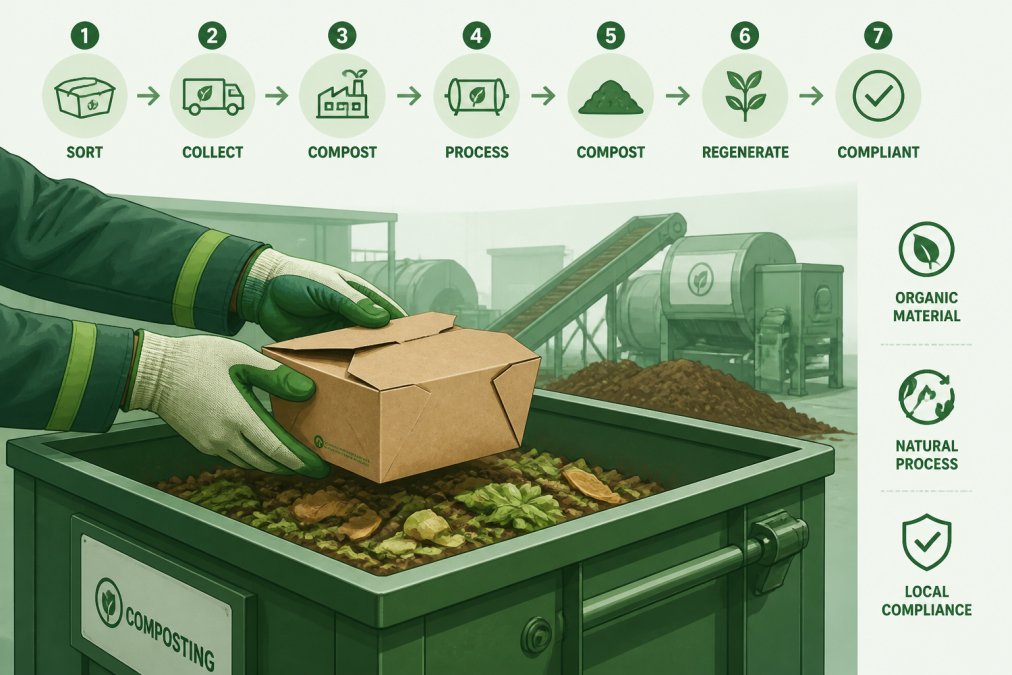
Many councils across Australia are moving toward accepting certified compostable packaging, but timelines vary significantly. Metropolitan areas typically have better infrastructure than regional locations. If your business operates across multiple suburbs, you may need to direct customers to specific drop-off points.
At industrial facilities, certified compostable containers are shredded, mixed with other organic materials, and processed at high temperatures. The timeline typically takes 12-16 weeks from arrival to finished compost (peer-reviewed research).
For your business, create a disposal system that works. Educate staff on the difference between compostable (industrial facilities only) and recyclable (kerbside collection). Provide clear signage for customers. Partner with local composting services if your council doesn't offer convenient collection. Compost Connect helps hospitality businesses locate industrial composting facilities in their area.
Bulk Ordering, Pricing, and Free Metro Delivery
Bulk ordering compostable packaging shifts economics in your favour. Per-unit costs drop significantly as order volumes increase, and Biodegradable Packaging AU offers free Melbourne metro delivery on orders over $200.
For a small cafe ordering 500 BioBoard Lunch Boxes at $69.55 per unit, the full order is approximately $34,775. If you use 500 boxes monthly, that's roughly $3,480 monthly. Compare this to your current plastic container spend and factor in reduced waste disposal costs.
Kraft paper bags offer better entry-point pricing. A bulk order of 1,000 Medium Flat Handle Kraft Paper Bags at $51.10 per unit costs $51,100, or roughly $4,260 monthly if you use 1,000 bags per month.
Free Melbourne metro delivery applies to orders over $200, eliminating hidden shipping costs. For businesses outside the Melbourne metro area, confirm shipping rates before finalising large orders.
Lead times for standard products are typically 2-3 weeks. Custom branded packaging requires longer lead times (3-4 weeks minimum), so plan accordingly.
| Product | Unit Price | Monthly Usage (est.) | Monthly Cost | Annual Cost |
|---|---|---|---|---|
| Small BioBoard Lunch Box | $69.55 | 300 | $20,865 | $250,380 |
| 780ml BioBoard Noodle Box | $156.45 | 150 | $23,468 | $281,616 |
| Medium Kraft Paper Bags | $51.10 | 500 | $25,550 | $306,600 |
| Large Kraft Paper Bags | $59.80 | 200 | $11,960 | $143,520 |
Adjust based on your specific throughput.
Cost-Benefit Analysis: Compostable vs. Traditional Plastic
Compostable packaging costs more per unit than conventional plastic. The real question is whether total cost of ownership justifies the difference.
A small cafe spending $2,500 monthly on plastic containers might pay $3,200 monthly for equivalent compostable packaging, a $700 increase. But if compostable packaging qualifies for cheaper green waste collection, that cost might drop from $400-600 monthly to $150-250 monthly, offsetting much of the premium.
The net calculation: $700 additional packaging cost minus $200-300 waste savings equals $400-500 net monthly increase. For a cafe with sustainability-conscious customers, that's often cheaper than the brand marketing achieving similar positioning.
Regulatory compliance adds another layer. The 2026 packaging regulations increasingly pressure hospitality businesses toward sustainable alternatives. Switching now positions you ahead of competitors scrambling to comply later.
Customers who choose your cafe partly because of sustainability commitments tend to have higher lifetime value and lower price sensitivity. This loyalty premium compounds over years.
Choosing certified compostable packaging delivery is a practical step toward reducing your business's environmental footprint while building customer trust. Biodegradable Packaging AU supplies certified AS4736 compostable foodservice solutions, BioBoard containers, kraft paper bags, and custom branding options, with free Melbourne metro delivery on orders over $200. Start with a bulk order of standard products, confirm your local council's composting infrastructure, and plan custom branding as your next phase. The initial cost premium pays for itself through waste management savings, brand differentiation, and positioning your business ahead of 2026 packaging regulations.
Frequently Asked Questions
What certifications should I look for in compostable packaging?
Look for AS4736 certification, which is the Australian Standard for industrially compostable plastics and products. This certification guarantees your packaging will break down in commercial composting facilities within the required timeframe. All BioBoard products are certified to AS4736, meaning they're genuinely compostable, not greenwashing. Verify certification on product packaging or supplier documentation before ordering.
How do I dispose of commercial compostable packaging properly?
Compostable packaging disposal depends on your local council's waste system. Check your council's website for approved composting facilities in your area. Many councils now accept certified compostable packaging in green waste bins or direct to industrial composting facilities. Contamination matters: packaging must be free of non-compostable items, and food residue should be minimal. Contact Compost Connect or your local waste authority to confirm drop-off locations and requirements.
Are minimum order quantities required for bulk compostable packaging?
Most wholesale suppliers, including Biodegradable Packaging AU, offer flexible bulk ordering. Bulk orders typically qualify for better per-unit pricing and free delivery (orders over $200 qualify for free metro delivery). Exact minimums vary by product. Contact the supplier directly to discuss your order size and negotiate pricing for your cafe, restaurant, or catering business.
Does compostable packaging hold up for hot takeaway food?
Yes, certified compostable containers like BioBoard boxes are designed for hot food. They feature waterproof linings made from Ingeo (a plant-based bioplastic) that resist heat and moisture. BioBoard Noodle Boxes (780ml/26oz) and Lunch Boxes are specifically engineered for hot liquids and meals. Grease and moisture won't compromise the structural integrity during transport or storage, making them reliable for coffee, soup, noodles, and hot takeaway meals.
What's the actual cost difference between compostable and traditional plastic packaging?
Compostable packaging typically costs more upfront than conventional plastic. However, when you factor in waste disposal fees, landfill levies, and brand reputation gains, the total cost of ownership often balances out. Small BioBoard Lunch Boxes start at $69.55 per unit. Kraft paper bags range from $49.65 to $59.80 per unit. Many cafes and restaurants find customers value the sustainability messaging enough to offset slightly higher packaging costs through brand loyalty.
This article was written using GrandRanker