Best Eco Friendly Takeaway Packaging 2026
August 12, 2026 · Grandranker

Table of Contents
- How We Evaluated Eco Friendly Takeaway Packaging for 2026
- Quick Comparison: Top Eco Friendly Takeaway Packaging Options
- 1. Sugarcane Bagasse Containers (BioCane Clamshells and Takeaway Bases)
- 2. Fiber-Based Paperboard Boxes (BioBoard Lunch, Burger and Noodle Boxes)
- 3. Compostable Cups, Cutlery and Carry Bags
- AS 4736 Certified Packaging: What the Label Actually Means
- Single-Use Plastic Bans by State: What Food Businesses Must Know
- How to Dispose of Eco-Friendly Takeaway Containers Correctly
Last Updated: August 12, 2026
The packaging choices food businesses make today carry regulatory, reputational, and environmental weight. At Biodegradable Packaging AU, we work with cafes, restaurants, and caterers navigating how to find eco friendly takeaway packaging that performs in a commercial kitchen, meets certification standards, and doesn't end up in landfill anyway.
This guide cuts through greenwashing and gives you a practical breakdown of the best options available in 2026, covering top materials, what certifications mean, state-based plastic bans, and the waste infrastructure reality most suppliers won't mention.
Quick Picks:
- Best for hot meals and durability: Sugarcane bagasse containers (BioCane clamshells and takeaway bases)
- Best for burgers, lunch, and noodle dishes: Fiber-based BioBoard paperboard boxes
- Best for beverages and zero-cutlery service: Compostable cups, PLA cutlery, and carry bags
- Best certification to look for: AS 4736 (commercial compostable) or AS 5810 (home compostable)
How We Evaluated Eco Friendly Takeaway Packaging for 2026
Choosing eco friendly takeaway packaging requires looking beyond the "green" label. Our evaluation framework covers six criteria that matter in a real food service environment.
| Criteria | What We Assessed |
|---|---|
| Certification | AS 4736 or AS 5810 verified, not self-declared |
| Food performance | Grease resistance, moisture barrier, thermal insulation |
| Material source | Renewable resources vs. recycled content vs. fossil-based |
| Disposal pathway | Municipal composting access, recyclability, home compostable |
| Carbon footprint | Supply chain emissions relative to conventional alternatives |
| Cost-effectiveness | Per-unit pricing against conventional plastic or foam |
A common mistake is evaluating packaging on price per unit alone. Real cost includes disposal fees, council compliance risk, and reputational cost of using uncertified packaging. We weighted certification and disposal pathway heavily because packaging that can't be composted in your local area fails the most important test.
Quick Comparison: Top Eco Friendly Takeaway Packaging Options
| Option | Material | Certification | Best Food Type | Compostable at Home? |
|---|---|---|---|---|
| Sugarcane bagasse clamshells | Sugarcane pulp | AS 4736 | Hot meals, saucy dishes | No (commercial only) |
| BioBoard paperboard boxes | FSC recycled paperboard + Ingeo PLA | AS 4736 | Burgers, lunch, noodles | No (commercial only) |
| PLA compostable cups | Cornstarch-derived PLA | AS 4736 | Hot and cold beverages | No (commercial only) |
| BioCup (double wall, aqueous coated) | Paper + aqueous coating | AS 5810 | Coffee, hot drinks | Yes |
| PLA cutlery | Plant-based bioplastic | AS 4736 | All food types | No (commercial only) |
| FSC wood cutlery | Certified birchwood | Biodegradable | Hot and cold foods | Yes |
| Bioplastic carry bags | Ecopond plant-based bioplastic | AS 4736 | All takeaway | No (commercial only) |
1. Sugarcane Bagasse Containers (BioCane Clamshells and Takeaway Bases)
Sugarcane bagasse containers are the most versatile option for hot, saucy, or oily meals. Bagasse is the fibrous pulp left after sugar cane juice extraction, a genuine by-product that would otherwise be burned or sent to landfill, making it lower carbon footprint than virgin plastic or foam.
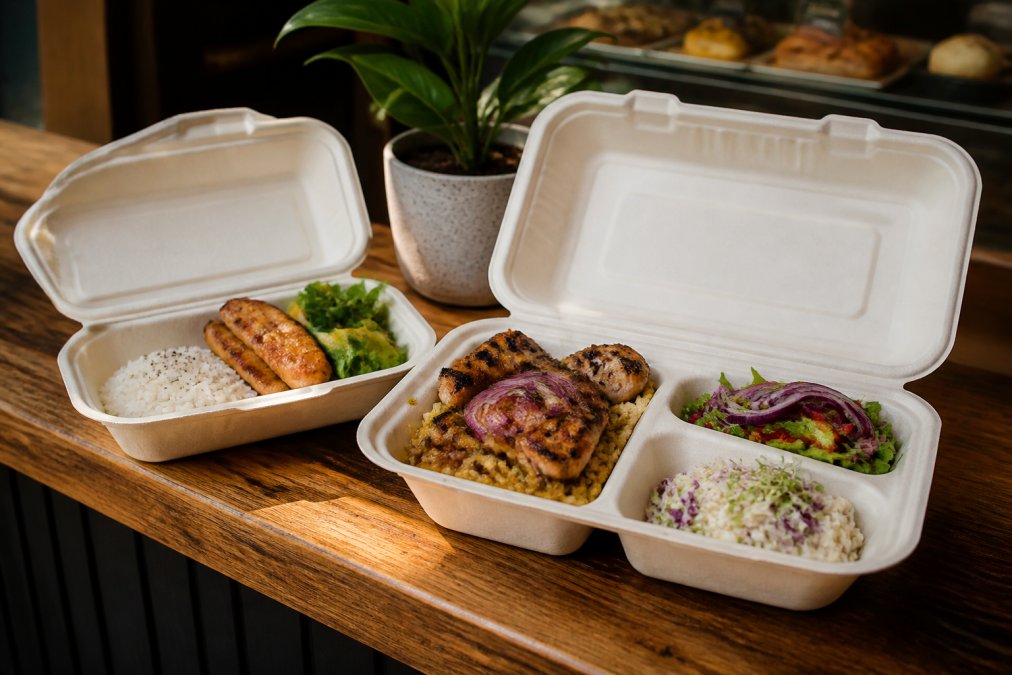
The 23x23x8cm 3-Compartment White Plant Fibre Clamshell at $88.65 per carton is built for meals needing separation, main with two sides, or protein with rice and salad. The three-compartment design keeps food presentation clean without multiple containers, reducing packaging cost and waste per order.

For larger portions, the 1,000ml Natural Plant Fibre Takeaway Base at $142.00 per carton handles volume without compromising leak-proof performance and stacks efficiently for delivery logistics.

What works: Natural grease resistance without PFAS coatings. Handles microwave reheating. Stackability aids storage and delivery. Sourced from rapidly renewable resources with lower carbon footprint than virgin plastic or foam.
What to watch: Bagasse containers require commercial composting infrastructure. Home compost bins don't reach sustained temperatures needed. If your council doesn't run FOGO collection, arrange separate composting.
2. Fiber-Based Paperboard Boxes (BioBoard Lunch, Burger and Noodle Boxes)
Fiber-based packaging is the workhorse of sustainable takeaway. BioBoard uses FSC Mix certified paperboard from responsibly managed forests, lined with Ingeo bioplastic derived from cornstarch rather than petroleum.
The Burger BioBoard Box at $70.50 per carton is straightforward and sturdy. The Large BioBoard Lunch Box at $111.20 per carton adds Ingeo lining, creating a moisture barrier that prevents sogginess during transit, critical for food quality and brand reputation.

The 780ml / 26oz BioBoard Noodle Box at $156.45 per carton is engineered for high-moisture dishes, handling sustained moisture exposure without losing structural integrity mid-delivery.
Food-type compatibility:
- Burgers and sandwiches: BioBoard Burger Box
- Rice bowls, salads, wraps: Large BioBoard Lunch Box
- Noodles, ramen, laksa: BioBoard Noodle Box
Limitation: BioBoard products are commercially compostable, not home compostable. The Ingeo lining requires industrial composting conditions. Communicate this clearly to avoid contaminating home compost bins.
3. Compostable Cups, Cutlery and Carry Bags
Coffee shops have the most visible packaging footprint. A busy cafe moves hundreds of cups daily, and the disposal pathway determines whether "compostable" is genuine or marketing.
The 295ml / 8oz White Double Wall BioCup at $199.95 per carton uses aqueous water-based coating rather than plastic lining. Critically, these are certified home compostable, allowing customers with home compost bins to dispose correctly without commercial facility access.
For cutlery, the choice between PLA and wood depends on use case. The 16.5cm PLA Fork at $75.25 per carton is plant-based bioplastic with smaller carbon footprint than conventional plastic. The 10cm Wood Teaspoon at $69.35 per carton, made from FSC 100% certified birchwood, is home compostable and biodegradable without industrial infrastructure.
The 8L Bioplastic Bags With Handle at $158.15 per carton are made from Ecopond plant-based bioplastic, replacing conventional plastic bags and complying with single-use plastic bans across all states.
AS 4736 Certified Packaging: What the Label Actually Means
AS 4736 certified packaging breaks down in commercial composting within 180 days, leaving no toxic residue. The standard is set by Standards Australia and is the benchmark for commercially compostable products.
Certification is not self-declared. Products must be tested by accredited laboratories and verified by certification bodies. According to Standards Australia's certification framework, AS 4736 covers biodegradability, disintegration, ecotoxicity, and heavy metals, four distinct tests a product must pass before carrying the certified compostable label.
Many products claim "biodegradable" or "eco-friendly" without meeting these criteria. A product breaking down in 10 years in landfill is technically biodegradable, but that's not what customers or councils mean by compostable.
AS 4736 vs AS 5810: Commercial vs Home Compostable
AS 4736 applies to commercial composting: temperatures above 55°C sustained over weeks, with industrial turning and monitoring. Most council FOGO bins and commercial composting facilities operate to this standard.
AS 5810 applies to home composting: lower temperatures, no turning requirement, ambient conditions. Products certified to AS 5810 also meet AS 4736, as home composting is the stricter standard.
Practical implication: With access to commercial composting, AS 4736 certified products suffice. For customers wanting home composting, AS 5810 is the standard to seek.
Greenwashing Red Flags to Avoid
- "Biodegradable" with no certification: Meaningless without a standard
- "Eco-friendly" or "sustainable" as standalone claims: Unverifiable under ACCC guidance on environmental claims
- "Compostable" without AS 4736 or AS 5810 certification: Self-declared and unverifiable
- "Made from plants" without specifying the lining: Paper cup with plastic lining is not compostable
- Recycling symbols on non-recyclable packaging: Technically legal but misleading
Single-Use Plastic Bans by State: What Food Businesses Must Know
Single-use plastic bans are now in effect across all Australian states and territories, though specific items and timelines vary. Food businesses operating across multiple states must understand which items are banned where.
According to the Australian Government's product stewardship framework, the national approach is driven by state-level legislation, creating compliance complexity for multi-state operations.
Commonly banned items include:
- Single-use plastic straws (all states)
- Single-use plastic cutlery and stirrers (all states)
- Expanded polystyrene food containers and cups (all states)
- Single-use plastic plates and bowls (most states)
- Lightweight plastic bags (all states)
- Cotton bud sticks with plastic stems (most states)
Practical implication: Any food business still using EPS foam containers, plastic straws, or single-use plastic cutlery is non-compliant in every state. Shifting to certified compostable or fiber-based alternatives is legally required, not optional.
Mobile food businesses operating across council areas face additional complexity. Some councils accept AS 4736 certified packaging; others don't. Check your local council's waste management policies before committing to a packaging system.
How to Dispose of Eco-Friendly Takeaway Containers Correctly
Correct disposal determines whether environmental benefit is real or theoretical. The container's certification only matters if it reaches the right waste stream.
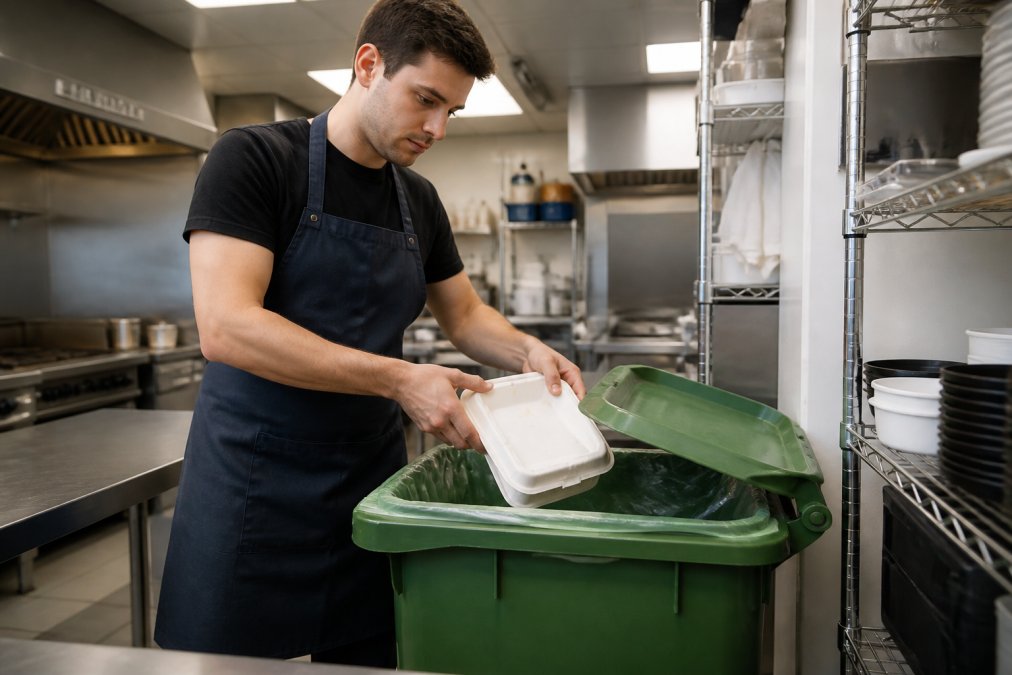
General disposal rules by material type:
- Sugarcane bagasse (AS 4736): Commercial compost bin or FOGO collection. Not suitable for home compost or kerbside recycling.
- BioBoard paperboard with Ingeo lining (AS 4736): Commercial compost bin only. Ingeo lining prevents paper stream recycling.
- Aqueous-coated BioCups (AS 5810): Home compost bin or commercial compost bin.
- PLA cutlery (AS 4736): Commercial compost bin only.
- FSC wood cutlery: Home compost bin or general waste.
- Bioplastic carry bags (AS 4736): Commercial compost bin or FOGO collection.
Waste Management Infrastructure Reality
Composting infrastructure in many areas is still catching up to certified packaging. A product certified to AS 4736 is only useful if a commercial composting facility receives it.
Many councils now offer FOGO collection, but coverage is uneven. Metropolitan areas generally have better access than regional areas. Businesses without FOGO collection face a genuine challenge: certified compostable packaging may still end up in general waste, where it won't break down as intended.
The honest solution is two-part: First, choose AS 5810 home compostable products where possible, aqueous-coated cups and FSC wood cutlery give customers real disposal options regardless of council infrastructure. Second, for items requiring commercial composting, partner with a composting service directly rather than relying on kerbside collection.
According to the Australian Organics Recycling Association's infrastructure data, commercial composting capacity is growing nationally, but the gap between certified packaging volumes and available composting infrastructure remains a real constraint for many businesses.
Practical disposal checklist:
- Confirm your local council's FOGO collection policy and what it accepts
- Display clear disposal instructions on packaging or at point of sale
- Train staff on which bin each packaging type goes into
- For commercial composting, set up a dedicated collection bin in the kitchen
- Review your packaging mix annually as council infrastructure improves
- Choose AS 5810 certified products where customer home composting is realistic
Sustainable packaging is a genuine operational challenge, not just marketing. The gap between "eco-friendly" labelling and verified environmental outcomes is wide enough to swallow a business's sustainability credibility. Biodegradable Packaging AU offers certified compostable foodservice packaging made from renewable plant-based materials, with custom branding options, access to composting support through Compost Connect, and free delivery for Melbourne metro orders over $200. Shop the sale items and start building a packaging system that holds up to scrutiny from regulators, customers, and the composting bin alike.
Frequently Asked Questions
What is the difference between biodegradable and home-compostable packaging?
Biodegradable means a material breaks down over time, but gives no guarantee on how long that takes or what conditions are needed. Home-compostable packaging, certified to AS 5810, breaks down in a standard backyard compost bin within 26 weeks. Commercially compostable packaging (AS 4736) requires an industrial composting facility with controlled heat and humidity. For most food businesses, AS 4736 certification is the practical standard, while AS 5810 offers a more accessible end-of-life path for customers.
Are compostable takeaway containers actually better for the environment?
Certified compostable containers made from sugarcane bagasse, kraft paper, or PLA carry a measurably lower carbon footprint than single-use plastic, because they come from renewable resources rather than fossil fuels. The environmental benefit is fully realised only when the packaging reaches a composting facility rather than landfill. Connecting with a local composting service, such as through Compost Connect, is the step that closes the loop and makes the investment worthwhile.
What single-use plastics are now banned in food service?
All Australian states and territories have now phased out key single-use plastic items used in food service, including plastic straws, cutlery, plates, bowls, and expanded polystyrene food containers. Specific timelines and item lists vary by state, so checking your state environment authority's current schedule is essential. Certified compostable alternatives made from sugarcane bagasse, PLA, or fiber-based paperboard comply with these bans across all jurisdictions.
How do I choose the right eco-friendly packaging for hot versus cold food?
For hot food, sugarcane bagasse containers handle temperatures up to around 120°C and provide good thermal insulation, making them suitable for curries, rice dishes, and hot chips. Fiber-based paperboard boxes with a bioplastic lining work well for burgers and wraps. For cold food and salads, PLA-lined kraft containers maintain moisture barriers without plastic. Avoid using standard kraft paper alone for wet or greasy hot food, as it lacks the grease-resistant coating needed to prevent leakage.
Where can I source AS 4736 certified compostable packaging for my cafe or restaurant?
Biodegradable Packaging AU stocks a full range of AS 4736 certified compostable foodservice packaging, including sugarcane bagasse clamshells, BioBoard boxes, compostable cups, PLA cutlery, and carry bags. Products are available in wholesale carton quantities, with free delivery to Melbourne metro areas on orders over $200. Custom branded packaging is also available for businesses wanting to reinforce their sustainability credentials with every order.
This article was written using GrandRanker