Best Compostable Coffee Cups for Cafes
August 20, 2026 · Grandranker

Table of Contents
- Why Compostable Coffee Cups Matter for Cafes
- Understanding Certified Compostable Takeaway Containers in Australia
- Single Wall vs. Double Wall Insulation
- AS 4736 Compostable Certification Standards
- Top Compostable Coffee Cup Options by Size
- Custom Branded Compostable Cups for Cafe Marketing
- Cost-Benefit Analysis for Small Cafes
- Disposal Infrastructure and Composting Reality
Why Compostable Coffee Cups Matter for Cafes
Switching to certified compostable coffee cups offers operational, regulatory, and commercial benefits. Cafes adopting them see reduced waste management costs, stronger alignment with customer expectations, and a verifiable answer to disposal questions. The regulatory landscape shifted in 2026: packaging regulations now require genuine waste diversion pathways, not just "eco-friendly" claims. Compostable cups must be certified, disposal methods must be verifiable, and teams must understand the difference between home and commercial composting. Without this, certified cups end up in landfill anyway.
Understanding Certified Compostable Takeaway Containers in Australia
Certified compostable takeaway containers break down completely in composting environments within a defined timeframe, leaving no toxic residue. The key word is "certified." Uncertified claims are marketing, not commitment.
In Australia, AS 5810 (home compostable) and AS 4736 (industrial/commercial compostable) define whether cups will actually decompose in available facilities. Without certification, you're gambling with environmental claims.
AS 5810 Certification Explained
AS 5810 certifies products suitable for home composting. Certified cups break down within 12 months under specific conditions: 20-30°C temperatures, adequate moisture, and active management. This proves cups are made from genuinely compostable materials (typically PLA-lined paper or water-based coatings), not traditional plastic, and won't persist in landfill for decades.
However, most home composters won't reach required conditions. AS 5810 certification proves the cup can break down at home under ideal conditions but doesn't guarantee your customer's backyard bin will achieve those conditions. It's valuable for brand perception but limited for actual waste diversion in practice.
Home vs. Commercial Composting
This distinction fundamentally changes your disposal strategy. Home composting is what customers imagine; commercial composting is what actually processes most organic waste at scale.
Commercial composting operates at 55-65°C with controlled moisture and aeration, processing certified compostable materials in 12-16 weeks. This is where AS 4736-certified cups excel and will actually break down reliably. The critical issue: commercial composting infrastructure is patchy across Australia. Some councils accept compostable packaging in organics collection; others explicitly reject it as contamination. Before committing to compostable cups, verify whether your local council's organics collection accepts them. If not, your certified cups become landfill-bound packaging that costs more than conventional alternatives.
Single Wall vs. Double Wall Insulation
Single wall cups are lighter, cheaper, and adequate for cold drinks and short service windows. For high-volume environments where speed matters more than temperature retention, single wall is practical.
Double wall cups insulate hot drinks longer, reduce hand-burn risk, and feel more substantial, influencing customer perception of value. The material composition is identical; the difference is the air gap between walls, which adds manufacturing cost but delivers measurable functional benefit. For cafes serving espresso-based drinks or operating in cooler climates, double wall is a worthwhile investment.

AS 4736 Compostable Certification Standards
AS 4736 is the Australian standard for industrial composting. It requires certified products to break down completely in commercial facilities within 12 weeks at 58°C. This is the certification that matters for actual waste diversion in Australia, because commercial facilities are where most compostable packaging ends up.
AS 4736 certification ensures cups reliably process through industrial composting without leaving microplastics or toxic residue. If your local council accepts compostable packaging in organics collection, they're almost certainly accepting AS 4736-certified products. Always verify with your specific council which standard they accept, this determines whether your choice actually diverts waste from landfill.
Biodegradable Packaging AU's BioCup range is certified to both standards, with clear labelling aligned to South Australian legislation effective March 1, 2026.
Top Compostable Coffee Cup Options by Size
Small Cups: 4oz to 8oz
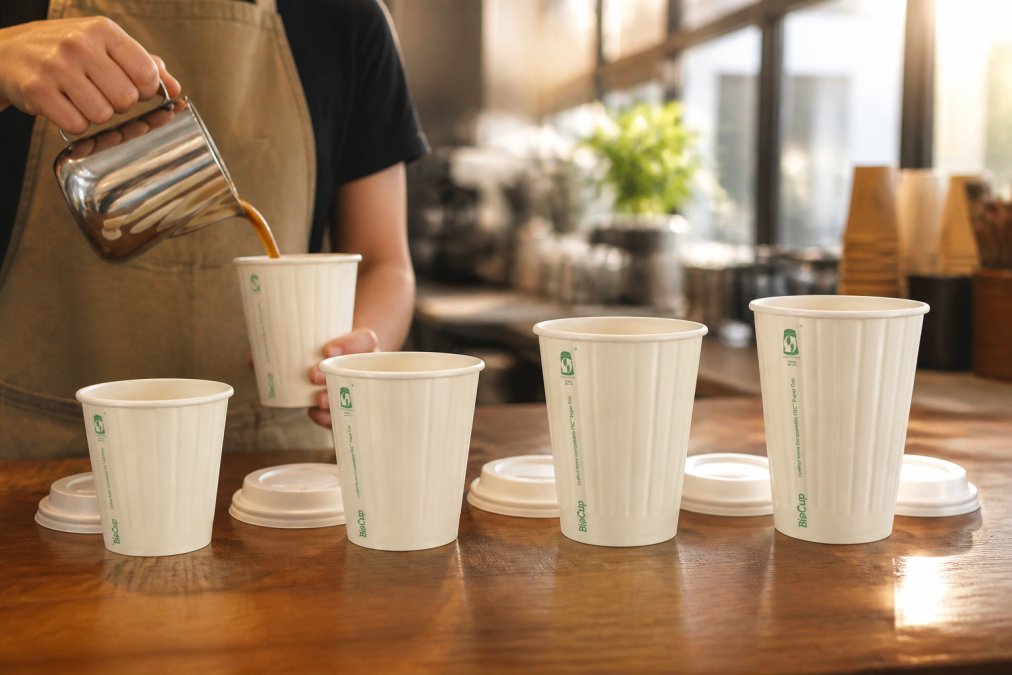
The 120ml / 4oz single wall BioCup at $134.65 is ideal for espresso shots and ristrettos. The 230ml / 6oz single wall BioCup at $110.20 handles cortados and small cappuccinos. The 280ml / 8oz single wall BioCup at $135.40 works for flat whites and small lattes.

Medium Cups: 10oz to 12oz
The 350ml / 12oz single wall BioCup at $136.40 is your workhorse for medium drinks, affordable and compatible with 80mm lids. For heat retention in cooler climates, the 390ml / 12oz double wall BioCup at $235.00 keeps drinks hot longer.
Large Cups: 16oz
The 510ml / 16oz single wall BioCup at $178.10 handles large lattes and specialty beverages. Single wall remains adequate for hot drinks at this size because larger volume means slower consumption.
Custom Branded Compostable Cups for Cafe Marketing
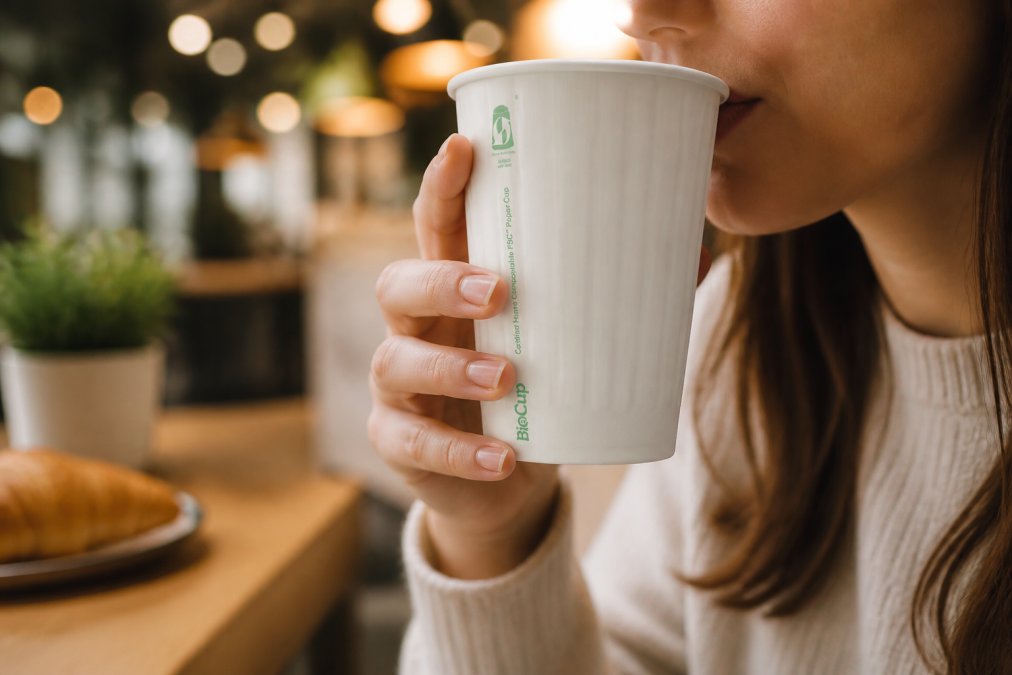
Custom branding on compostable cups integrates your logo, colours, and messaging directly into the cup design. This becomes a mobile advertisement and visible expression of environmental commitment. Custom printing requires 2-4 weeks for production, depending on order volume and design complexity. Custom branding delivers brand differentiation, visible sustainability commitment, and extended brand presence beyond the cafe.
Cost-Benefit Analysis for Small Cafes
Compostable cups cost more than conventional alternatives. A small cafe serving 300 cups daily faces roughly 9,000 cups monthly. Using Biodegradable Packaging AU pricing, mixed single wall cups average $130-$155 per 1,000 cups, costing $1,170-$1,395 monthly. Conventional paper cups cost $60-$80 per 1,000 cups, or $540-$720 monthly, a difference of $450-$675 monthly or $5,400-$8,100 annually.

Compostable packaging alone doesn't drive revenue. The honest assessment is that most customers appreciate it but won't change purchasing behaviour. Where compostable cups save money: if your local council offers subsidised or free organics collection accepting compostable packaging, disposal costs may drop compared to conventional waste. If your council doesn't accept compostable packaging, you've added cost with no offsetting benefit.
Compostable cups make financial sense for small cafes if disposal infrastructure exists locally and your brand positioning supports the investment. Without both factors, they're a cost premium requiring strong environmental commitment to justify.
Disposal Infrastructure and Composting Reality
Disposal infrastructure is the limiting factor, not the cups themselves. You can buy perfectly certified compostable cups, but if your local council doesn't accept them in organics collection, they end up in landfill. Your environmental claim becomes greenwashing.
Infrastructure varies dramatically across Australia. Some councils have mature organics collection programs explicitly accepting AS 4736-certified compostable packaging. Others accept organics but reject compostable packaging as contamination. Still others lack organics collection entirely. Before committing to compostable cups, contact your local council and ask: Do you accept organics collection? Do you accept compostable packaging? Which standard do you require?
For cafes without organics collection, compostable cups aren't a viable environmental solution. For cafes with access to commercial composting infrastructure, they become a genuine waste diversion tool with verified disposal pathways and substantiated environmental claims.
Biodegradable Packaging AU provides free Melbourne metro delivery on orders over $200, reducing logistics costs for cafes in that region. For cafes outside that zone or without composting infrastructure, the business case changes significantly.
Compostable cups only work if actually composted. Verify your disposal pathway before committing to the cost premium.
| Cup Size | Single Wall Price | Double Wall Price | Best For | Lid Compatibility |
|---|---|---|---|---|
| 4oz (120ml) | $134.65 | N/A | Espresso shots | 63mm |
| 6oz (230ml) | $110.20 | N/A | Small specialty drinks | 80mm |
| 8oz (280ml-295ml) | $135.40 | $189.25-$199.95 | Flat whites, small lattes | 90mm / 80mm |
| 12oz (350ml-390ml) | $136.40-$155.75 | $235.00 | Standard medium drinks | 80mm / 90mm |
| 16oz (510ml) | $178.10 | N/A | Large drinks, iced beverages | 90mm |
Switching to compostable coffee cups combines environmental responsibility, brand positioning, and operational reality. Verify that your local council accepts compostable packaging and confirm which standard they require. Calculate whether the cost premium aligns with your brand positioning and customer base.
For cafes with access to commercial composting infrastructure and sustainability-focused customers, compostable cups deliver genuine environmental benefit and brand differentiation. For cafes without that infrastructure, they're a cost without corresponding benefit. Make the decision based on your specific circumstances, not on assumptions that all compostable packaging reaches composting facilities.
Biodegradable Packaging AU's certified compostable cups offer reliable quality and compliance with Australian standards. Their custom branding options and free Melbourne metro delivery on orders over $200 make them practical for cafes in that service area. For operations outside that region or without local composting infrastructure, evaluate whether the investment aligns with your environmental commitment and customer expectations. The best compostable cup is one that's actually composted.
Frequently Asked Questions
Are compostable coffee cups actually compostable in Australian facilities?
Yes, certified AS 5810 compostable coffee cups break down in approved composting facilities within 12 weeks. However, they only compost in industrial or approved home composting environments, not standard landfills. Check your local council's organics collection program to confirm access. Many facilities now accept certified compostable cups, but infrastructure varies by region. Verify with Compost Connect or your local waste authority before switching to ensure your cups will actually be processed.
What certifications should I look for in compostable coffee cups?
Look for AS 5810 certification, which guarantees home compostability in Australian conditions. AS 4736 is another standard covering compostable plastics. Cups should display clear compostability labelling and meet South Australian legislation effective 1 March 2026. Certified cups from reputable suppliers include verification from independent testing bodies. Avoid unmarked 'biodegradable' claims without third-party certification, as these often indicate greenwashing rather than genuine compostability.
What's the actual cost difference between compostable and standard disposable cups?
Compostable cups typically cost 15-25% more than conventional plastic. A certified 12oz double wall BioCup costs around $235 per case, compared to standard cups at roughly $180-200. For small cafes serving 200 cups daily, this adds approximately $40-60 per week. However, many cafes recover costs through customer perception of sustainability, potential waste disposal savings, and alignment with 2026 packaging regulations. Some suppliers offer bulk discounts and free delivery over certain thresholds, reducing the effective price gap.
How do single wall and double wall compostable cups differ?
Single wall cups offer basic insulation and cost less (from $110-$178 per case). Double wall cups provide superior thermal retention, keeping drinks hot longer and preventing hand burn, costing $189-$235 per case. Double wall is ideal for hot beverages and premium positioning. Single wall suits cold drinks and budget-conscious operations. Both are certified compostable and food-safe. Choose based on your menu focus and customer experience expectations.
Can I get custom branding on compostable cups, and how long does it take?
Yes, custom branded compostable cups are available, but production lead times typically range from 3-6 weeks depending on order volume and design complexity. Stock availability and urgency affect timelines. Discuss lead times with your supplier before committing. For mobile food businesses or cafes needing rapid restocks, maintaining buffer stock of unbranded cups ensures you're never without packaging while custom orders are in production. Factor printing costs into your pricing model.
This article was written using GrandRanker